(OPGOV GLOBAL) – The United States has officially lost its measles elimination status after 26 years, marking a significant setback in the country’s efforts to control a highly contagious disease that has been considered eliminated through sustained vaccination and public health measures.
The Pan American Health Organization (PAHO) announced the decision on Nov. 17 after its Regional Verification Commission meeting, in which it reviewed epidemiological and laboratory evidence during the meeting on Nov. 10-13. The commission determined that the same measles virus genotype and lineage had circulated continuously in the United States for at least 12 months, meeting the criteria for re-established endemic transmission.
Mexico and Bolivia also lost their measles elimination status following the review. According to PAHO’s official announcement, the designation does not mean every area of the United States is experiencing an outbreak of measles. Rather, it confirms that the virus has continued to spread domestically without interruption for the required period.
The decision follows a sharp increase in the number of confirmed cases. The Centers for Disease Control and Prevention (CDC), in its Nov. 13, 2026, Measles and Outbreaks update, reported 5,412 cases in the United States in 2026. As of Nov. 12, 5,394 were reported by 47 jurisdictions, and 18 involved international visitors.
The CDC recorded 2,289 cases during the full year of 2025. Combined, the two annual totals represent 7,701 cases across two calendar years for measles.
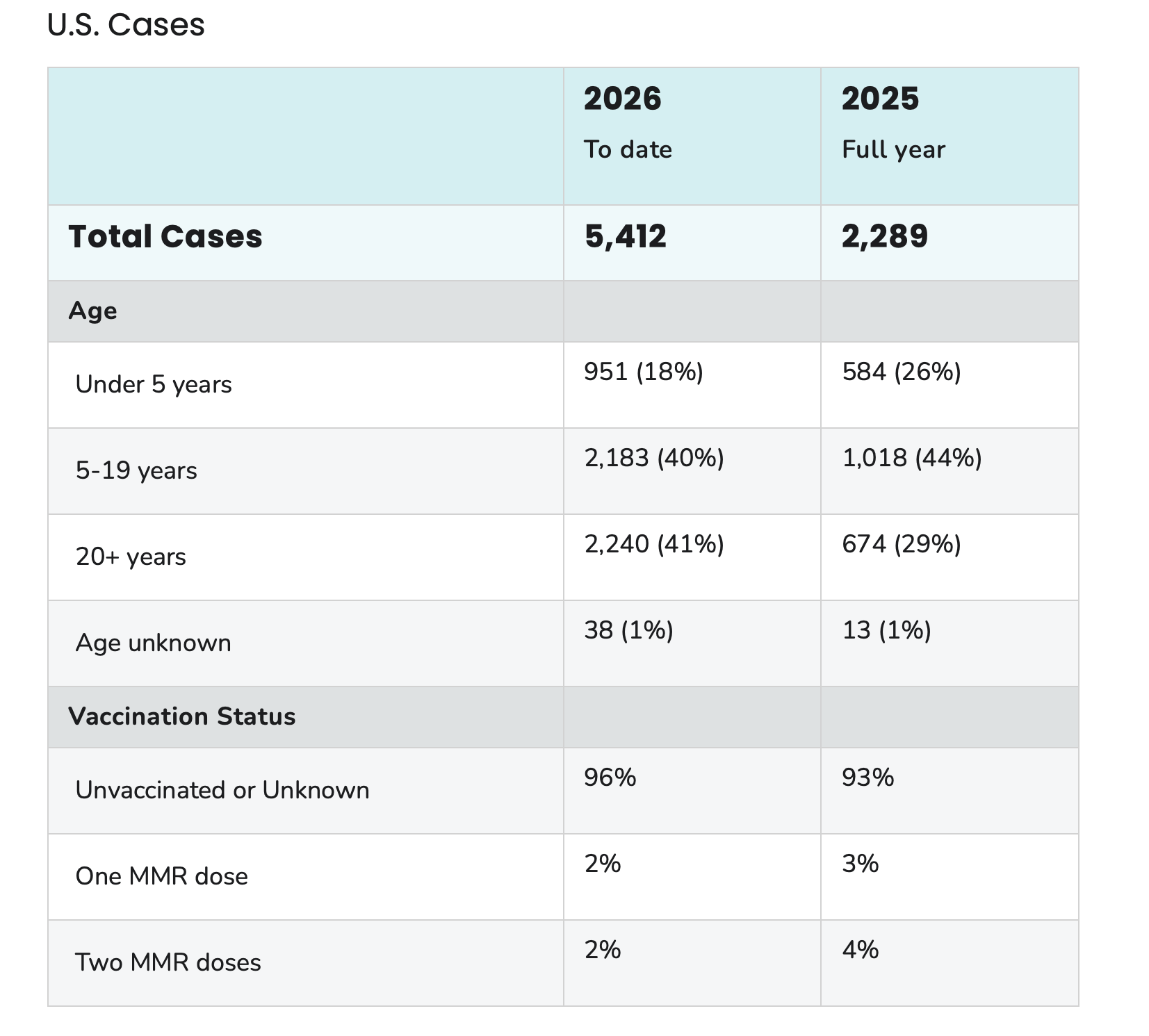
Photo Credit: The Centers for Disease Control and Prevention (CDC) / https://www.cdc.gov/measles/data-research/index.html / A table compares U.S. cases in 2026 (5,412) against the full year of 2025 (2,289), breaking down the totals by age group and MMR vaccination status.
The agency also reported 43 outbreaks in 2026, with 96% of the confirmed cases associated with outbreaks. Its latest update listed six measles-associated deaths in 2026, a figure subject to change as additional information becomes available and reviews are completed.
The CDC’s surveillance data also showed decreasing childhood vaccination rates over the years. Measles, mumps, and rubella (MMR) vaccination among kindergarteners fell from 95.2% during the 2019-2020 school year to 92.4% in 2025-2026. The agency also reported that they estimate that approximately 280,000 kindergarteners were at risk during the latest school year.
The CDC also emphasized that the vaccination coverage of at least 95% in every community is important for preventing sustained transmission and protecting people who receive vaccines for medical reasons.
OpGov.News has followed the resurgence through national reporting and local coverage documenting confirmed infections, exposure notices, and public health surveillance in several states.
In a Nov. 12 report, “U.S. Faces Loss of Measles Elimination Status as Cases Surpass 5,000 Across 47 Jurisdictions,” OpGov.News examined the rising case count and the growing risk to the country’s elimination status. The report documented the spread across jurisdictions and declining childhood vaccination coverage before PAHO’s official determination.
Local coverage documented outbreaks and exposure concerns in several states. In Georgia, “Health Officials Confirm Four More Measles Cases Linked to Metro Atlanta Daycare,” authored by Mia Sims, reported four additional cases connected to an earlier outbreak confirmed Aug. 18. The children were unvaccinated or not fully vaccinated, highlighting the vulnerability of group settings where infections can spread through close contact.
In Arizona, “Measles Outbreaks in Gilbert on the Rise,” reported by Teri Tracey, documented three cases in Maricopa County and multiple potential exposure locations in January. In North Carolina, “Measles Exposure Notices Issued as Charlotte Area Health Officials Monitor Spread,” covered exposure alerts issued by Mecklenburg County as officials monitored regional transmission.
Oregon reporting also followed the state’s response. “Measles Outbreaks in Oregon Tracked With Existing Surveillance Methods,” written by Rory Holbrook, examined how health officials used existing surveillance methods, including wastewater monitoring, to identify potential signs of spread. Months later, Holbrook also reported, “Oregon Health Authority Identifies 3 New Locations With Potential Measles Exposure,” which documented additional locations where people may have been exposed to the virus.
Together, these reports show how measles returned across regions, prompting local officials to investigate cases, notify potentially exposed people, and monitor transmission.
Following PAHO’s announcement, the CDC and its public health partners issued a joint statement on the loss of U.S. measles elimination status, pledging to stop outbreaks and work towards restoring the designation.
The statement identifies MMR vaccination, improved surveillance, data sharing, and rapid outbreak response as central priorities. The CDC also reported providing approximately $100 million in additional funding since August to strengthen prevention and response to measles and other vaccine-preventable diseases through most of 2027.
Federal assistance has included epidemiological support for states responding to outbreaks, including Texas, South Carolina, Virginia, Kansas, New Mexico and Wisconsin. Pennsylvania and New York also requested assistance, according to the agency.
Losing elimination status does not mean measles has been eradicated elsewhere or that every U.S. community is experiencing an outbreak. Elimination means sustained domestic transmission has been interrupted, although imported cases can still occur.
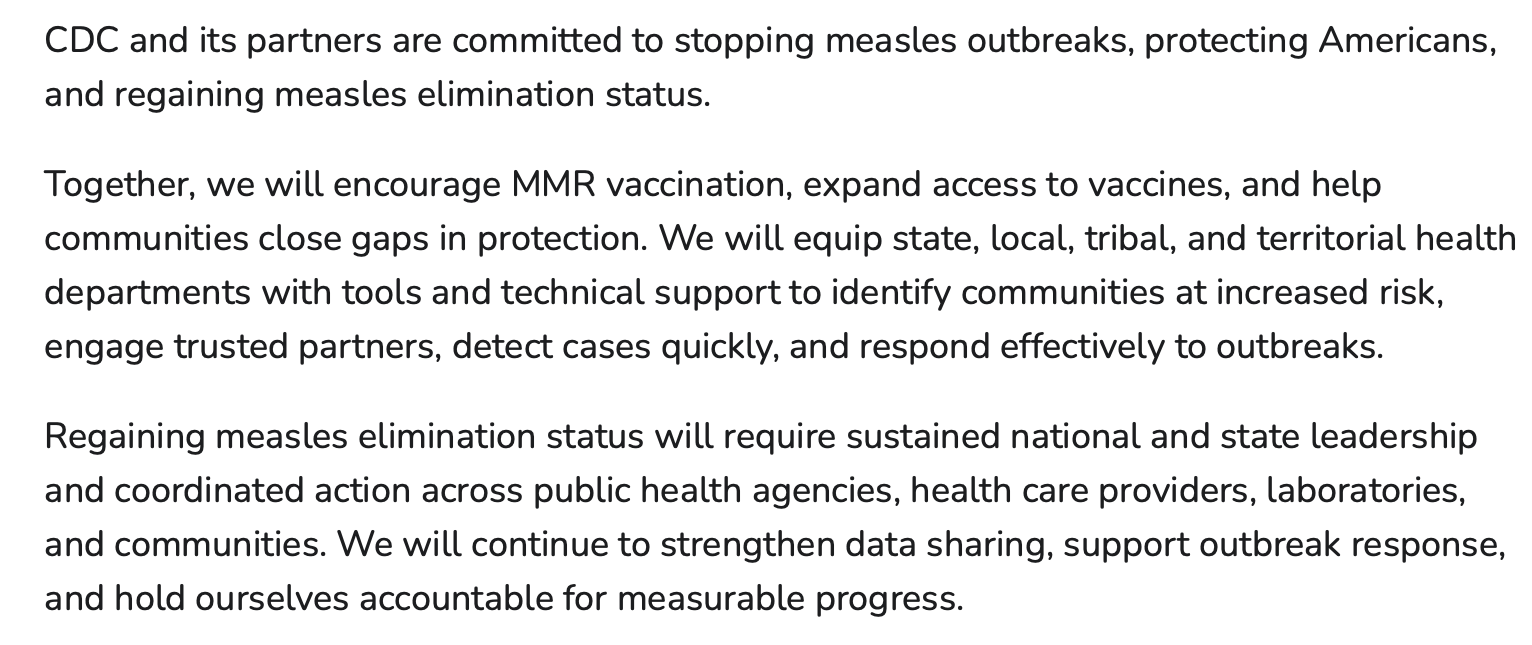
Photo Credit: The Centers for Disease Control and Prevention (CDC) / https://www.cdc.gov/media/releases/2026/loss-of-usmeasles-elimination-status.html / A CDC statement outlines its commitment to stopping measles outbreaks and regaining elimination status by promoting MMR vaccination, expanding vaccination status, and coordinating with public health partners.
Under PAHO’s criteria, a country loses its status when the same virus genotype and lineage circulate continuously for at least 12 months. Regaining the designation requires interrupting that sustained transmission and demonstrating effective vaccination, surveillance, and outbreak control.
PAHO recommends maintaining at least 95% coverage with both doses of the measles vaccine in every community. The United States now faces the challenge of rebuilding the protection while interrupting the transmission that has persisted long enough to reverse two decades of elimination.
To add to or correct any information in this report, please get in touch with me at victoria.o@lead4earth.org.
Thumbnail Photo Credit: Pan American Health Organization (PAHO) / https://www.paho.org/en/news/17-11-2026-paho-urges-countries-step-efforts-stop-measles-outbreaks-and-move-towards / An excerpt reports that, following a November 2026 regional commission review accepted by PAHO Director Dr. Jarbas Barbosa, Mexico, Bolivia, and the United States lost their measles elimination status due to re-established endemic transmission.
0
0

Comments