(OPGOV GLOBAL) – The United States is facing possible loss of its measles elimination status for the first time since 2000, following a dramatic increase in infections across the country. With more than 5,000 confirmed cases reported in 2026, outbreaks spanning multiple states, and declining childhood vaccination coverage, public health officials are confronting renewed transmission of a disease that had previously been eliminated through decades of effort with vaccinations and surveillance.
The Pan American Health Organization (PAHO) is reviewing the country’s elimination status during its Nov. 10-13, 2026 Regional Verification Commission meeting. The assessment will examine whether sustained domestic transmission has returned and whether the United States continues to meet the requirements for maintaining its measles-free status.
According to the Centers for Disease Control and Prevention (CDC), 5,182 confirmed measles cases have been reported nationwide as of Nov. 5, 2026. Infections were documented across 47 jurisdictions, making 2026 the highest year for reported cases since 1991. The CDC also reported 43 outbreaks during the year, with 96% of reported infections associated with outbreaks.
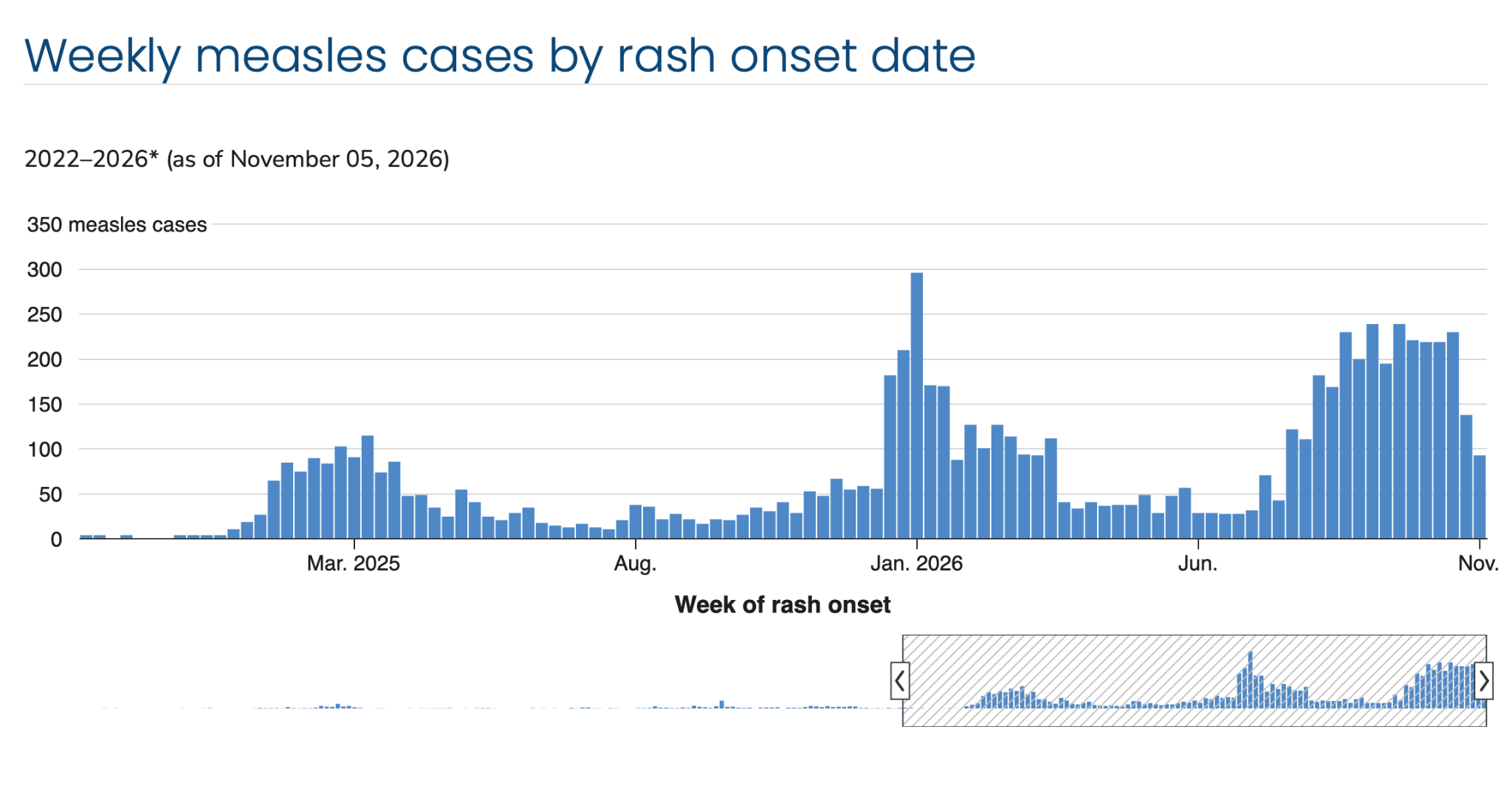
Thumbnail Photo Credit: Centers for Disease Control and Prevention (CDC) / https://www.cdc.gov/measles/data-research/index.html / This bar chart tracks weekly measles cases through November 5, 2026.
The growing number of cases represents a significant reversal of public health progress. The United States recorded 2,289 cases in 2025 and 285 in 2024, showing how quickly the transmission has expanded.
Local health departments' reports throughout 2026 illustrate how measles infections have emerged across different regions, affecting schools, childcare facilities, healthcare locations, and surrounding communities.
In January, concerns were raised about measles in Arizona. OpGov.News Jan. 30 report, “Measles Outbreaks in Gilbert on the Rise,” written by Teri Tracey, documented three confirmed cases of measles in Maricopa County, along with multiple public exposure locations identified between Jan. 5 and Jan. 24. Officials encouraged residents to review vaccination records, monitor symptoms, and use county health resources.
In February, North Carolina was reporting on potential exposures. Mecklenburg County issued exposure notices as the Charlotte-area health officials monitored regional transmission. OpGov.News Feb. 20 report, “Measles Exposure Notices Issued as Charlotte Area Health Officials Monitor Spread,” highlighted concerns involving primarily unvaccinated individuals and also encouraged residents to check their vaccination records and contact healthcare providers when necessary.
Oregon also reported infections in February. According to OpGov.News Feb. 24 report, “Measles Outbreaks in Oregon Tracked With Existing Surveillance Methods,” written by Rory Holbrook, the state had confirmed five cases of measles earlier in the year. The Oregon Health Authority was also utilizing wastewater surveillance to monitor potential community transmission, identifying low levels of the virus in multiple counties.
In March, Sacramento County confirmed two measles infections involving unvaccinated children. OpGov.News March 10 report, “Sacramento County Confirms Two Measles Cases in Unvaccinated Children,” reported by Sarah Denos, described one infection associated with travel to South Carolina and another from an unknown source. Potential exposure at a Kaiser Permanente facility in Roseville also brought up concerns about additional transmission.
The situation continued into the summer. On July 16, the Oregon Health Authority added on three more identified locations where members of the public may have been exposed. Holbrook wrote, “Oregon Health Authority Identifies 3 New Locations With Potential Measles Exposure,” which documented the continued challenges of identifying and notifying individuals who may have been exposed and encountered infected people.
By August, Georgia was also recording additional cases connected to a childcare facility. OpGov.News Aug. 30 report, “Health Officials Confirm Four More Measles Cases Linked to Metro Atlanta Daycare,” authored by Mia Sims, documented four cases among individuals who had close contact with a previously confirmed case on Aug. 18. The children were either unvaccinated or had not completed their vaccination series for measles.
Altogether, these reports provide a localized picture of the national resurgence, showing how outbreaks and potential exposures developed across states like Arizona, North Carolina, Oregon, California, and Georgia. Although these individual reports do not establish that every outbreak was connected, they do demonstrate the geographic reach of the public health challenge.
One of the major concerns behind the sudden resurgence is declining childhood vaccination coverage.
The CDC’s 2025-2026 school vaccination data found that only 92.4% of kindergarten students received the measles, mumps, and rubella (MMR) vaccine. This falls below the approximately 95% coverage generally needed to maintain community protection against measles.
The agency estimated that approximately 280,000 kindergarten students attended school without vaccination documentation of completing the MMR vaccination series during the 2025-2026 school year. Exemptions from one or more required immunizations increased to 4.2%, compared to 3.6% the previous year.
The Congressional Research Service reported on September 29 that immunization gaps were a concern as well. Its analysis found that more than 92% of reported measles cases across 2025 and 2026 involved those who were unvaccinated or whose vaccination status was unknown. It also highlighted geographic differences in vaccination coverage, particularly in communities where rates fall substantially below national averages for the required and recommended vaccinations.
The CDC estimates that two doses of the MMR vaccine are approximately 97% effective against measles. Because the virus is extremely contagious, even the relatively small declines in vaccination rates can create opportunities for outbreaks, specifically when it comes to communities with a large percentage of unvaccinated individuals.
A separate October 29 assessment from the Johns Hopkins Bloomberg School of Public Health Center for Health Security classified the national measles situation as Scenario 5: sustained and difficult-to-control situation.
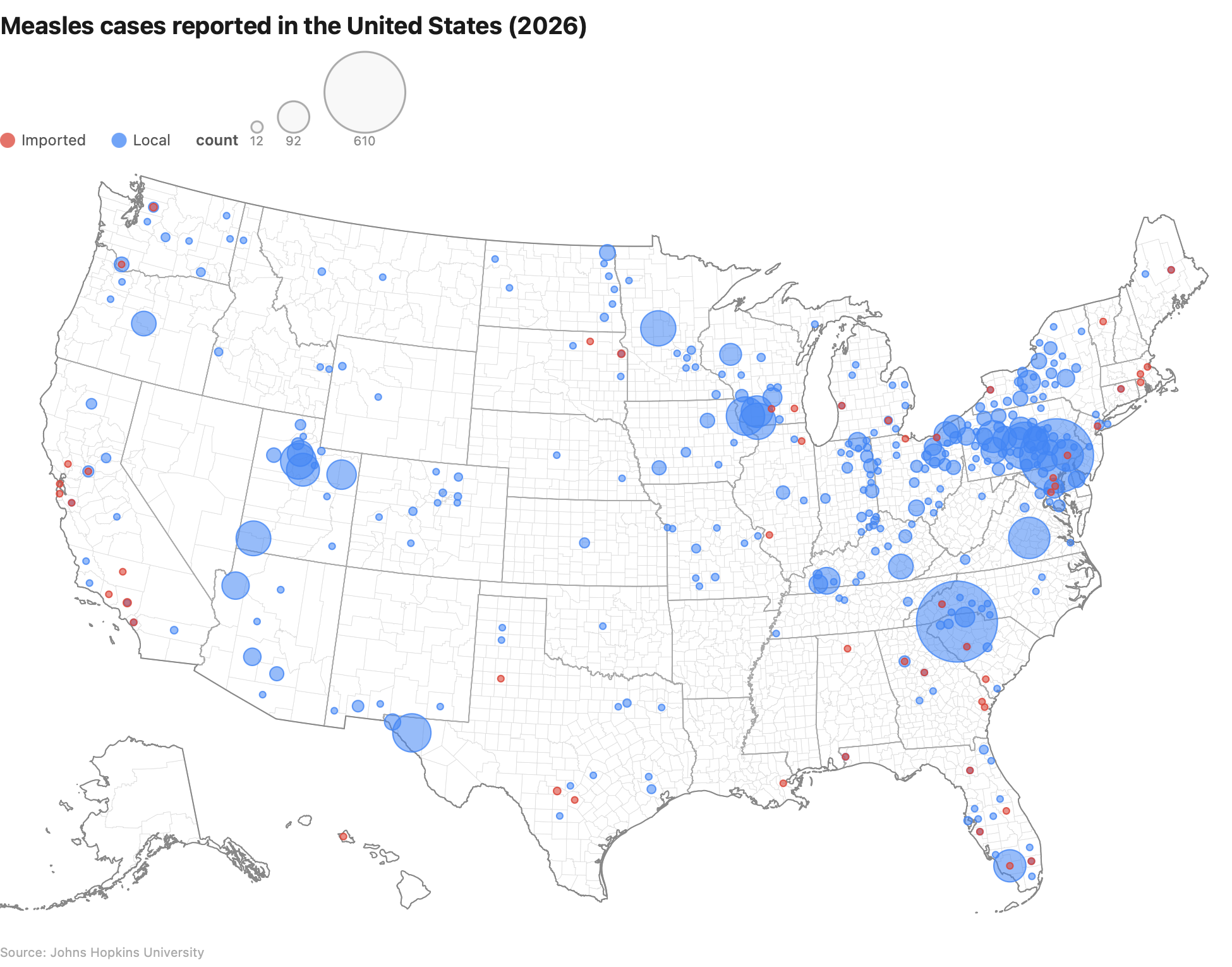
Photo Credit: Johns Hopkins University / https://publichealth.jhu.edu/ivac/resources/us-measles-tracker / A proportional-symbol map showing local (blue) and imported (red) U.S. measles cases in 2026.
The assessment reported 4,852 confirmed cases as of Oct. 29 and identified ongoing transmission across multiple jurisdictions. It also examined genetic evidence suggesting that measles viruses circulating in different states shared close similarities, which raised questions about whether transmission chains had continued domestically.
The researchers of the assessment emphasized that genetic similarities alone cannot establish continuous transmission. However, when it comes to combining epidemiological evidence, genomic sequencing can help those investigating determine whether infections are connected or if they represent separate introductions from international sources.
The report itself also identified Pennsylvania, Wisconsin, Kentucky, and New York among the states experiencing significant outbreaks, showcasing that transmission is not just in the localized reports as seen in OpGov.News.
The United States eliminated endemic measles transmission in 2000, but its longstanding status is now under review. In the PAHO Oct. 14 announcement, the Nov. 10-13 assessment will examine vaccination coverage, disease surveillance, laboratory findings, and evidence of sustained transmission.
Under the PAHO criteria, elimination status may be lost when the same measles virus lineage spreads continuously for at least 12 months. Following Canada's loss of its designation in 2025, the review will determine whether the United States has experienced a similar return of endemic transmission.
Measles can cause serious complications, including pneumonia, encephalitis, and hospitalization, particularly among young children and immunocompromised individuals. The CDC estimates that approximately one in five unvaccinated people who contract measles are hospitalized.
Increasing infections also strain hospitals, schools, and local health departments responsible for testing, contact tracing, and exposure notifications. Whether or not the United States loses its measles elimination status, the return highlights the need to restore vaccination coverage, strengthen disease surveillance, and improve outbreak response to prevent further transmission.
To add to or correct any information in this report, please contact me at victoria.o@lead4earth.org.
Thumbnail Photo Credit: Centers for Disease Control and Prevention (CDC) / https://www.cdc.gov/measles/data-research/index.html / A state-level map displays confirmed cases of measles in the United States as of November 5, 2026.
0
0

Comments