(DUBLIN, CA.) – On Mar. 24, Dublin’s City Council receives a presentation detailing the construction of a new wireless telecommunication facility.
Given by a city staff member, this presentation covers the background of this project, the agreement Dublin has with potential carriers, and details such as the location and size of the tower.
Before the presentation commences, Council member John Morada recuses himself from the council, as his residence is too close to the proposed site for him to speak on the issue.
Following persistent gaps in wireless service in Eastern Dublin, city staff explored ways to resolve this problem and conducted a wireless coverage and service community survey in November 2024.
There are also other causes of low connectivity, such as the natural disasters faced by RedRover Responders.
Based on these results, city staff determined that the best course of action was to construct a monopine, or faux tree, structure at Fallon Sports Park. This was proposed to and accepted by city council on Apr. 1, 2025.
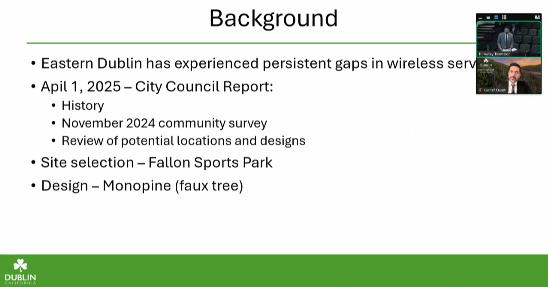
Photo Credit: https://dublinca.new.swagit.com/videos/379162
They then selected Wireless Edge Towers III LLC. to be the vendor for this project.
The proposed location is a 60-by-45-foot plot of land behind field C of Fallon Sports Park. Here, not only would the monopine tower be constructed, but also areas for carriers to store their equipment.
“The proposed plot [...] includes space for three carrier equipment areas or sheds, a municipal equipment shed if needed, a staging area for maintenance and other needs by the contractor, and the monopine structure itself,” says city staff.
The monopine facility itself would be 95 feet tall. This is the required height to ensure there's enough space for all four carriers that would be on site and to maximize the coverage area.
City staff goes on to explain the agreement made between Dublin and Wireless Edge.
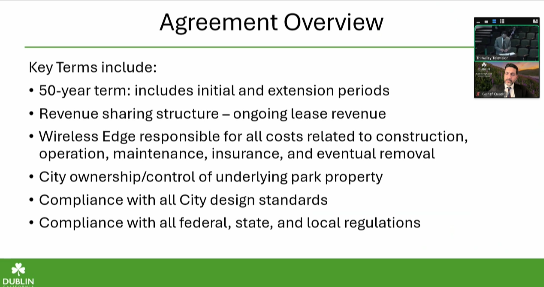
Photo Credit: https://dublinca.new.swagit.com/videos/379162
According to staff, this agreement costs the city nothing and aligns with Dublin's goal of using public assets to improve services while also gaining revenue. This revenue would come from the minimum $40,000 rent that carriers have to pay and additional bonuses that come with new subleases.
Dublin’s neighboring city, Pleasanton, CA., may greatly benefit from having revenue of its own like this, as it is in a structural budget deficit.
Concluding the presentation, staff explains that the approval of the information and plans presented would commence the next part of the project.
These next steps include reviewing the environmental impact of the project, preparing engineering and site plans, and obtaining the required permits for the project.
Before approval, however, the city council has a period of time to ask questions.
Opening the discussion, Council member Michael McCorriston inquires about the design plans for the shed spaces mentioned in the presentation.
According to President and CEO of Wireless Edge Towers John Arthur, Wireless Edge will provide a common concrete slab for all carriers to use and build a rooftop over it.
About 12 feet high, this rooftop is typically metal and would be designed and painted to match the nearby fire station. Each carrier would have a 12-by-12-foot or 12-by-15-foot space on the concrete slab.
McCorriston also has concerns regarding the bigger picture, asking how staff and these companies plan to address other areas in Dublin with low connectivity.
City staff responds that they will continue working with Horizon Towers Consulting Support to identify weak spots in the city and explore what facilities would be possible to build.
Council member Kashef Qaadri, also curious about how well these companies will serve Dublin, asks how much increased coverage this new facility will provide.

Photo Credit: https://dublinca.new.swagit.com/videos/379162
Arthur can only give an estimate, stating that, based on the terrain of the area, there should be about a half mile of increased coverage.
After only a short discussion period, the council accepts the plans presented, allowing the project to move on to its next steps.
To add to or correct any information in this report, please contact me at Madison.v@lead4earth.org and leave a comment below with your thoughts.
0
0

Comments