(CHARLOTTE, NC.) – Charlotte City Council reviewed the I-77 South Express Lanes project during its September 14 business meeting, focusing on financial obligations, community benefits, multimodal improvements, and transportation alternatives before a scheduled September 21 vote.
City staff reviewed the project's history, alternatives considered by the North Carolina Department of Transportation and the public-private partnership structure. Council members had requested an independent analysis of alternatives, but staff said there was not enough time to complete it before the upcoming vote.
The discussion followed the council's May decision to withdraw support for the project. “Charlotte Moves to Pause $4B I-77 Toll Lane Project,” previously reported on the request to pause and expand the review of design alternatives, traffic modeling and community impacts.
Under Session Law 2026-41, Charlotte could be required to reimburse NCDOT for nearly $70 million in preliminary project costs dating to 2018 if the city does not reinstate support for the public-private partnership. Council members discussed potential effects on property taxes, bond ratings, affordable housing and public facilities.
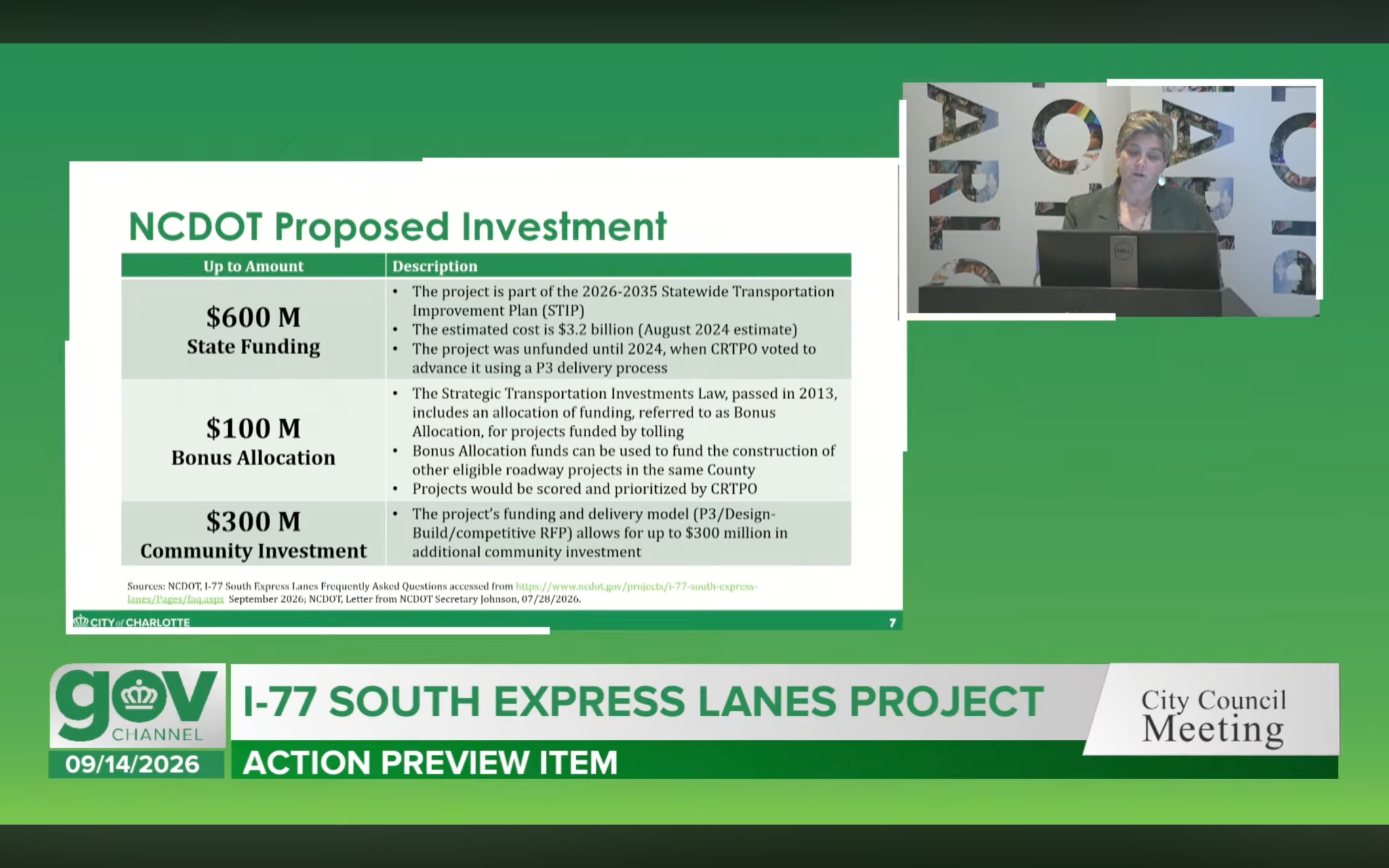
Photo Credit: City of Charlotte / YouTube/ A City Council presentation slide details the NCDOT funding model and community investment allocations for the proposed $3.2 billion project.
“Charlotte Council Committees Debate Housing, Public Safety and I-77 Project Amid State Policy Concerns,” previously reported on those financial questions and the council's efforts to obtain additional information about the project.
Earlier concerns about transparency, displacement and public participation were also documented in “Charlotte City Council Divided as Residents Urge Pause on I-77 South Toll Lanes,” which covered an earlier council discussion of the project.
Community benefits remained a central issue September 14. Council members questioned whether commitments involving neighborhoods along the corridor should be legally binding rather than remain general assurances.
Reverend Mack of the NAACP and Ricky Hall of the West Boulevard Neighborhood Association submitted a Community Impact Framework asking the city council and Charlotte Regional Transportation Planning Organization to preserve the project delivery path while establishing a process to develop, evaluate, and track an attainable corridor benefits package.
Council Members Kimberly Owens, LaWana Mayfield, J.D. Mazuera Arias, and Renee Johnson raised concerns about the state's approach, transparency, and financial obligations. Council Members Malcolm Graham and Ed Driggs emphasized continued negotiations and the potential loss of project benefits if an agreement is not reached.
Council Member Joi Mayo highlighted proposed improvements at crossings along the corridor. Mayo said 17 of the 22 crossings would include improvements such as sidewalks, bike lanes, lighting, and other connections between neighborhoods.
Project materials provided to OpGov.News lists a range of proposed facilities. At West Boulevard, plans include 10-foot sidewalks and 8-foot buffered bike lanes under I-77. At 5th Street, proposed improvements include 10-foot sidewalks and 8-foot buffered bike lanes on the bridge.
Mayo also said Bus Rapid Transit would be a separate opportunity requiring consideration through the Metropolitan Public Transportation Authority. She said she had raised BRT and park-and-ride options with NCDOT since November.
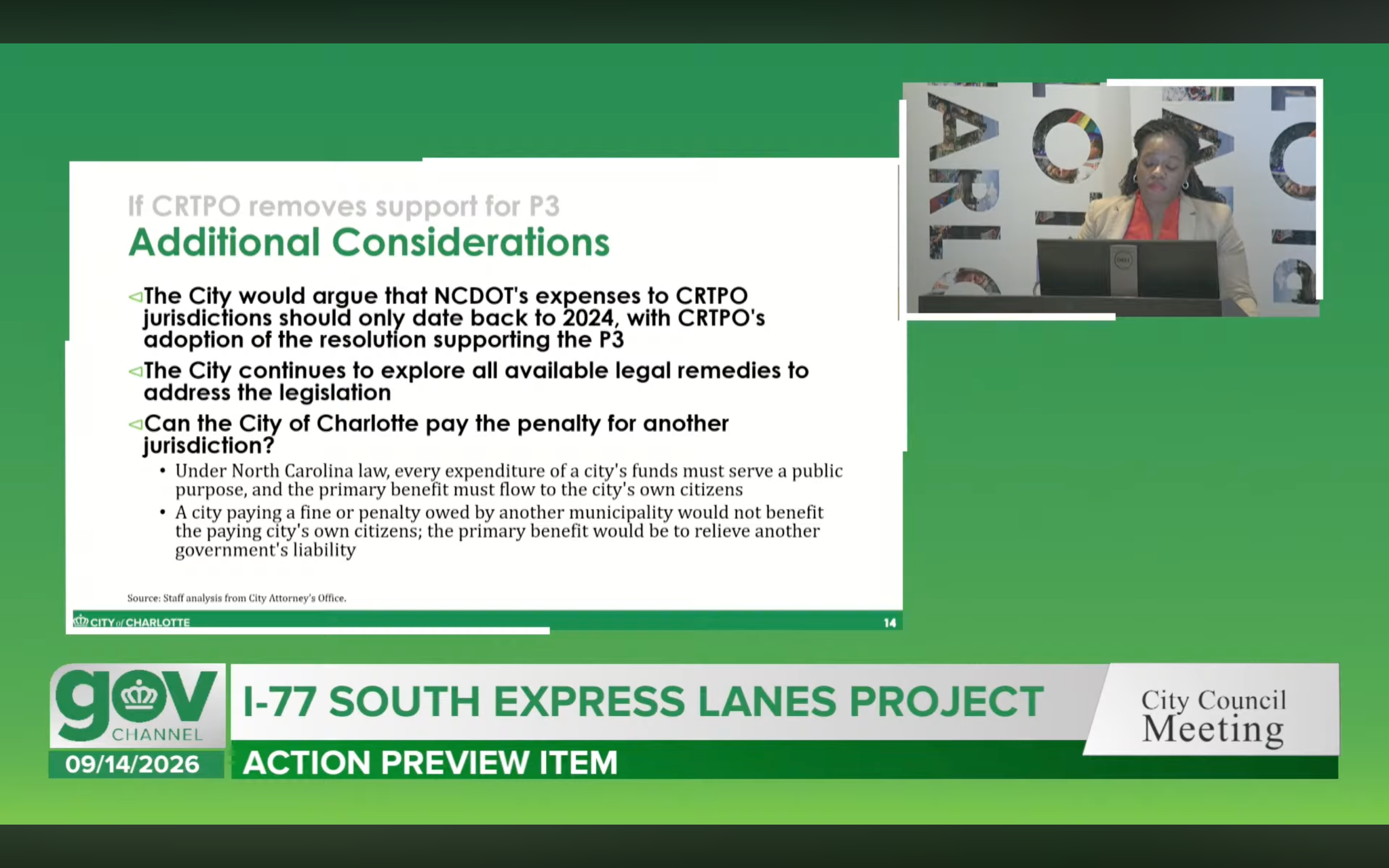
Photo Credit: City of Charlotte / YouTube / Presentation slides highlight legal remedies and state policy questions surrounding potential financial penalties if CRTPO support is removed.
Mayo said NCDOT had met with community leaders before the May vote to hear their priorities and concerns. She said the City Attorney's Office was working with NCDOT to determine how those commitments could be formalized.
Johnson also responded to OpGov.News after the meeting, emphasizing the need for a written agreement.
“We certainly need a written agreement, right now there is not one that has any level of specifics,” Johnson said. “It is our responsibility to ensure there is.”
The meeting also included a separate proposal to sell city-owned land for 12 affordable townhomes. A motion to refer the sale to committee failed after council members questioned whether homeowner association fees could affect long-term affordability.
Residents watching the meeting through the city's YouTube livestream also posted questions and comments in the chat. These comments were submitted online and were not statements made during the council meeting.
“How can Council Vote on this Project when Council won’t have the information from Staff until after Vote?” wrote YouTube user @CMillen-yd2oo.
Another viewer, @Awnbvcfhj, asked, “Why hasn't this project been shared with the public more widely?”
The same viewer wrote, “As a south Charlotte resident I am vehemently opposed to this toll lane.”
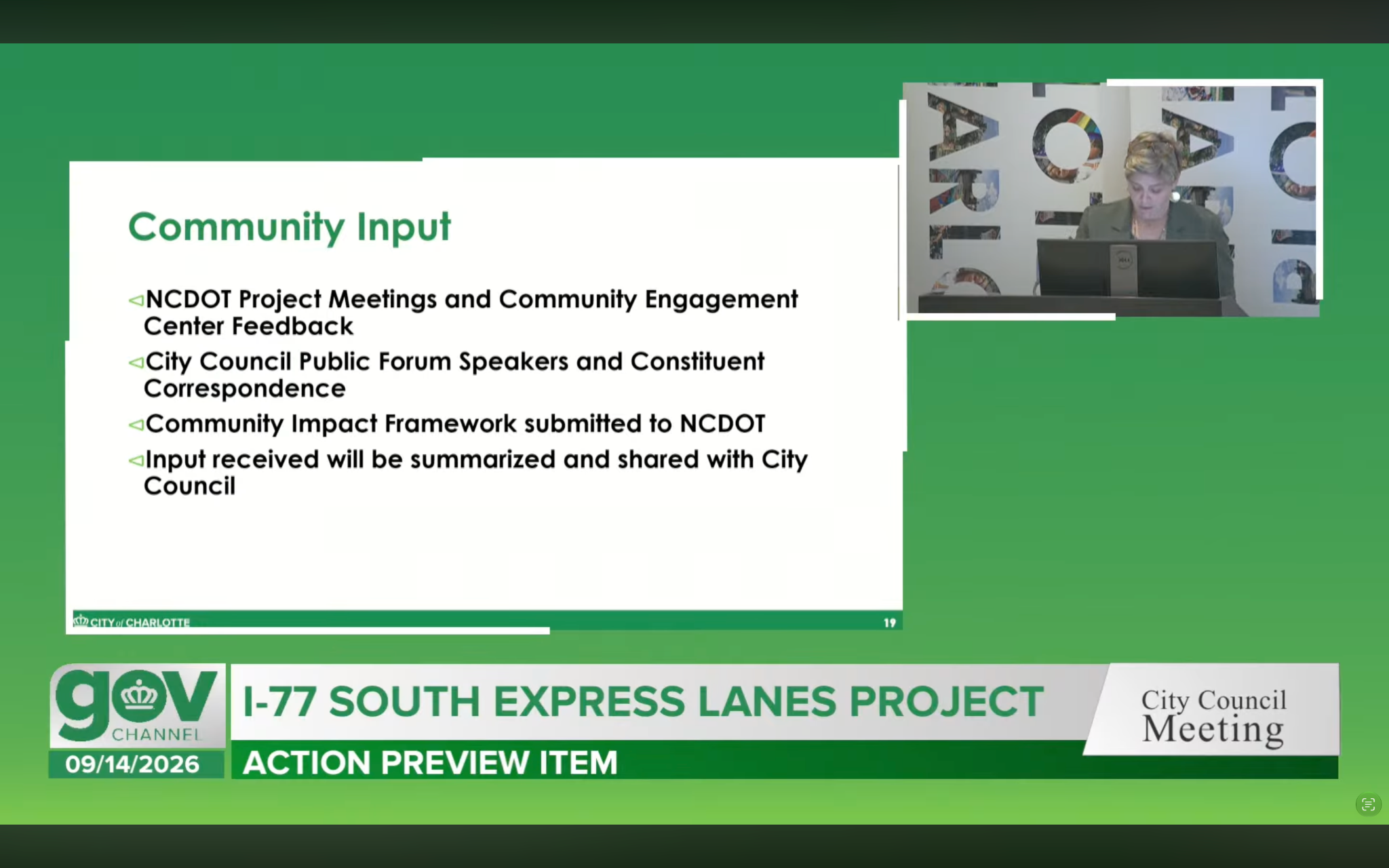
Photo Credit: City of Charlotte / YouTube / A slide presented to council members outlines public engagement avenues and community input gathered regarding corridor improvements.
Other viewers questioned whether the state could face a lawsuit, whether toll lanes would affect congestion, and how homeowner association fees and property taxes could affect affordability.
Council is scheduled to continue considering the I-77 South Express Lanes project September 21. CRTPO is scheduled to consider the project September 23.
To add to or correct any information in this report, please get in touch with me at victoriao@lead4earth.org.
Thumbnail Photo Credit: City of Charlotte / YouTube / A presentation slide from the September 14 Charlotte City Council meeting outlines key takeaways and financial implications surrounding the I-77 South Express Lanes project.
0
0

Comments