(CHARLOTTE, NC.) – Charlotte City Council committees advanced legislative recommendations and delayed several major policy decisions during August 3 special meetings, with discussions focusing on rental housing standards, affordable housing funding, minority business participation, public safety technology, and the future of the I-77 South Express Lanes project.
The meetings included the Housing and Neighborhood Services Committee, Economic Development, Workforce and Intergovernmental Relations Committee, and Safety Committee.
While committees moved forward with recommendations regarding state legislation on air conditioning requirements and vehicle noise enforcement, council members requested additional information before taking action on affordable housing funding, hospitality investments, contracting policies and transportation decisions.
The Housing and Neighborhood Services Committee unanimously recommended that the Budget, Government and Intergovernmental Relations Committee pursue state legislation clarifying whether municipalities have authority to require air conditioning in rental housing through minimum housing codes.
The discussion followed concerns about the city's HVAC pilot program, which staff reported received no qualified applicants. Council members questioned whether the program requirements limited participation and requested additional details about landlord outreach, particularly among smaller property owners.
Council members also asked for historical context regarding when housing standards have been considered health and safety requirements, comparing potential air conditioning requirements to previous housing code changes involving basic living conditions.
Staff will return in September with revised policy language and additional information regarding the potential mandate.
The committee also delayed action on affordable housing funding recommendations after council members questioned changes involving Housing Trust Fund allocations and down payment assistance programs.
Members requested additional details about how funding changes could affect current housing projects and whether existing funding guidelines should provide more flexibility as housing needs change.
The discussion followed broader concerns about access to affordable housing programs raised in previous Charlotte coverage. In “Non-Profit Tells Affordable Housing Committee Members the City Has Poor Communication Skills for Accessory Dwelling Units,” OpGov.News journalist Angela Underwood examined concerns from housing advocates regarding communication challenges between residents, organizations and city programs.
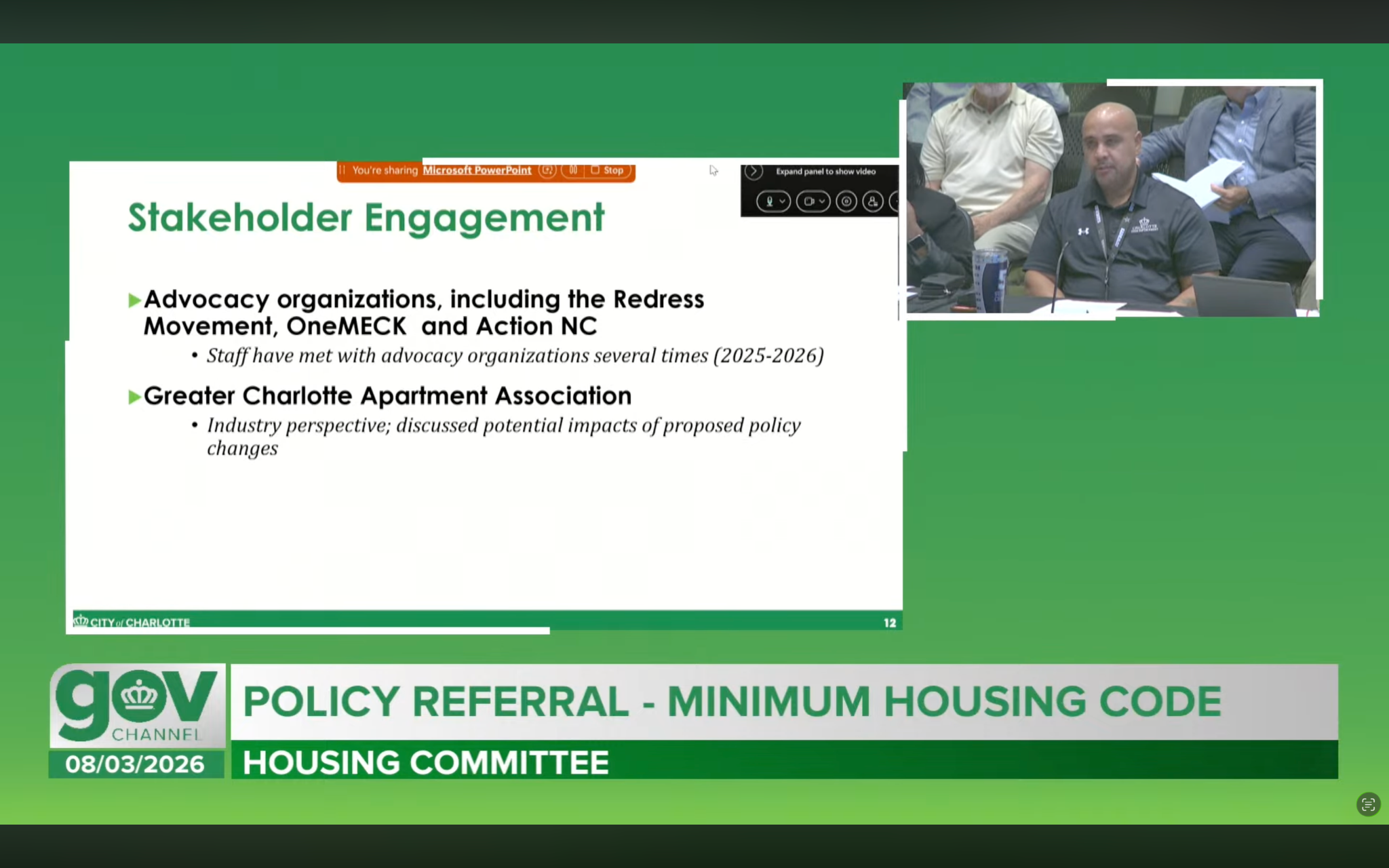
Staff details stakeholder outreach with community advocacy groups and housing associations during the Housing Committee's minimum housing code review.
Photo Credit: City of Charlotte/YouTube
During the Economic Development, Workforce and Intergovernmental Relations Committee meeting, council members discussed the impact of new state legislation eliminating race- and gender-conscious contracting goals.
Members expressed concerns about maintaining participation among minority-owned businesses while complying with the new state requirements.
The committee reviewed updates to Charlotte's Small Business Enterprise program but delayed action after requesting more information about contract thresholds, outreach efforts and implementation plans.
Council members also discussed hospitality funding priorities and requested additional financial information regarding public investments connected to tourism projects, including Truist Field.
No vote was taken, with staff expected to return with additional information.
The Safety Committee unanimously approved forwarding Charlotte's Fiscal Year 2026 Model Cities Initiative grant application to the full council.
The initiative would use federal funding to support violence reduction efforts through community partnerships, intervention programs and technology.
Council members asked how programs would continue after the three-year grant period and requested additional information regarding future funding commitments from the city and Mecklenburg County.
The committee also discussed concerns surrounding law enforcement technology, including predictive analytics, drones and automated license plate readers.
Members requested additional transparency regarding how information collected through these systems is used and how privacy protections are maintained.
The discussion comes as communities across the country continue debating oversight of automated license plate readers. OpGov.News previously covered those concerns in “Supreme Court Ruling Raises New Questions for Flock Plate Readers Amid Officer Arrests,” written by OpGov.News journalist Pepper Mc'Quiffins, which examined questions surrounding accountability and privacy protections connected to surveillance technology.

The Safety Committee reviews the strategic goals for Charlotte's Fiscal Year 2026 Model Cities Initiative grant proposal.
Photo Credit: City of Charlotte/YouTube
The Safety Committee also unanimously recommended that Charlotte prioritize state legislation allowing automated noise enforcement technology as part of the city's 2027 legislative agenda.
The recommendation followed continued complaints from residents regarding excessive vehicle noise, particularly in Uptown neighborhoods.
Charlotte-Mecklenburg Police Department officials said officers continue enforcing existing laws but noted challenges involving vehicles that are modified or improperly classified.
Officials also discussed concerns involving electric bikes and motorized vehicles, explaining that some vehicles commonly referred to as e-bikes are actually unregistered motorcycles without pedals.
No action was taken, with staff directed to return with proposed ordinance revisions and enforcement strategies.
Transportation discussions focused on the proposed I-77 South Express Lanes project and potential financial penalties associated with withdrawing regional support.
Council members questioned the state's reimbursement requirements, including a possible $64 million penalty, and requested additional information about how the figure was calculated.
Members also asked for details regarding Powell Bill funding and whether an independent review would evaluate alternatives to managed toll lanes.
The discussion generated significant debate among viewers during the city's livestream.
One viewer, posting under the username @RockefellerSteel, questioned whether additional highway capacity would solve congestion.
“Additional lanes don't provide congestion relief,” the commenter wrote.
Another viewer, @mauriciorano134, defended managed lanes as a potential transportation solution.
“Congestion along I-77 is terrible. If the government doesn't have $ for alternative congestion relief solutions, what do you want?” the commenter wrote.
Other viewers debated transportation alternatives, funding sources and potential community impacts associated with the project.
No action was taken on I-77 because of time constraints. Council members indicated the issue will return for additional discussion during a future full council meeting.
As Charlotte continues addressing growth-related challenges, council members are expected to revisit several proposals in September, including affordable housing policies, hospitality funding priorities and Small Business Enterprise program updates.
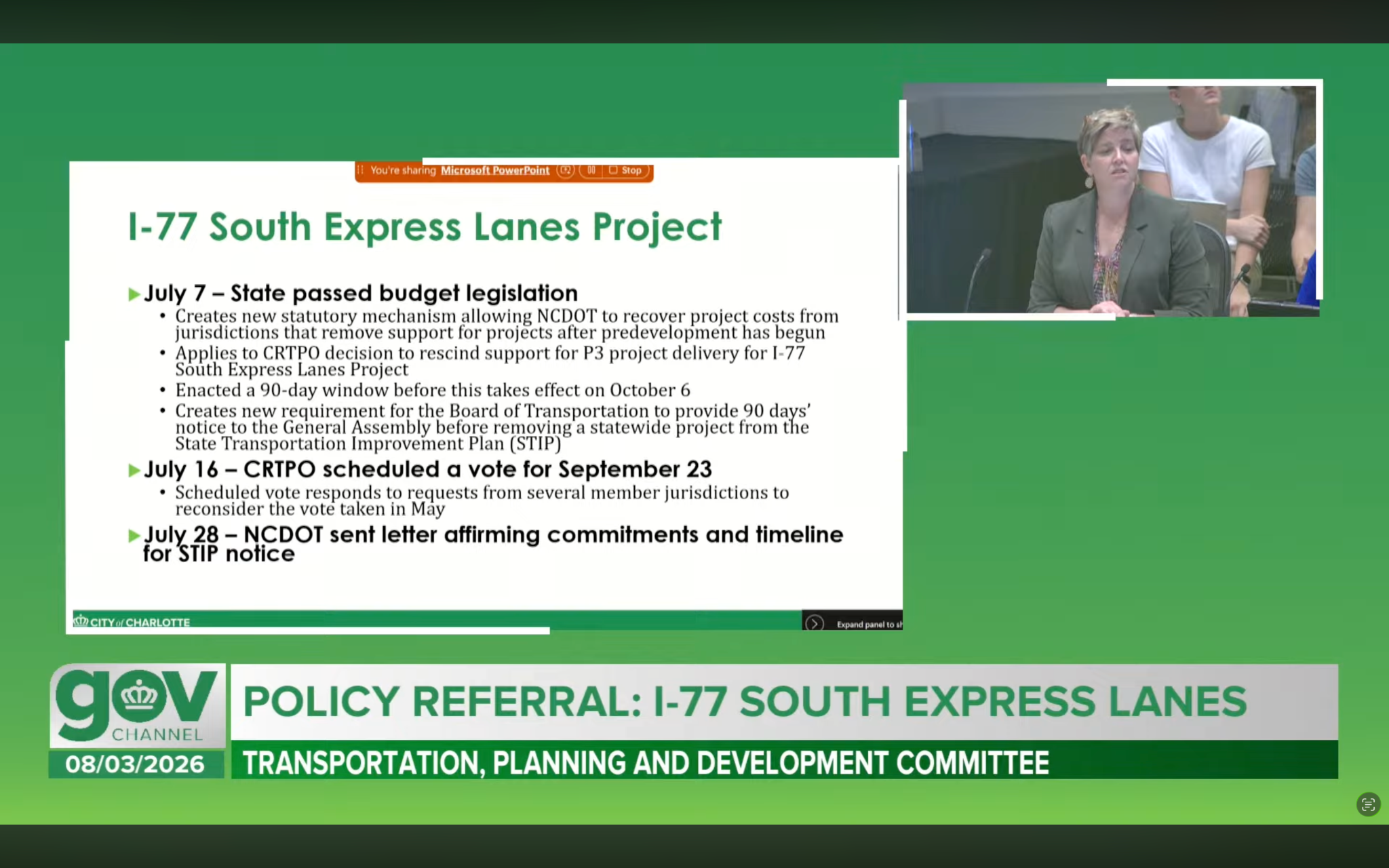
Transportation Committee members analyze state budget legislation and timeline updates regarding the I-77 South Express Lanes project.
Photo Credit: City of Charlotte/YouTube
To add to or correct any information in this report, please contact me at victoria.o@lead4earth.org.
Thumbnail Photo Credit: City of Charlotte/YouTube
0
0

Comments