(CHARLOTTE, N.C.) — A contentious debate over the proposed I-77 South toll lane expansion dominated the Charlotte City Council meeting Monday, as residents, advocates, and council members voiced deep concerns about transparency, equity, and displacement tied to the state-led project.
Dozens of speakers urged the council to call for an immediate pause to the North Carolina Department of Transportation’s proposal, arguing that the timeline and engagement process have sidelined meaningful public input.
Though several council members expressed similar reservations, a motion to add an immediate vote to pause the project to the agenda failed due to a lack of unanimous consent, underscoring the city’s limited direct authority over state transportation decisions. Instead, council members reached consensus to add the I-77 discussion to their March 2 retreat agenda, citing urgency tied to the state’s request for qualifications timeline.
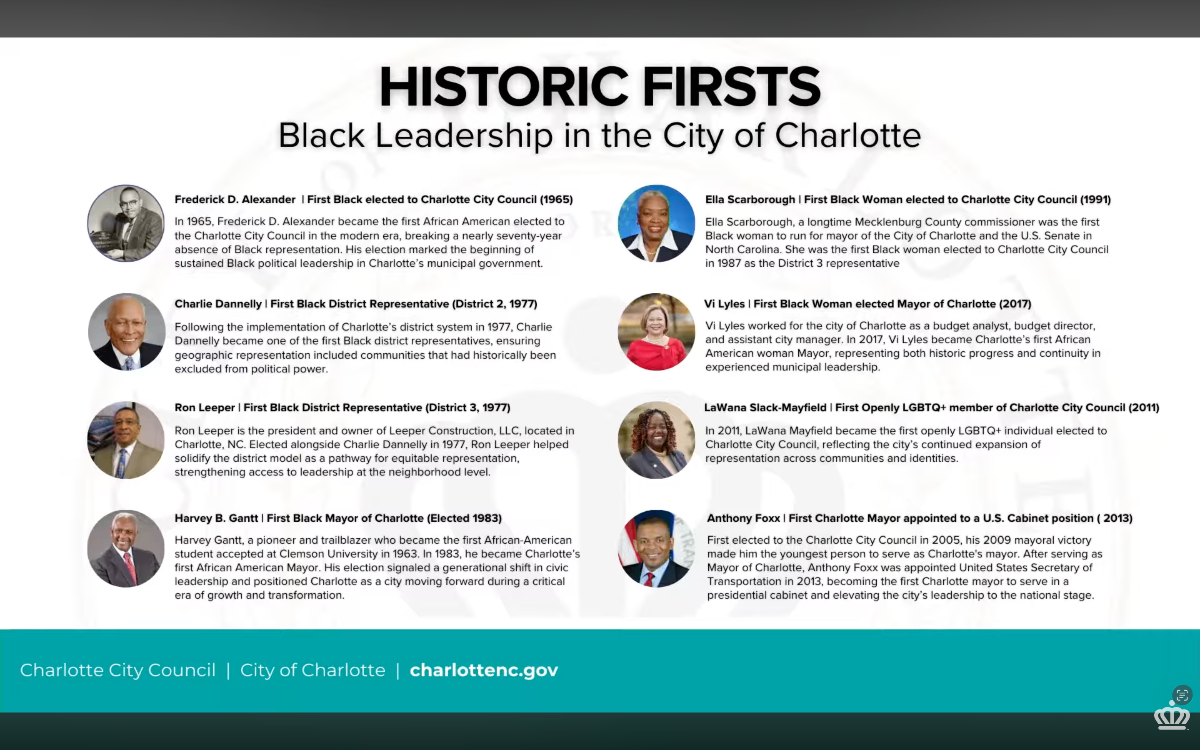
The meeting touched on the legacy of leadership in Charlotte as the council weighed the impacts of infrastructure on historically Black neighborhoods.
(Photo Credit: City of Charlotte/YouTube)
The project itself, a $3.2 billion initiative, would extend 11 miles of managed toll lanes from the South Carolina state line into Charlotte, adding two new lanes in each direction, reconstructing interchanges, upgrading bridges, and adding direct connectors to improve congestion.
NCDOT has advanced it as a public-private partnership, with multiple construction teams already shortlisted for procurement. Officials estimate travel times could be reduced by 20–30% during peak hours, though opponents argue the benefits may be uneven and the cost disproportionately affects low-income residents.
The tension mirrored debates playing out nationwide. In Asbury Park, residents recently packed a special meeting over the future of a deteriorating waterfront landmark, highlighting how major public infrastructure and redevelopment decisions can quickly become flashpoints for broader concerns about transparency, legal authority, and community voice.
Planning authority has also been a point of contention. The Charlotte Regional Transportation Planning Organization (CRTPO) has been central to advancing the I-77 South project since 2014. Reports show that environmental assessments and public engagement were required at multiple phases, though critics say these processes have not led to meaningful community influence.
The project’s documentation notes that traffic modeling predicts daily vehicle usage could exceed 80,000 trips per day on the new toll lanes once completed, highlighting both the scale of the development and the potential community impact.
Public safety concerns extended beyond the toll lane debate. During public comment, Micah O. Israel Smith connected transportation planning to pedestrian fatalities in Charlotte.
“As a leader in the Charlotte running community, my request to speak was initiated by the tragic and senseless death of Lance Otello in January,” Israel said. “Since Lance’s death, five other pedestrians have died on the streets of Charlotte.”
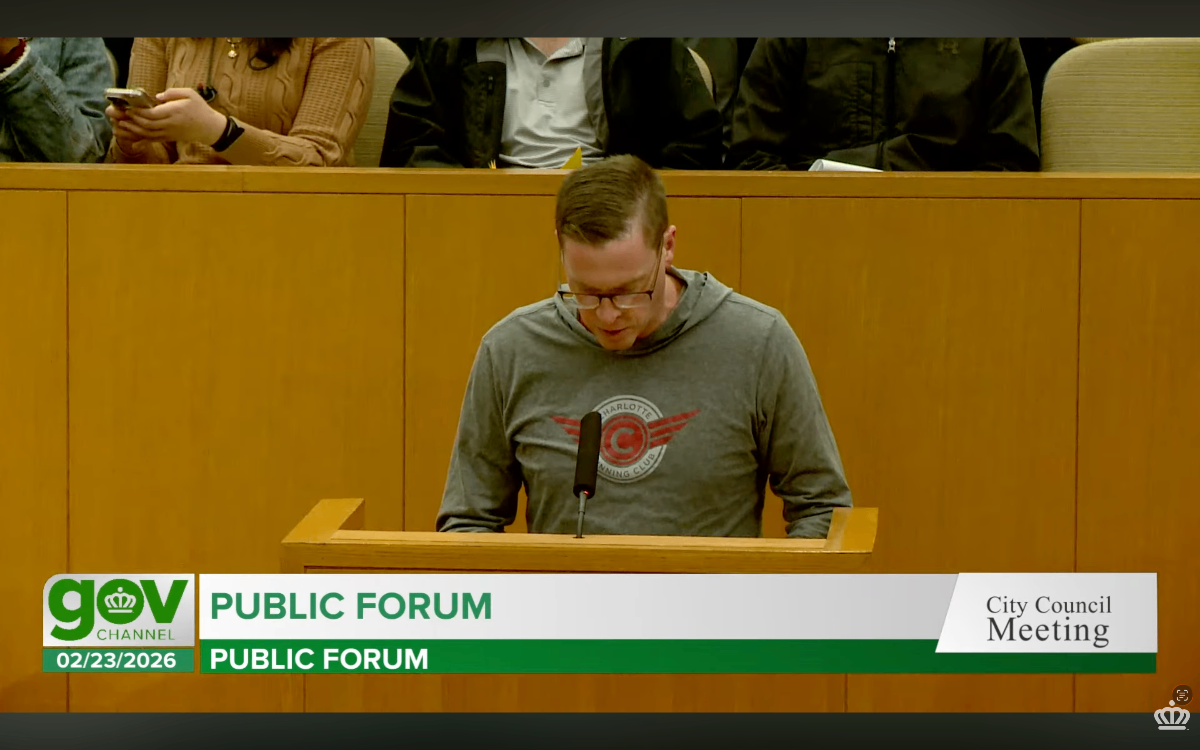
During the public forum, residents like Micah O. Israel Smith connected transportation policy to public health, urging the council to prioritize "leading pedestrian intervals" and midblock signals.
(Photo Credit: City of Charlotte/YouTube)
Israel urged the council to prioritize pedestrian infrastructure in the upcoming budget, including clearly marked crosswalks, functional traffic signals, leading pedestrian intervals, and midblock beacon signals. He framed pedestrian safety as both a public health issue and a politically resonant priority.
Opposition to the toll lane expansion remained the meeting’s focal point. Representatives from Sustain Charlotte and the Housing Justice Coalition characterized the project as a “bait and switch,” arguing council members were previously promised a meaningful vote.
Speakers warned that elevated toll lanes would worsen air quality, accelerate displacement in historically Black neighborhoods, and conflict with the city’s 2040 Comprehensive Plan and climate goals.
Residents along the West Boulevard and Wilkinson Boulevard corridors described cumulative impacts from both highway expansion and the growth of Charlotte Douglas International Airport, saying past infrastructure decisions have repeatedly displaced communities without adequate protections or compensation.
The concerns parallel themes raised in Water Rate Increase Enrages Gilbert Residents, where residents questioned transparency, long-term financial impact, and whether elected officials were fully accounting for the community burden. In both cases, speakers framed the issue not simply as policy disagreement, but as a matter of public trust and equitable decision-making in large-scale government actions.
Business leaders urged continued engagement without halting the project, calling it a generational infrastructure decision for a rapidly growing region and arguing that growth and community protections are not mutually exclusive.
Beyond the I-77 debate, the council unanimously approved several major agenda items. The body adopted the historic landmark designation for the R. Kent and Gertrude N. Blair House and approved its 2026 federal and state legislative agendas, which prioritize mental health services, law enforcement recruitment and retention, judicial staffing, transit safety, and housing policy.
Council members also adopted an initial findings resolution authorizing up to $120 million in installment financing for equipment and public safety facilities, including improvements to the Animal Care and Control Adoption Facility.
In a move that drew questions but ultimately unanimous approval, the council authorized a $1 annual lease of approximately 20 acres of city-owned property at the former Statesville Avenue Landfill to Envision Charlotte. Some members raised concerns about the absence of a broader request for proposals and the nominal lease rate. Phil Rieger, the city’s general services director, defended the agreement’s purpose.
“This is to help advance the circular economy. It is taking in wood waste at our Statesville landfill,” Rieger said.
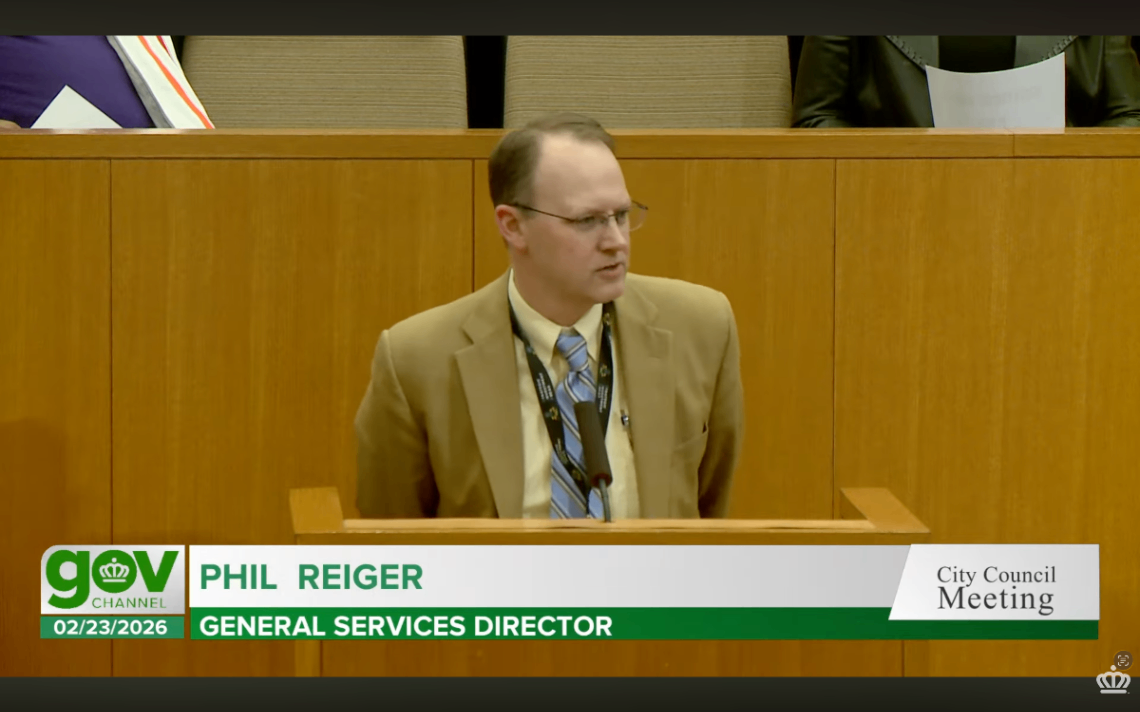
Phil Rieger answers questions from council members regarding the environmental and economic benefits of the newly approved wood waste processing agreement.
(Photo Credit: City of Charlotte/YouTube)
The council also approved more than $4.1 million from the Housing Trust Fund and Transit-Oriented Development Affordable Housing Development Bonus Program Fee-in-Lieu funds to support Historic West End Partners’ Five Points land acquisition. The project aims to deliver mixed-use affordable housing in the historic West End.
Additional approvals included an interlocal agreement extending risk management services with the Metropolitan Public Transportation Authority through fiscal year 2027.
While the meeting concluded with forward movement on housing, public safety, and environmental initiatives, the unresolved tension surrounding I-77 signaled that the debate over growth, equity, and transportation priorities in Charlotte is far from over.
Council members repeatedly emphasized the need for meaningful community engagement as the city grapples with infrastructure decisions that could shape its neighborhoods for decades.
The full council meeting transcript and materials are available on OpGov.ai at Charlotte City Council Meeting.
Make sure to comment your opinions on how Charlotte handled the latest I-77 South toll lane debate—do you think the council should have forced a vote to pause, or is the March retreat the right time for this discussion?
You can reach Victoria Osborne at victoria.o@lead4earth.org
(Thumbnail Photo Credit: City of Charlotte/YouTube)
0
0

Comments