(PENSACOLA) --- A significant disconnect between public concerns and council actions marked the May 14 Pensacola City Council meeting.
Those are OpGov.News platform's exact words, and I dare you to disagree.
While most of my reports incorporate the platform and this real-life reporters' coverage, I have decided to offer only the OpGov.News point-of-view this time to prove all factual points made, beginning with FLOCK.
The very accuracy of this AI-generated coverage of the meeting proves the residents' fears regarding Flock. If artificial intelligence, seen below, can hone in on this meeting with such accuracy, what are the cameras picking up?
With that, let's begin with the LeRoy Boyd Public Forum.
A large portion of the public comments focused on severe criticism of Mayor D.C. Reeves' decision to unilaterally approve a $108,000 contract for Flock camera surveillance using opioid abatement funds, bypassing council oversight.
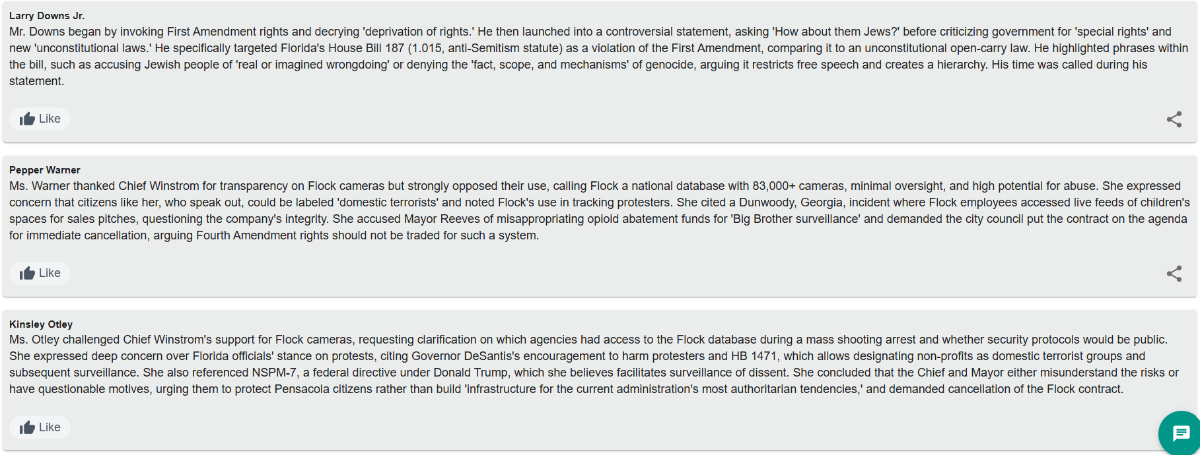
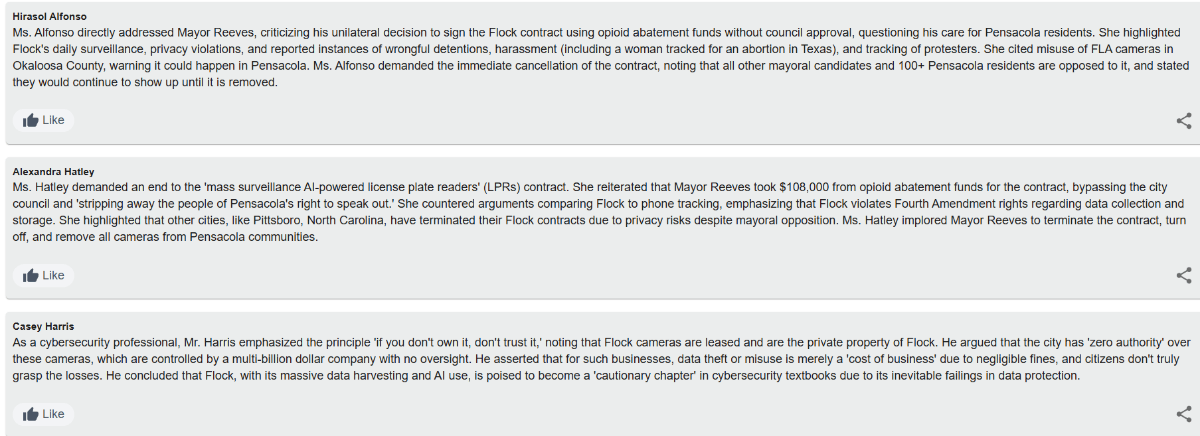
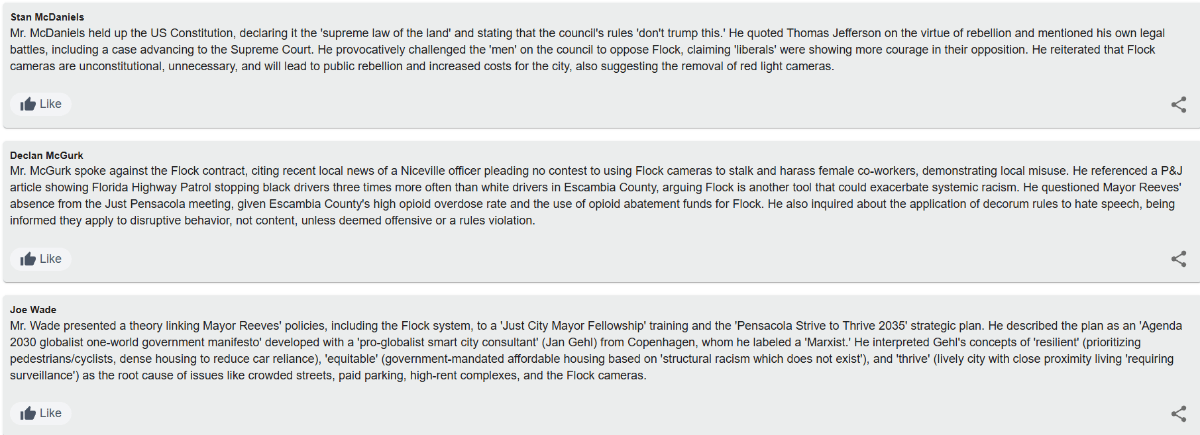

(OpGov.News summary of 10 residents, most of whom have been confronting the council for 3 months, beginning in January)
Speakers passionately argued that these AI-powered license plate readers violate Fourth Amendment rights, facilitate systemic discrimination, have been misused for stalking and political surveillance (tracking protesters, women seeking abortions), and are a "bad product" controlled by a private company without adequate public accountability.
If you did take time to review the 10 speakers summarized, it is obvious that the OpGov.News platform got it right, noting that despite extensive and detailed public opposition, including petitions and citing examples of other cities terminating contracts, the council took no action to address the Flock contract.
Moving on, other critical issues raised included the council's perceived inaction on a mental health pilot program proposed by JUST Pensacola.
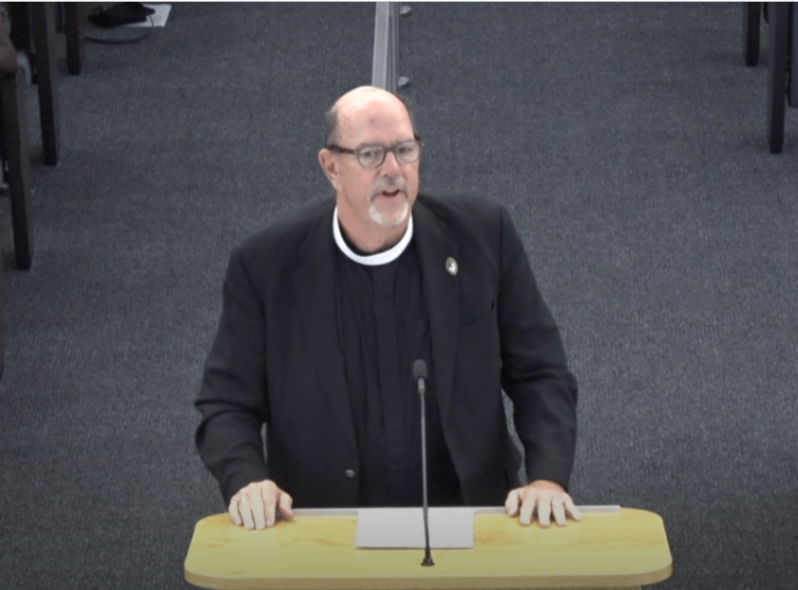
(Photo: JUST Pensacola Bishop George Young confronts council on their no-show at Nehemiah Project meeting)
This is the second time Bishop George Young and the group have been ignored.
Representing JUST Pensacola, an organization of 18 congregations, Bishop Young expressed frustration that no council members attended their Nehemiah Action Assembly, where over 700 constituents gathered to discuss the mental health crisis.
He detailed their proposal for a two-year pilot program: $25,000/year for a public awareness campaign for United Way of West Florida's 211 and 988 helplines, and $55,000/year for one care coordinator position for the 211 helpline.
He criticized the council's lack of public support despite private acknowledgments of mental health struggles, stating JUST Pensacola would continue to advocate for these solutions.
Next comes the lack of inclusive playgrounds in District 2.
Former Councilwoman Sherri Myers, who is running again for the District 2 seat, spoke about Florida Constitution Article 1, Section 2 (Basic Rights) regarding physical disabilities.
This is one of several times Myers has addressed city officials with concerns of inclusivity.
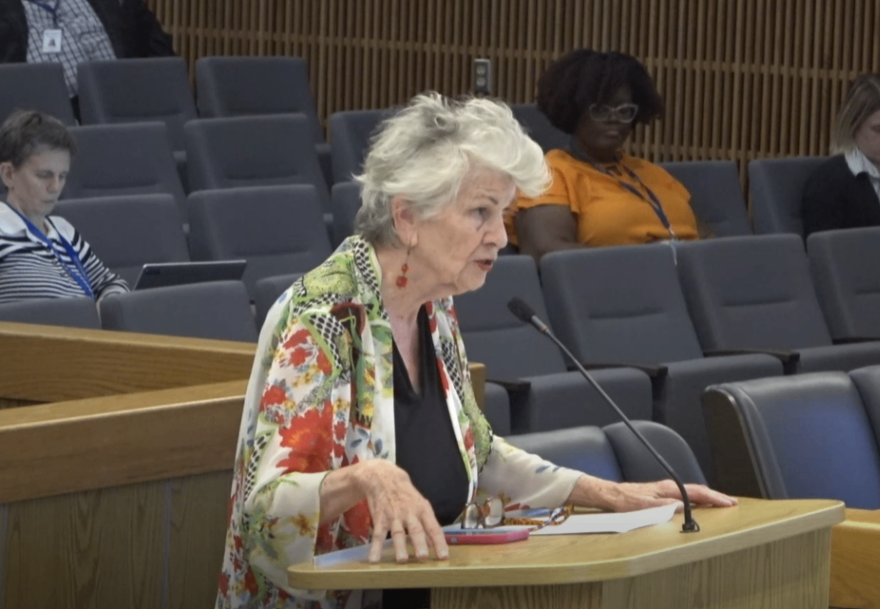
(Photo: Former District 2 Councilwoman, Candidate Sherri Myers, confronts the council again on the lack of inclusive parks in Pensacola)
She expressed outrage after surveying most of the city's 90 parks, particularly Bruce Beach, finding no accessible or inclusive playgrounds for children with disabilities.
She recounted her past involvement in preventing Bruce Beach from becoming a fish hatchery. She declared her intention to fight for inclusive parks in District 2, emphasizing that, despite serving on the CRA (Community Redevelopment Agency) for 12 years, the district lacks such facilities.
Then comes Brenda Donaldson, who had three issues: the imposition of fees for children to access recreation at community parks, as well as the lack of progress on developing low-income housing at the Malcolm Young Community Center.
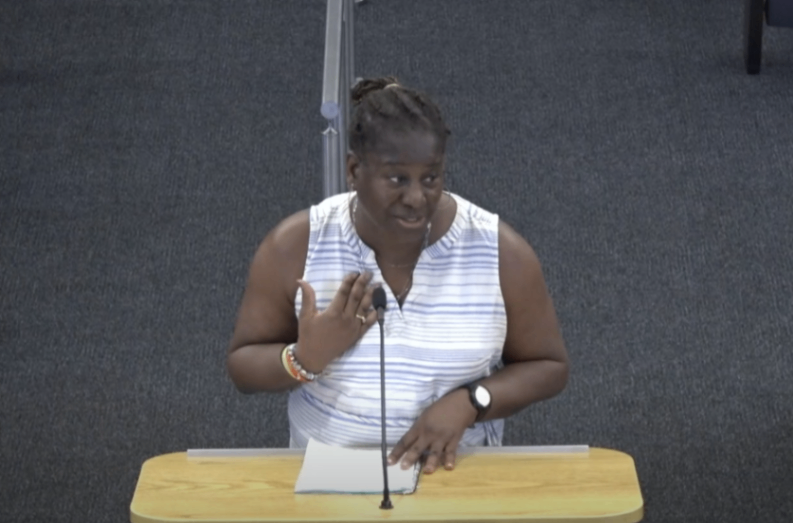
(Photo: Brenda Donaldson confronts the council on why they are charging fees to use a park, a low-income housing project)
She was not alone in her third concern: freedom of speech, specifically concerning violations and citations for placing political signs in private yards, which she believes restricts citizens' ability to express support for their chosen representation.
Doris Hayes brought up the same issue at the last meeting.
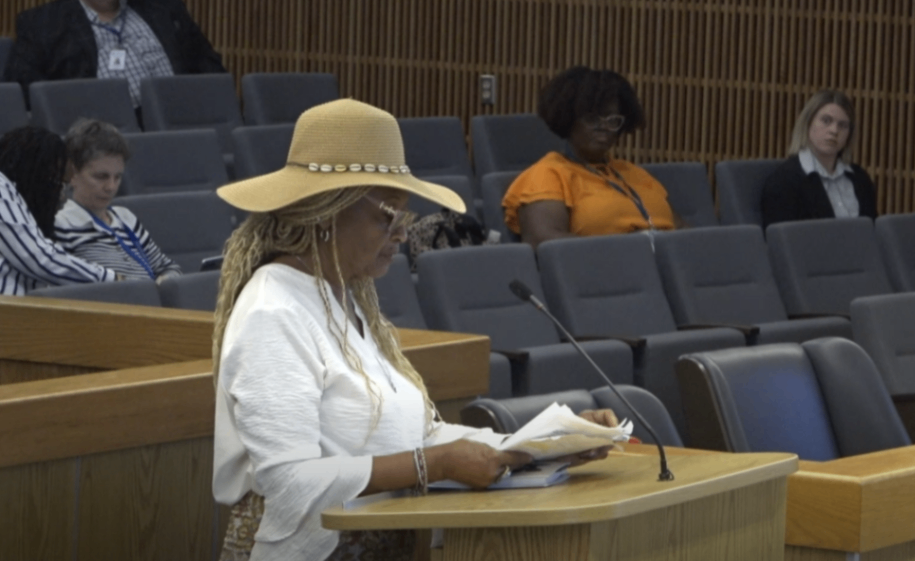
(Photo: Doris Hayes raises code enforcement concerns regarding election signs)
This time, she argued that the officer incorrectly treated her seven parcels of property as a single lot, resulting in an inaccurate assessment of the number of permitted signs.
She asserted her legal right to place signs on each parcel. She called for a change in the law, if necessary, to ensure that property owners can display the signs they desire, especially during election periods, on the land they pay taxes on.
The mayor and Deputy City Administrator Amy Miller indicated they would investigate, attributing it to a possible misunderstanding of "parcel" vs. "property" by code enforcement.
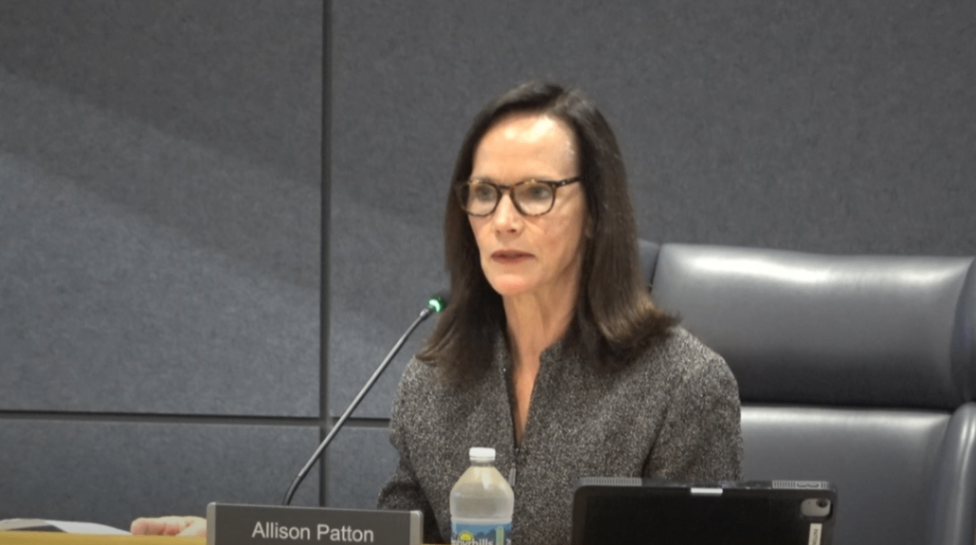
(Photo: Council President Allison Patton, admitting public forum is overwhelming in many ways)
While the mayor's communications highlighted positive city events and infrastructure progress, it largely avoided the contentious surveillance debate.
OpGov.News ends by noting that Council President Allison Patton concluded the meeting by re-reading rules of decorum, implicitly acknowledging the tension and perceived breaches during public comments.
As for my two cents, I conclude by countering Patton.
This reporter has been following the Pensacola City Council for 6 months. After dozens of hours of reporting, I add that all "tension and perceived breaches" can be directly related to how the mayor and the city council have treated the public.
I dare you to disagree.
0
0

Comments