(DUBLIN, CA.) – During the council meeting on July 21, the Dublin council received a report on the history of Dublin’s Transient Occupancy Tax (TOT) in preparation for a discussion on whether to entertain a potential increase.
The TOT is also known as the hotel tax, and it is paid by those who rent rooms in a hotel or motel.
Economic Development Manager Felicia Escover delivered the report in the form of a presentation.
This presentation detailed the history of Dublin’s TOT, the TOTs of surrounding cities, multiple studies on the effects of increasing a city’s TOT, and the proposed measure that would potentially increase it.
Beginning with the TOT background, Escover reported that Dublin’s TOT has not increased from its 8% since 1984 when it was established. Even today, it remains among the lowest in the region, as the median in Alameda county is 12%.
Discussions related to this measure dated back to April 2024, when the city adopted a strategic plan that marked long-term infrastructure and sustainability investments as a goal. In April and June of 2025, discussions arose regarding how the city might meet this goal. Increasing the TOT was identified as an asset that the city could utilize.
In February of 2026, the council unanimously directed staff to prepare a measure.
If the council approves it, this measure would be placed on the ballot in November for voters to decide whether the tax will be increased.
If the voters do pass the measure, Dublin’s TOT would increase from 8% to 10% on July 1st, 2027, and from 10% to 12% on the same date in 2028.
This approach is almost identical to the approach Pleasanton, CA., decided to take when drafting the language for a TOT increase ballot measure of their own.
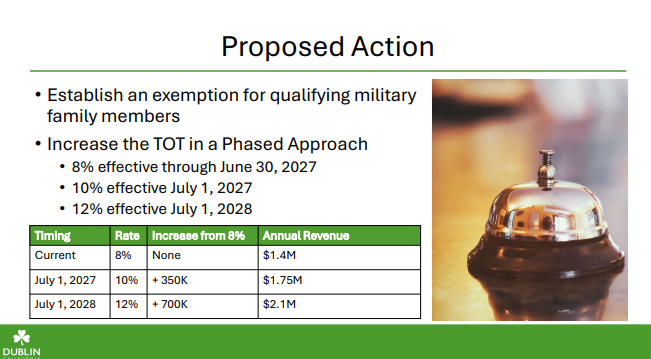
Photo Credit: City of Dublin Powerpoint Presentation
All revenue made from this tax would be put toward Dublin’s general fund, which can be used for things like public safety, community service, and infrastructure.
The most recent developments regarding the matter took place in April and June of 2026, when the council reaffirmed fiscal sustainability and the pursuit of revenue sources as some of their priorities.
On June 2, the council requested additional information about the potential impacts of a TOT increase on the Dublin hospitality industry.
Following this request, staff reviewed both local and regional hotel performances and academic research.
Finally, Escover shared these findings during her presentation.
These came in the form of five academic research and relevant studies taking place in various U.S. states, including both cities with tourism-based hotel economies and those with business-based hotel economies, much like Dublin.
The data used in these studies were pulled from points in time between 1986 to 2015, while the studies themselves were published within the range of 1991 to 2018.
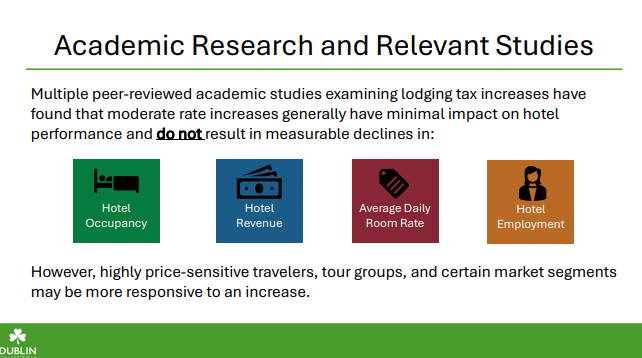
Photo Credit: City of Dublin Powerpoint Presentation
One study that examined specifically California hotel data from 2003 to 2009 had especially promising results due to its relevancy to Dublin compared to other studies that focused on other parts of the U.S.
“The main takeaway from this study is that across thousands of California hotel establishments, higher TOT rates were not associated with significant reductions in sales or employment.”
Moving on from these studies, Escover shared the Dublin community’s general opinion on this measure according to a survey input conducted in 2025.
“When [citizens] were asked about increasing the TOT paid by hotel and motel guests, 52% expressed either strong or somewhat strong [support], 35% expressed opposition, and 13% responded that they were unsure. These results provide one indicator of community sentiment and overall appear to support an increase in TOT,” Escover cited.
Wrapping up the presentation, Escover shared the ballot language that staff wrote up as well as staff’s recommendation, which was to pass the measure and allow it to appear on the ballot in November.
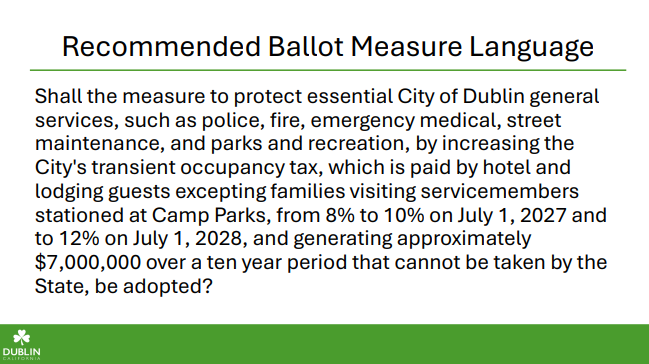
Photo Credit: City of Dublin Powerpoint Presentation
The next step during this meeting was to take public comments and discuss whether or not to pass this measure, which is covered in a separate article.
To add or correct any information in this report, please contact me at madison.v@lead4earth.org.
0
0

Comments