(PLEASANTON, Calif.) — Pleasanton voters will decide this November whether to increase the city's Transient Occupancy Tax (TOT), commonly known as the hotel tax, after the City Council unanimously voted on July 7 to place the measure on the Nov. 3, 2026 General Municipal Election ballot.
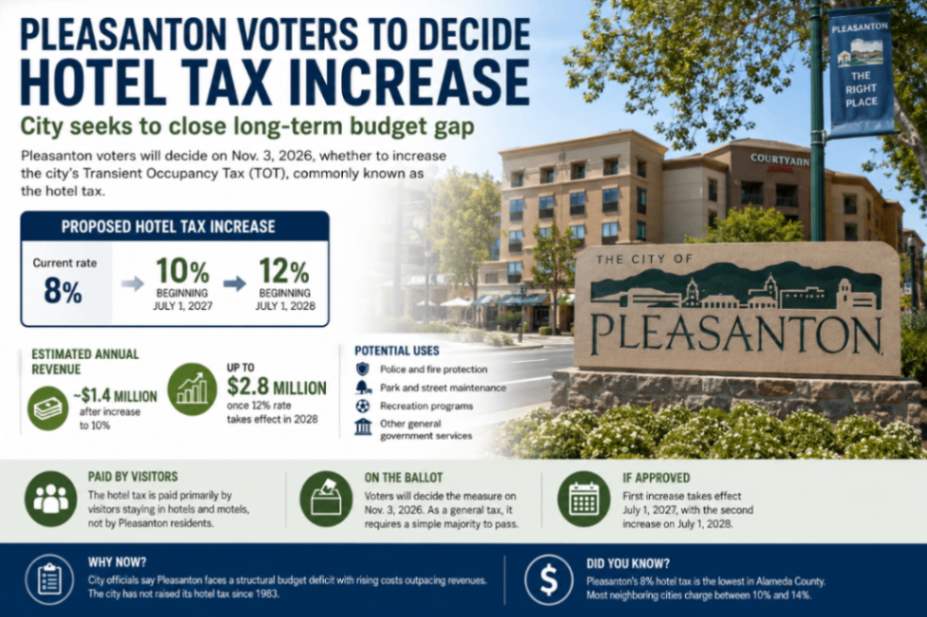
If approved, the measure would increase the city's hotel tax from the current 8% to 10% beginning July 1, 2027, followed by a second increase to 12% on July 1, 2028.
Unlike a sales or property tax, the TOT is paid primarily by visitors staying in hotels and motels rather than by Pleasanton residents. City officials have described it as one of the few revenue sources available that shifts much of the financial burden away from local taxpayers.
Addressing a Structural Budget Deficit
City officials said the proposal is part of a broader effort to address Pleasanton's long-term structural budget deficit, where recurring expenditures are projected to outpace recurring revenues over time.
During the July 7 council meeting, Assistant to the City Manager Aaron Zavala said the city's long-range financial forecast continues to show annual General Fund shortfalls, even before accounting for future investments needed for streets, parks, and other infrastructure.
According to city staff, Pleasanton has pursued a two-part strategy to improve its financial outlook by reducing expenditures where feasible while also identifying sustainable revenue sources. The proposed hotel tax increase is one component of that strategy.
Mayor Jack Balch noted that Pleasanton has not increased its hotel tax since 1983, despite decades of inflation and rising municipal service costs. He said placing the proposal before voters allows the community to determine whether the increase is an appropriate way to help address the city's financial challenges.
(Photo Credit - AI image)
Lowest Hotel Tax in Alameda County
City staff told the council that Pleasanton's current 8% hotel tax is the lowest in Alameda County, with neighboring jurisdictions generally charging between 10% and 14%.
Officials said increasing the rate would bring Pleasanton more in line with surrounding cities while remaining competitive within the regional lodging market.
Estimated Revenue
If approved, the city estimates the measure would generate:
Approximately $1.4 million annually after the initial increase to 10%.
Up to $2.8 million annually once the full 12% rate takes effect in July 2028.
Because the proposal is structured as a general tax, the revenue would be deposited into Pleasanton's General Fund rather than being legally dedicated to a specific purpose.
According to the ballot language, funds could be used for a variety of municipal services, including:
Police and fire protection
Street and park maintenance
Recreation programs
Other general government services
Alternative to Previous Tax Proposal
The hotel tax proposal follows the defeat of Measure PP in 2024, when Pleasanton voters rejected a proposed half-cent local sales tax that city officials estimated would have generated approximately $10 million annually for municipal services.
Following that outcome, city staff evaluated alternative revenue options and determined that a hotel tax increase—paid largely by visitors rather than residents—could provide a more targeted source of additional funding. Staff also conducted outreach with local hotel operators and surveyed residents before recommending the measure to the City Council.
Next Steps
Pleasanton voters will decide the measure during the Nov. 3, 2026 General Municipal Election.
As a general tax, the proposal requires approval by a simple majority of voters to pass.
If approved, the first tax increase would take effect on July 1, 2027, with the second increase scheduled for July 1, 2028. Revenue generated by the measure would be available for general municipal operations, subject to future City Council budget decisions.
To add to or correct any information in this report, please contact me at pratik@lead4earth.org
0
0

Comments