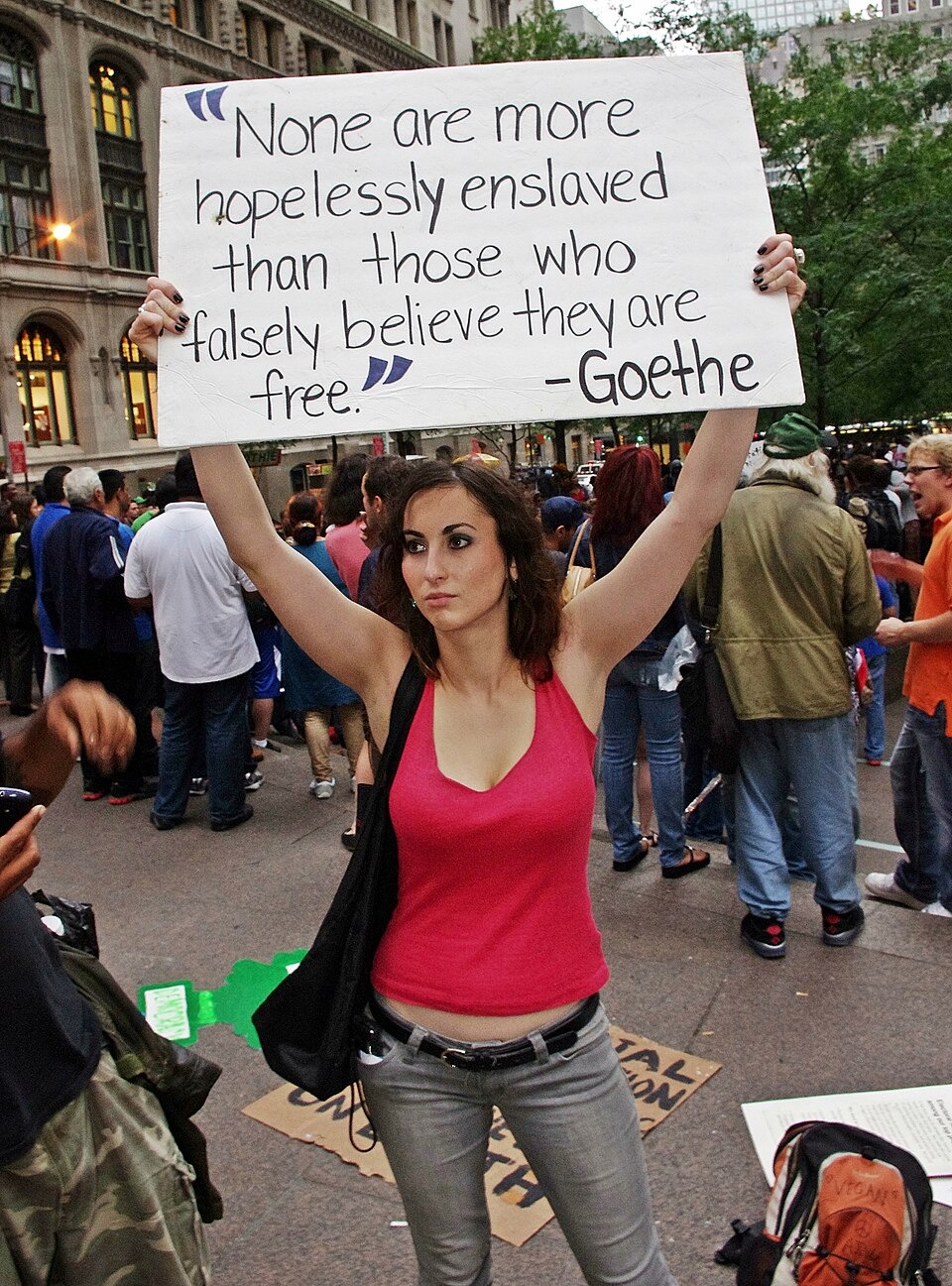
Photo Credit: (CC) David Shankbone / Wikimedia Commons / Occupy protester on September 28, 2011.
(OPGOV GLOBAL) – September 17 belongs to two very different moments in the history of American political protest: the day the Constitution was signed in 1787 and the day protesters occupied Zuccotti Park in 2011.
Inspired by the 1960s Civil Rights and Anti-War movements, Occupy Wall Street (OWS)–later more broadly known as Occupy or the 99% Movement–would eventually spread to over 80 countries around the world.
The slogans “We are the 99%” and “The only solution is world revolution” are still evident on a primary OWS website, like the cave paintings of a vanished civilization. Otherwise, the Google deemed “not secure” site is derelict, accumulating the electric cobwebs of spam comments on posts made in the forum “14 years ago.”
It’s hard not to wonder what happened. How did a call from a small magazine become the spark for a global movement that seemed to crumble in less than a year—and what survived it?
Arab Spring & The Great Recession
The call that helped launch Occupy Wall Street came from an unlikely place: a Canadian non-profit magazine called Adbusters. Founded by Kalle Lasn and Bill Schmalz in 1989, the magazine blends journalism with political activism. Its work challenges consumer culture, corporate power, and the excesses of modern capitalism.
While the movement was far greater than Adbusters, it served as the catalyst, drawing together various activists from differing backgrounds, influenced by a variety of events during the time.
As global economies struggled following the 2008 financial crisis, mass protests erupted across the globe, including in the US, where the Tea Party gained political prominence, Spain, and the Middle East. In Tunisia and Egypt, mass demonstrations helped topple longtime leaders, while protests also spread across countries including Yemen, and Syria.
Adbusters was paying attention. In February 2011, the magazine published an article by Kono Matsu calling for a “million man march on Wall Street,” drawing explicitly from the protests taking place in the Middle East.
While influenced by a variety of movements, Adbusters repeatedly returned to Tahrir Square in Cairo as its most important point of comparison. The occupation of Tahrir had demonstrated the power of a physical place as a symbolic center of political resistance. Adbusters referenced Tahrir multiple times in the months leading up to the September 17 occupation of Zuccotti Park.
The aftermath of the financial crisis created another backdrop for Occupy Wall Street: anger over inequality, unemployment, foreclosures, the financial industry's role in the crisis, and the government’s financial assistance to banks with taxpayer dollars.
Ruth Milkman, Stephanie Luce, and Penny Lewis, in Changing the Subject: A Bottom Up Account of Occupy Wall Street in New York City, wrote that as Occupy grew, it “was building self-consciously on the wave of a surge of worldwide and domestic protest in 2011.”
But Occupy was riding a much older wave.
The movements of the 1960s and 1970s had already filled streets and campuses with demonstrations, occupations, and experiments in decentralized organizing.
Lasn saw the resemblance. “It felt uncannily similar to what happened in 1968 when a student uprising in the Latin Quarter of Paris spread like wildfire,” he wrote, “For a few heady weeks in 1968 and 2011 a tantalizing question hung in the air: Could this be the beginning of a world revolution?”
From Twitter to Zuccotti Park
By June, Adbusters was moving from commentary to action. On June 9, 2011, Adbusters tweeted: “America needs its own Tahrir…Imagine 20,000 people taking over Wall Street indefinitely.”
Five days later, according to Milkman, Luce, and Lewis, a “group affiliated with Anonymous attempted an occupation of Zuccotti Park.” Only a handful ultimately took part. Nonetheless, the abstract idea was beginning to become reality.
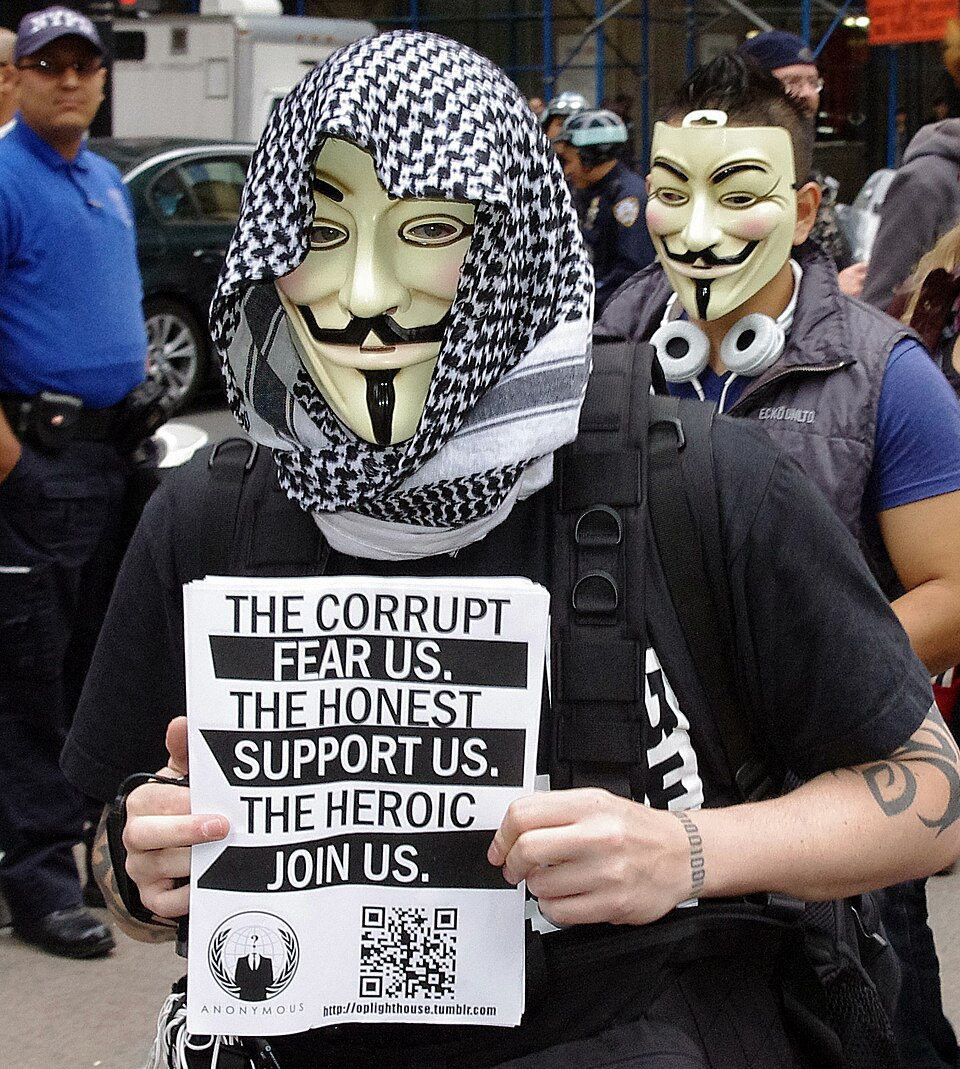
Photo Credit: (CC) David Shankbone / Wikimedia Commons / “A member of the group known by the pseudonym Anonymous, at the Wall Street occupation protest in New York on September 17, 2011.”
On July 13, Adbusters sent a mass message to its email list and published a blog calling for an uprising resembling the one in Cairo. The date was set for September 17.
A transcription of the blog from The SAGE Encyclopedia of Economics and Society shows that it called for applying tactics from the Middle East and Spain against Wall Street, which it described as, “the financial Gomorrah of America.” The blog proposed the establishment of a “presidential commission to separate money from politics,” and was accompanied by an image now associated with the campaign: a graphic of a ballerina dancing atop Wall Street’s charging bull with protesters in the background.
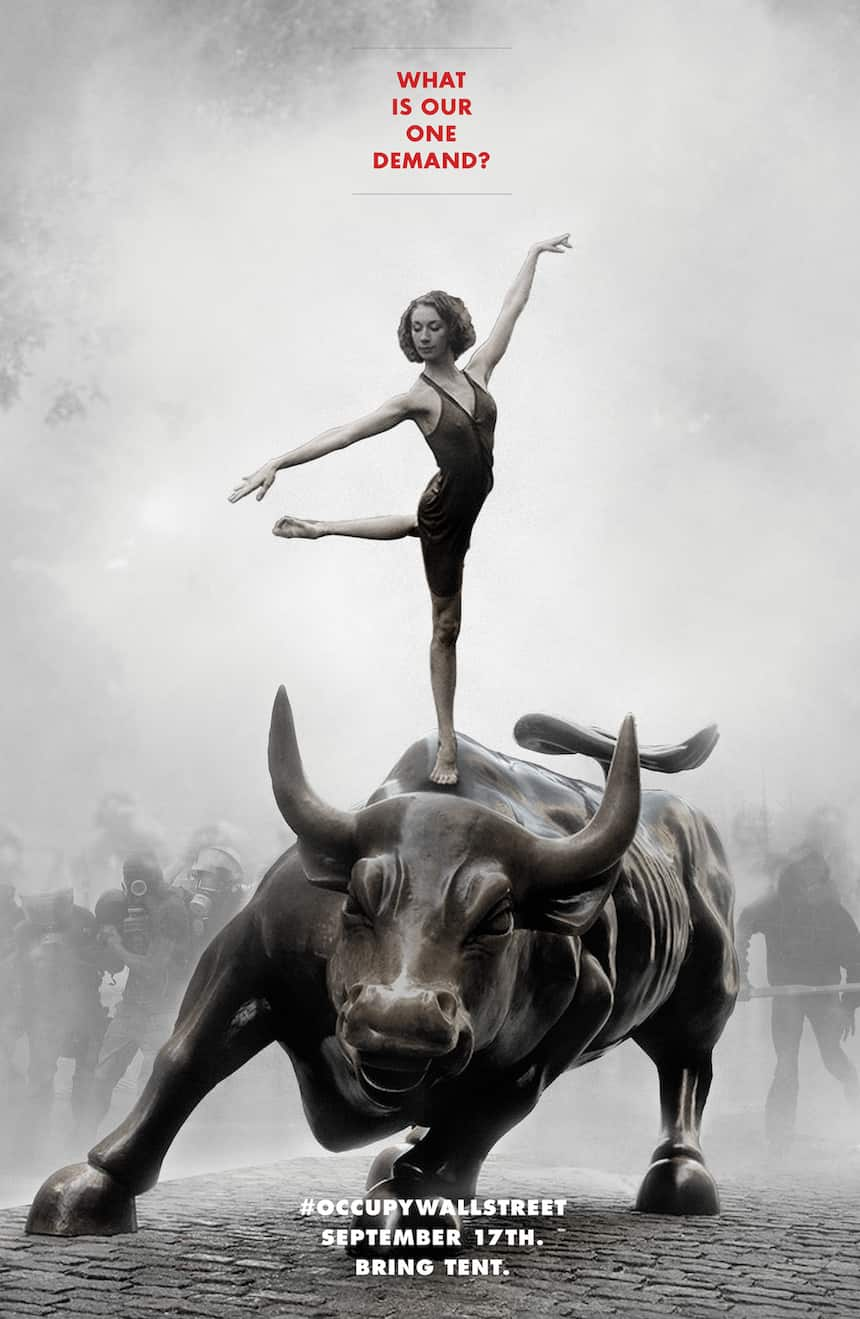
Photo Credit: Adbusters / Graphic for the September 17, 2011 occupation in New York City.
According to Milkman, Luce, and Lewis, on September 17, 2011, “about 2,000 protesters assembled…and occupied a previously obscure ‘privately owned public space,’” Zuccotti Park.
The day was not chosen to coincide with Constitution Day. Lasn later wrote that September 17 was chosen because it “was my mother’s birthday. For me, it was personal.” The coincidence, however, gave the occupation a sense of historical symmetry.
Inside the Occupation
The OWS protesters were not demographically representative of New York. Accounts, including Milkman, Luce, and Lewis, found that Occupy Wall Street was disproportionately college-educated white men. While the movement would diversify, Changing the Subject, says, “As OWS grew…it became increasingly diverse, although its diversity never approached that of the city as a whole.”
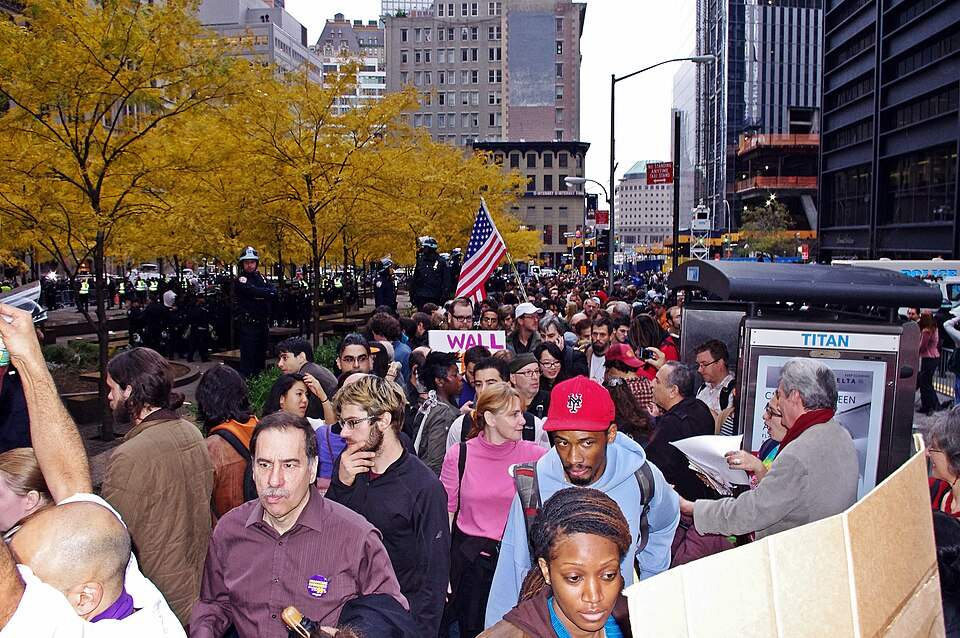
Photo Credit: (CC) David Shankbone / Wikimedia Commons / Protesters in Zuccotti Park on November 15, 2011, the day it was cleared by the NYPD.
As with the Arab Spring, social media became an important tool in Occupy’s rapid growth. This included coordination, communication, and the rapid sharing of information. As Penn State notes in 2021, Occupy was “remarkable for the prominent role social media, and in particular Twitter, played in facilitating communication among its participants.”
By then, Occupy had grown dramatically. The Library of Congress reported that by October 9, 2011, “protests had taken place or were ongoing in 951 cities across 82 countries, and over 600 communities in the United States.”
As the crowds gathered, the encampment at Zuccotti Park was a town within a city. Milkman, Luce, and Lewis, describe “activities” that the protesters engaged in. They write, “There were daily marches from Zuccotti Park to Wall Street, [General Assembly] meetings twice a day in the park, meetings of working groups organizing outreach, direct action, kitchen, security, and dozens of others,” including, “the production of all kinds of media.”
The physical occupation of Zuccotti Park lasted 59 days, from September 17 to November 15. That morning, the NYPD forcibly removed the protesters. Writing for the Columbia Journalism Review, Sam Thielman reported that on that day, “just outside a boarded-up vacant lot in Lower Manhattan, several NYPD officers held down a protester and beat him with batons, while a number of onlookers…chanted, “Shame, shame, shame.”
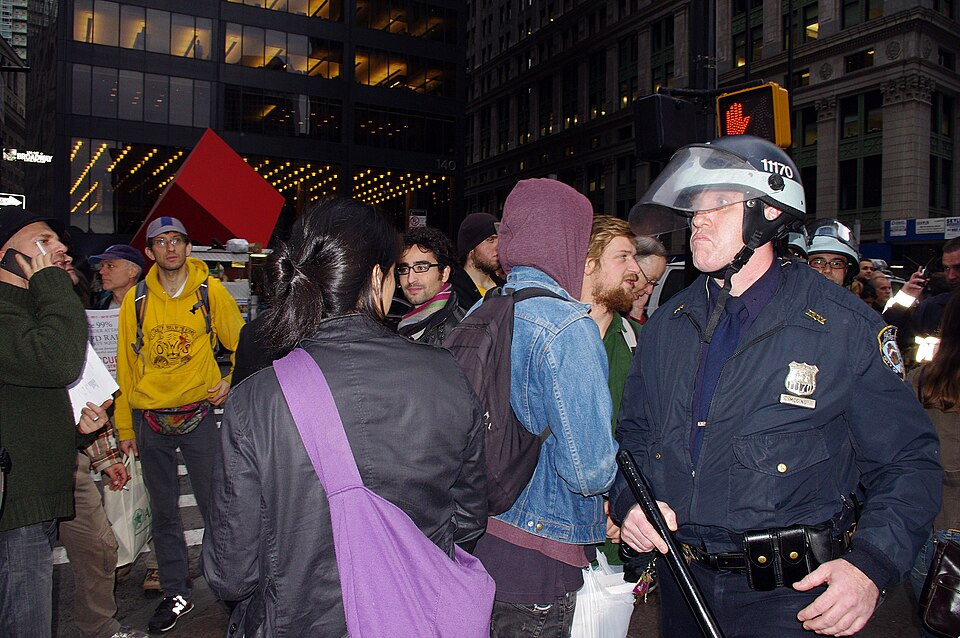
Photo Credit: (CC) David Shankbone / Wikimedia Commons / Police and protesters in New York City, November 15, 2011.
The eviction was one of many as authorities moved to dismantle Occupy encampments around the country and abroad. The Library of Congress noted that by the end of 2011 “most of the major camps” had been cleared.
But the evictions were only part of the movement’s collapse. Occupy’s decentralized structure was both a strength and a challenge. It allowed people with different perspectives, backgrounds, and grievances to participate without waiting for centralized approval. But that same structure also made it difficult to determine what came next, especially when the movement faced the normal struggles of an expanding social movement and the challenge of transitioning from a sustained protest into durable organization.
Plus, New York winters can be very cold.
As Kalle Lasn wrote, “We kept shouting, ‘We are the 99%!’ But when winter crept in and Mayor Bloomberg ambushed Zuccotti Park in the wee hours of the morning, we lost our momentum and will to fight back.”
Micah White, PhD, who now goes by Micah Bornfree, has a different assessment: “I co-created Occupy Wall Street. It was a constructive failure.”
Either way, Occupy had largely disappeared by 2012. The tents were gone, the public squares emptied. The Occupy website says that it was “crushed.”
After the Occupation
By the standards of its original ambitions, Occupy fell short. Its encampments disappeared, its organizational structure fragmented, and the broader movement never settled on a single concrete demand.
But political movements are not always measured by what they accomplish while they exist. Milkman, Luce, and Lewis wrote that Occupy “shifted the national political conversation to focus on rising inequality.”
Lasn sees the issue more broadly, arguing, “You can trace a direct line from #OWS to the rise of #MeToo, #BlackLivesMatter” and other recent movements. “Occupy Wall Street politicized a whole generation of young people, just like my generation got politicized back in 1968.”
The encampments may have disappeared, but many of those involved continued their activism and writing. Dr. Bornfree, for example, published The End of Protest: A new playbook for revolution in 2016.
Adbusters continues publishing with Kalle Lasn as its Editor-in-Chief.
The contrast is striking. The old Occupy website looks like a digital ruin, its slogans frozen, its forum filled with spam. Adbusters’ modern, visually elaborate website appears anything but dormant. Marking the fifteenth anniversary of Occupy, the magazine has announced that it is founding a new political party, writing, “This is not a protest. It’s a call to create something that does not yet exist.”
The language has been altered, the issues have expanded, but a similar impulse for change remains.
So what happened to Occupy?
One explanation comes from Kalle Lasn, who said, “Looking back, what killed the momentum in 1968 and 2011 wasn’t that people failed to put their asses on the line. They did. But we failed to deliver what every revolution needs: one big issue to galvanize around.”
Occupy was one stage in the life of an idea: that ordinary people could challenge concentrated power by reclaiming public space and organizing outside traditional political institutions.
But the thing about waves is that they don’t disappear. They only change shape, giving their energy to the next.
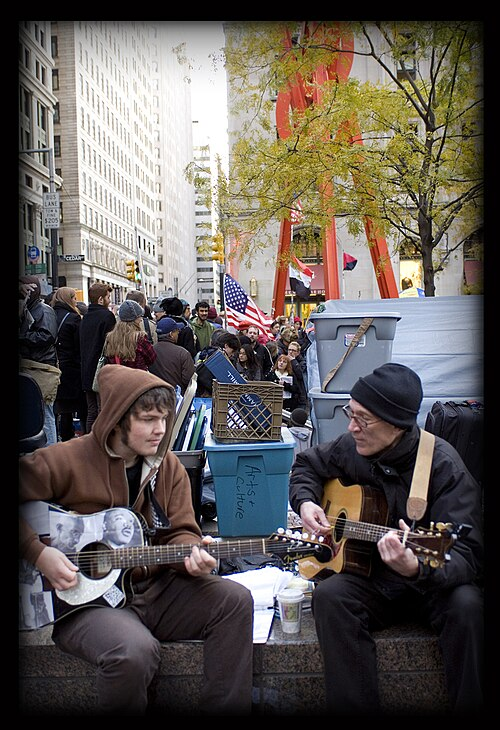
Photo Credit: (CC) Deborah M. Gaines / Wikimedia Commons / Two guitarists playing in Zuccotti Park on November 11, 2011.
To add to or correct any information in this report, please contact me at robert.m@lead4earth.org or leave a comment below with your thoughts.
0
0
Comments