(OPGOV GLOBAL) – Many people practice yoga as a way to increase their strength, flexibility, mindfulness or mental wellbeing as a whole.
But there are many other benefits to practicing yoga that are both scientifically proven and experienced by those who practice it.
One reddit user shared their personal experiences with yoga on the r/loseit subreddit.
“[Because of yoga, I have] better sleep, recovery, flexibility, strength, focus, mood, relationship with my body, relationship with food, relationship with everything in my life. Significant reduction in my depression and anxiety symptoms, stress, injury, and aches and pains.”
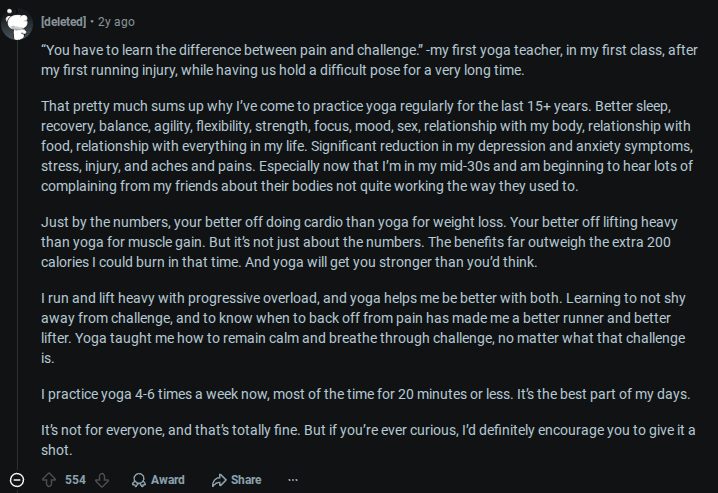
Photo Credit: Reddit / r/loseit
Many others on the same thread shared that yoga helped significantly with back pain, along with some of the other benefits listed in the anecdote above.
According to an article by Hannah Nichols on MedicalNewsToday, yoga originates from Hinduism, and was at first practiced for spiritual and religious reasons rather than physical benefits.
It was not until European countries colonized India that yoga began to become more of what it is today.
“After Europeans colonized India, they and some prominent Indian thinkers became more interested in yoga as a form of physical activity or exercise.”
With this history in mind, the article also provided a definition of yoga as most know it today.
“Yoga is a mind and body practice that combines movement, meditation, and breathing.”
These things are the main elements of what makes yoga, and can be combined and executed in different ways.
The many different ways these components can be combined and executed results in there being many different types of yoga.
A few of these include Iyengar, Hatha, Mysore, Yin, Dharma and Restorative.
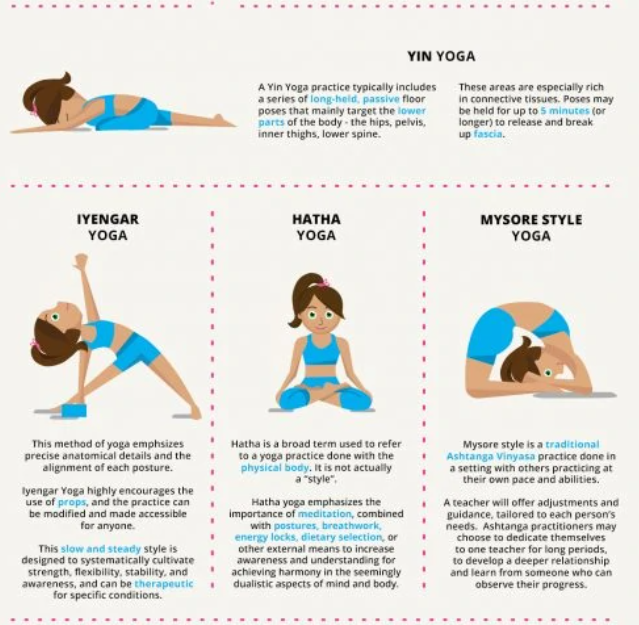
Photo Credit: All Yoga Training / The 15 Different Types Of Yoga: Explained
Iyengar Yoga mostly aims to build physical strength and flexibility. Dharma Yoga, on the other hand, is meant to be both physically and spiritually challenging.
Some have more specific goals, like Restorative Yoga, which aims to create deep relaxation, soothe the nervous system and improve the immune system.
But the goals that these different types of yoga aim to accomplish are not merely what participants hope to experience, but actually do.
According to a study published in the International Journal of Behavioral Nutrition and Physical Activity, yoga improves a variety of physical abilities in people, especially in older adults.
“This study provides robust evidence for promoting yoga in physical activity guidelines for older adults as a multimodal activity that improves aspects of fitness like strength, balance and flexibility, as well as mental wellbeing.”
Another physical benefit associated with yoga is improved heart health.
Such a benefit may be appealing considering heart attacks have been on the rise in younger populations.
According to this study in the Journal of Ayurveda and Integrative Medicine, different types of yogic breathing have numerous effects on the body.
One of them includes increasing heart function and health.
Other scientifically proven benefits of yoga include improved sleep in people with sleep disorders, decreased stress and decreased depression symptoms.
Another reddit user from the same thread on r/loseit holds this exact opinion; that yoga can be a very stress-relieving practice.
“[Yoga] combines physical exercise with breathing technique exercises and mindfulness exercises which lowers stress and increases contentment. And if undertaken in a group class setting, it provides a sense of social togetherness, which also lowers stress.”
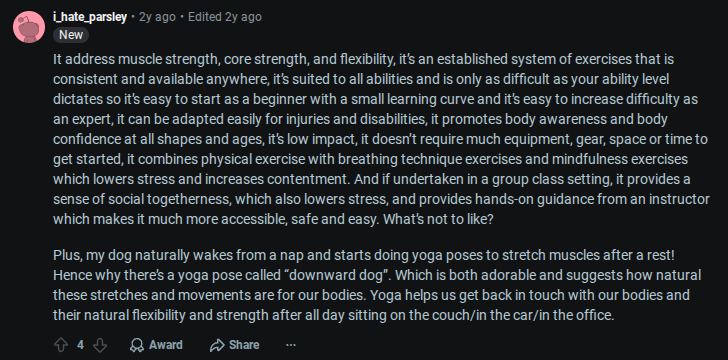
Photo Credit: Reddit / r/loseit
To add or correct any information in this report, please contact me at madison.v@lead4earth.org.
0
0

Comments