(OPGOV GLOBAL) – As I write this, I’m sitting in my home office with only one option. What’s affordable to me, however, wasn’t within reach for about 35% of American women over 50 in 2024. Imagine that figure now.
That’s not even the tip of the iceberg.
Last year, I found a lump in my left breast. That lump led to the discovery of another, adjacent lump, which an oncology radiologist dubbed, “benign fibroadenomas.” This type of tumor is found to be a low-risk, common form of benign (not cancerous) tumor that is solid in form and is correlated with other estrogen-fed diseases such as endometriosis and polycystic ovary syndrome, though is not found to be caused by these illnesses directly.
The first two scans I received after a quick chat with my doctor about my symptoms, with health insurance, set me back around $425 in copays. To qualify for the more reliable ultrasound, my insurance company first wanted a mammogram, despite my doctor’s preference for an ultrasound as soon as possible, to ensure that the pricier, diagnostically more accurate scan was necessary.
According to MDSave, my next ultrasound will cost me an average of $534 out-of-pocket with no savings programs or health insurance. For women living paycheck to paycheck, that figure, even the $287 this website claims to bring the bill down to, is just not feasible.
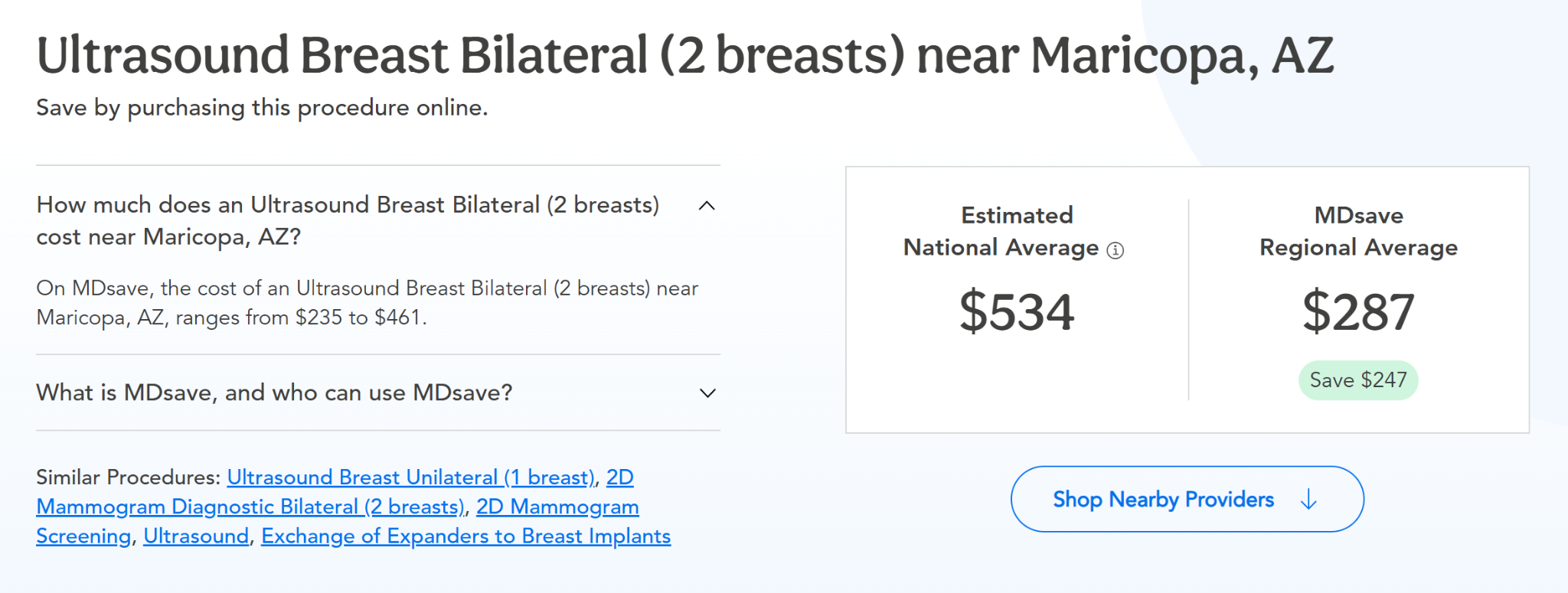
Photo Credit: MDSave / Estimated Out-Of-Pocket Cost For Breast Cancer Screening
Being under 40 years old, it was only my complaint of pain and general discomfort and a palpable lump that led my insurance company to approve the initial mammogram, despite established findings that ultrasound is more accurate than mammography for young women with dense breast tissue.
Now that I fall in with the 30% of Americans with little to no access to healthcare, I’m personally experiencing the delicate calm before the storm. Millions of people in the U.S. are finding themselves in a similar situation: mounting healthcare needs and nowhere to turn.
For many, this ultrasound is just the beginning– the tentative whispers before a life-changing diagnosis on the edge of ruin, followed by a chaotic act of testing, unavailable treatment options, and sacrifice in any attempt to see life through.
We’ve all read the heartbreaking stories about the couple who sold their home, took extra jobs, started GoFundMe campaigns, and entirely deconstructed their entire lives just to break even on healthcare costs after harrowing diagnoses.
But the real kicker here is that 60% of women without health insurance will die of breast cancer. That’s an average of 40,000 women annually, but what really sinks in is that this figure has not improved since 2008.
The math adds up to 18 years of little progress taking that number down, despite the efforts of major breast cancer foundations, charities, and research labs.
Disparity doesn’t stop there, though. Most women under 40 with a health insurance carrier through a workplace or spouse are not eligible to be covered for breast cancer screening without an order from their doctor. Even that order can be denied before or after the fact.
Under the Affordable Care Act, the Health Resources and Services Administration (HRSA) states, “The WPSI recommends that women at average risk of breast cancer initiate mammography screening no earlier than age 40 years and no later than age 50 years.”
This recommendation comes entirely blind to the fact that in 2022 alone, “27,136 new cases of breast cancer were reported in women younger than 45 years in the United States,” according to the Centers for Disease Control (CDC).
Having worked in healthcare, experience has taught me that insurance companies will do anything they can to avoid paying steep prices set by healthcare companies (compare insured rates to out-of-pocket rates for screening, I dare you), and that includes compromising the health of a patient if necessary.
The problem for women who need access to breast cancer screening isn’t just getting a doctor to listen to and respect their concerns; that’s only the first hurdle in a terrifying time. It’s convincing their insurance company that their concerns are pressing enough to take action to prevent a condition that could permanently alter their lives or end them altogether.
The CDC itself addressed this problem in 2024, and yet the number of women who are unable to access breast cancer screening and the exorbitant prices of follow-up screening is still a weight we bear.
We know we are not alone in our struggle, but we also know that we’re the only ones paying attention to the issue at all. In fact, many of us are aware that it would cost less money to pay for breast cancer screening for every eligible woman in the United States per year as it has cost the country so far to pay for the current conflict with Iran.
While that figure sinks in, healthcare is becoming less and less accessible for everyone in general. It’s a little ironic that globally-recognized figures are lamenting steep decreases in population while the current population struggles just to survive.
To add to or correct any information in this report, please contact me at tracy.t@lead4earth.org.
0
0

Comments