(SAN RAMON, CA) - Summer’s here, and the ongoing conflict between the United States and Iran that has been disrupting global oil markets for the past few months may finally come to an end.
The U.S. and Iran reached a deal focused on reopening the Strait of Hormuz and lifting the American naval blockade of Iranian ports. A signing ceremony will be hosted on June 19 in Switzerland.
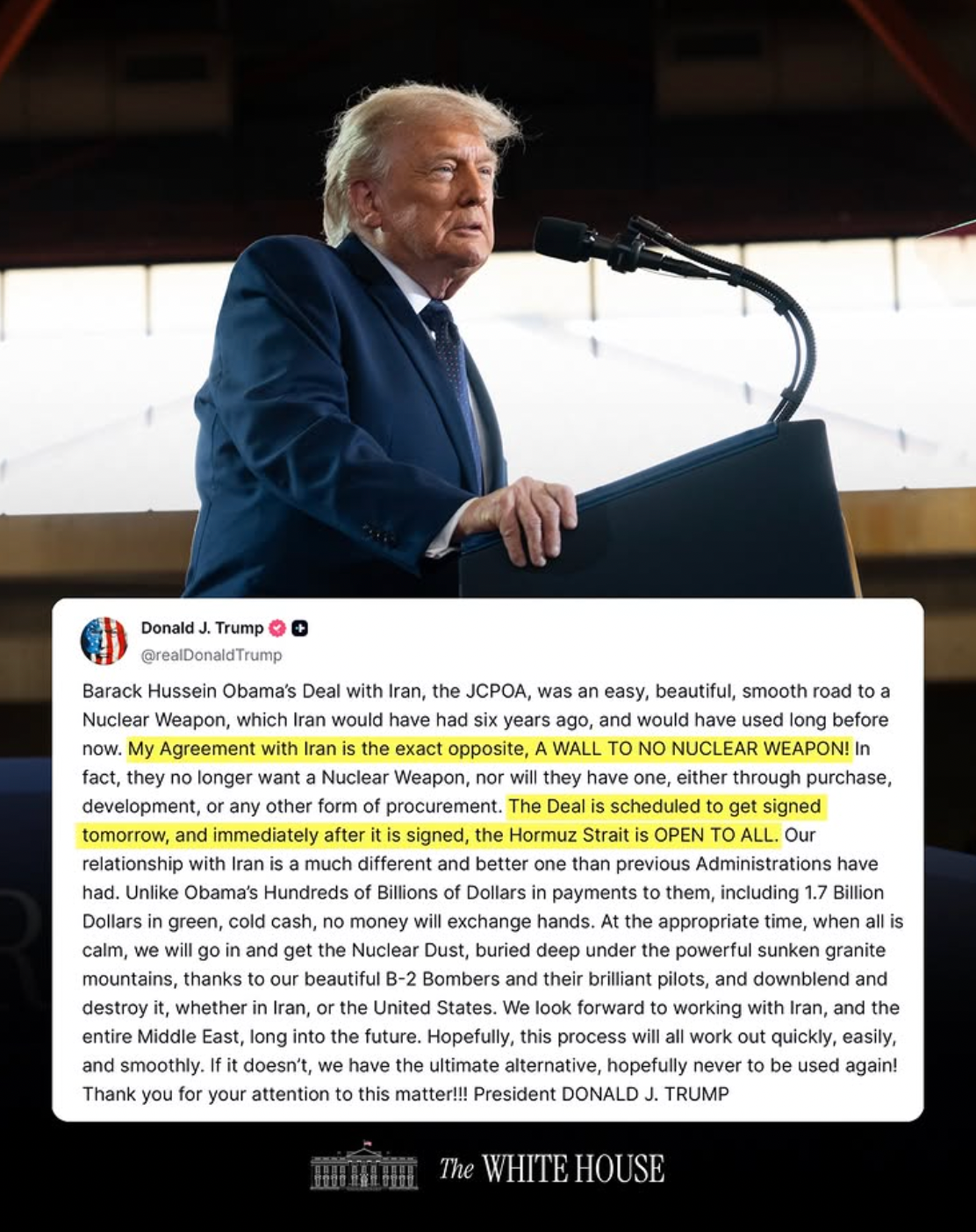
Photo Credit: Donald Trump’s Instagram / Post regarding deal with Iran
The conflict caused a sharp increase in gas prices, which angered many Americans.
According to the American Automobile Association (AAA), as of June, the national average price for a gallon of regular gas is about $4.09, while California's average remains among the highest in the nation at approximately $5.99 per gallon.
So how exactly is the exchange of missiles and bombs between America and Iran leading to Americans feeling the burn every time they use the gas pump?
It begins with the U.S. and Israel’s joint-strike ambush on Iran, which led to the killing of the country’s Supreme Leader, Ayatollah Ali Khamenei, on Feb. 28. He had led the country since 1989.
Khamenei’s demise sparked outrage across the Middle East and escalated the conflict between the nations.
As a form of retaliation, Iran enforced a closure on the Strait of Hormuz- a waterway between the Persian Gulf and the Gulf of Oman, through which 20% of the world’s oil flows, according to the U.S. Energy Information Administration, on Mar. 4.
The blockade results in a limited number of ships getting through the strait, which means a limited amount of oil is reaching international markets, forcing a strain on the global oil supply. Due to this, oil costs have skyrocketed, which in turn has led to a drastic increase in gas prices.
Further intensification of the situation was caused by the American Naval blockade on Apr. 13. According to the U.S. Central Command (CENTCOM), ships entering and exiting all Iranian ports and coastal areas, including the Arabian Gulf and Gulf of Oman, would be shut off.
President Donald Trump claimed that the blockade was costing Iran roughly $500 million per day, while a Pentagon assessment reported by Axios estimated that Iran had lost approximately $4.8 billion in oil revenue by May 1.
As headlines and debates fill people’s feeds while they’re doomscrolling or watching the news, adult perspectives are strongly represented. However, the conflict between America and Iran is more than an issue meant to be faced by the "older" generations.
The youth have a lot to say about it as well.
"Gas prices have gone up because a large majority of the U.S. gasoline is imported, and because it's being blocked off right now, it's going to be bad,” high school senior Lincoln Stanley said.
Stanley believes that the leaders of the countries involved need to get together and listen intently, think about what they're doing, and step outside of their own circle to think from the perspective of someone on the ground.
"Some people are more focused on national security concerns, while others are more concerned about the humanitarian impact and the loss of lives,” college freshman Mishti Ramachandra said. "I'm more concerned about the humanitarian impact, including the displacement of individuals and civilians."
Ramachandra’s concern stems from the Feb. 28 airstrike on Iran's Shajarah Tayyebeh Elementary School, which killed 168 people, including 120 students, according to PBS News.
"Many young people have grown up in a highly connected world where we can see the human impact of conflicts in real time,” Ramachandra said. "I feel like that shapes how younger people think about war and peace."
College freshman Daniela Noubleau said when it comes to international conflicts, Americans mainly get to see the U.S. perspective of things.
"We're pretty shielded from what's going on in other countries, especially in the Middle East,” Noubleau said. "That also influences our perception of it."
Noubleau emphasizes how social media plays a huge role in the content people are consuming, but sometimes that information can be misleading, which is why it’s crucial to verify and fact-check your sources.
“Social media has made information more accessible and immediate," Ramachandra said. "At the same time, it's shown me the importance of verifying information because different viewpoints and varying levels of accuracy can spread quickly. You can't really believe everything you see on TikTok and Instagram, which is why I like to do my own research as well."
Stanley also believes that educating yourself is important, stating that being oblivious does not put society in a good position.
“This generation specifically is paying a lot more attention to these issues than I thought they would,” Stanley said. “The movements that have been started, even if they aren't all large-scale, are giving people an opportunity at this age to express themselves openly, which is something that not a lot of people in previous generations could actually do."
While Noubleau believes that young people are well-educated about global issues, she believes that the level of being informed only goes so far, stating that most people only pay attention when conflicts are major; for example, issues related to Iran or Palestine.
Noubleau also believes that the government has a responsibility to be transparent and honest with its people.
"[The government] should keep people updated, and not just straight up bomb someplace and then say, 'Oh, this guy's dead,'" Noubleau said. "There was so much that could have been avoided to stop the war, and we wouldn't be in this situation if they had."
While many people refer to the situation as a war, legally, America has not formally declared war on Iran. According to Britannica, while Trump has characterized the conflict as a war, only Congress has the authority to declare one.
Stanley believes that what the United States is doing, at least on social media, is actively belittling and mocking entire groups of people and boasting to other countries.
"It really comes off as the kid on the playground who has a new toy, and he's all of a sudden going up to everyone and being like, 'Oh, I have this. You don't have this,'" Stanley said.
Noubleau echoed similar sentiments, saying how, when a big world power is threatening a smaller nation and vice versa, situations don’t end well because there's always discourse that goes beyond them.
"It's already affecting my future,” Noubleau said. “Gas prices are going up. Things are getting more expensive."
Ramachandra said that beyond just the potential implications that the conflict has on the global economy, energy prices, and overall security, there is concern over the long-term instability in the Middle East, where periods of conflict and terrorism have affected parts of the region for decades.
"I think the cabinet and the people up there are weaponizing hatred and division,” Stanley said. “And they're counting on it, hoping that people stay divided and stick to their selfish and stunted ways of thinking.”
Stanley also voiced concerns for future generations.
"Dehumanization is the one thing that I think the cabinet is really doing well, sadly,” Stanley said. “I'm worried that that's going to carry over into the way that people think going forward. What is it going to be like when I have kids? When they have kids? It'll be terrible."
Noubleau believes that at the end of the day, the younger generations are the ones who are going to be here in the future and that their voices are just as important as the people sitting in the White House.
"Young people want a future that is safe, stable, and full of opportunity,” Ramachandra said. “We hope leaders will pursue peaceful solutions whenever possible, and we hope they carefully consider the long-term consequences of conflict."
To add to or correct any information in this report, please email me at yashi.s@lead4earth.org or leave a comment below.
0
4

Comments