(SACRAMENTO, CA.) — From the moment Mark Velasquez opened the door of his South Land Park home, his sweet and excited Doberman mix bounded forward to greet me. Mark welcomed me inside with a warm smile and said, “I hope you don’t mind cats and dogs.” His beloved pup circled me with excited energy. The moment felt genuine and disarming — the kind of greeting that instantly makes a house feel like a home.
Inside, the warmth deepened. Mark’s living room felt like stepping into a family album, with framed photos of his two children, himself, and his wife thoughtfully placed throughout the space. The room carried a quiet mixture of love, memory, and resilience, offering an early glimpse into the heart behind his campaign.
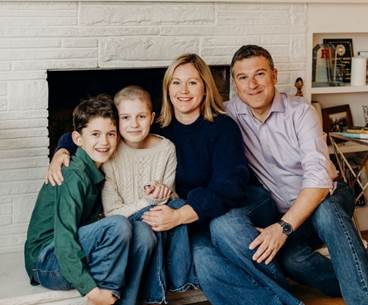
(Velasquez family photo. Credit: Mark Velasquez.)
“Thank you for interviewing me… and welcome to my home,” Mark Velasquez said as I settled in, his voice carrying the same sincerity that filled the room. Velasquez is running for Sacramento City Council District 7 against incumbent Rick Jennings and candidate Scott Lau.
It quickly became clear to me early on in our conversation that his decision to run for Sacramento City Council District 7 did not grow out of political ambition. It grew out of heartbreak.
Mark spoke openly about the loss of his daughter Samantha, who passed away two days before her 13th birthday after a three-year battle with cancer. He explained how the experience of burying her led him to a sobering realization: Sacramento is facing an overlooked crisis — the city is running out of affordable burial space.

(Mark with his daughter Samantha. Credit: Mark Velasquez.)
“I’ve always thought about politics, and my background is working for the government. I’ve been a city attorney, deputy city attorney, general counsel for lots of special districts, including cemetery districts,” Velasquez said. “But what really pushed me into entering this race was the death of my daughter and, more specifically, her burial and me realizing that Sacramento is about to run out of affordable burial options — burial space.”
It is the kind of reality most people never confront until they are suddenly living through the pain of laying a loved one to rest. Mark said the issue felt even more urgent when he began seeing people standing on street corners with signs asking for help covering burial expenses for family members.
“I love being able to go see her… not everyone’s into cemeteries,” Velasquez said, adding that having a place to visit deceased loved ones still holds deep importance for many families. “So, I decided to use her passing — one of the things I could take from it — to see if I could help other people by making sure this city starts planning for affordable burial spaces.”
After bringing the issue before the current city council for more than a year, Velasquez said he felt largely ignored. Each time he asked city leaders to begin planning for affordable burial space, the concern was pushed aside.
“They basically ignored me… and then I realized I can do better. We deserve better,” he said.
Rather than simply criticize, Velasquez came prepared with a proposal. With the help of an architectural firm that volunteered its services, he developed a community-driven vision for the 102 acres of landlocked, city-owned property near Meadowview (OpGov.news related article).
Drawing from his years as a city attorney and counsel for cemetery districts, he recognized the site as “perfect for a public cemetery.”
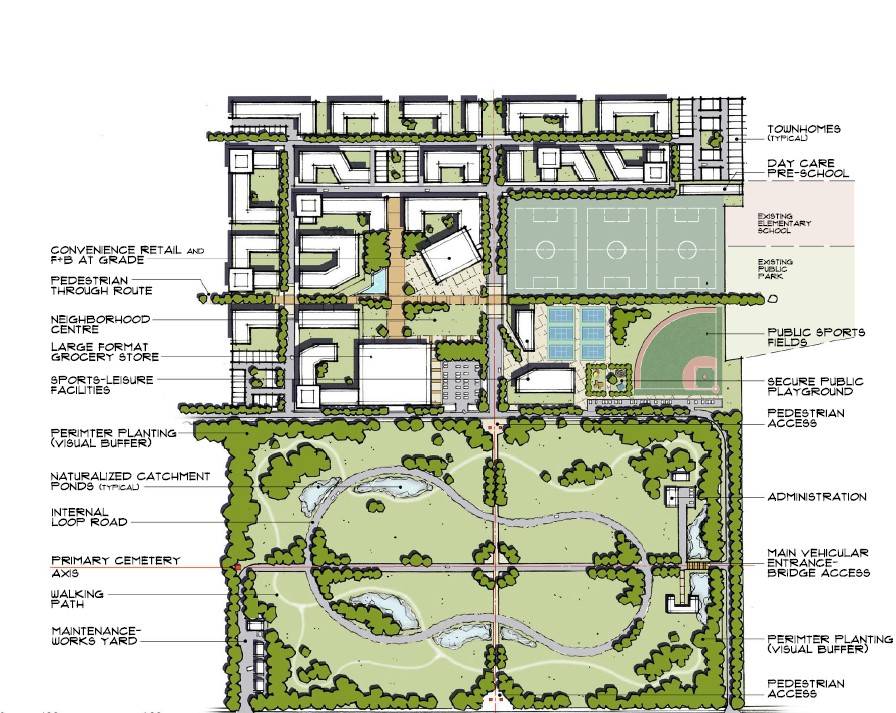
(Mark Velasquez wants the city to use half of a 102‑acre property in Meadowview to create a new public cemetery called Meadowview Memorial Park. Credit: Mark Velasquez.)
The proposal would use recycled water from a nearby facility, incorporate vernal pools, and function as a broader public asset.
“Cemeteries are really parks — open space, beautiful to walk through,” Velasquez said.
The design he shared with OpGov.news included not only a memorial park, but also sports fields and affordable housing.
“We looked at all the comments from the community and said, let’s give them everything,” Velasquez said.
As the conversation shifted from personal grief to city policy, Mark’s focus sharpened on public safety and infrastructure. Living near a school, he described a daily hazard he sees firsthand.
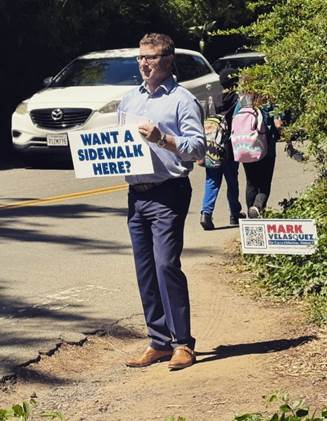
(Mark Velasquez at Sutterville Elementary highlighting the need for sidewalks on the west side of the school. Credit: velasquezforsacramento Instagram.)
“The sidewalk stops halfway… kids and parents are in the middle of the street during drop-off because there’s no sidewalk to get to school,” Velasquez said.
The irony, he noted, is that Sacramento already recognizes the importance of safe school access through its Vision Zero plan, yet projects often go unfunded.
“We shouldn’t wait for a kid to be killed to fix it,” he said.
That same theme — strong intentions but inconsistent follow-through — extended to Sacramento’s parks. For example, Land Park, one of the city’s busiest public spaces, attracts thousands of visitors every weekend. Yet Velasquez said enforcement and oversight remain limited.
“And not a single public safety officer to be found,” he said.
He argued that proposed restrictions on street parking would simply push congestion into nearby neighborhoods. A more practical solution, he said, already exists.
“Put some park rangers in on weekends,” Velasquez said.
That practicality also shaped his views on permits and public services. As both a homeowner and attorney, he said he has experienced firsthand how cumbersome city systems can become.
“You have to get a permit to change out a light switch,” he said.
More concerning to him, however, are the barriers faced by working families.
“If you want music or a bounce house, you need a permit — but there’s no online option,” Velasquez said, describing residents who must take time off work simply to file paperwork in person.
Without enforcement in parks and with staffing shortages in parking services, he argued, compliance becomes inconsistent and city revenue suffers.
“We’re losing money, and nobody’s checking — so people don’t bother,” he added.
When the discussion turned to homelessness, Velasquez avoided sweeping promises. Instead, he emphasized accountability and follow-through.
“We study so much and put money toward studies… then we don’t see them through. Let’s see the effectiveness and return on investment, then adjust,” Velasquez said.
District 7 lacks the large open parcels available in other areas of Sacramento, but he believes smaller-scale solutions — including micro-communities, seasonal shelters, and volunteer patrols — can still make a meaningful impact. Larger solutions, he said, would become clearer once he is able to work directly with city staff.
Local businesses, too, are feeling mounting pressure. Velasquez said business owners frequently describe long permitting delays and repeated break-ins that threaten their ability to survive.
“It takes eight months to open a boba tea place,” he said.
In one nearby strip mall, he noted, four break-ins occurred within just a few months.
“There was a failure… and still the police took forever to come out. They never really searched for the cause,” Velasquez said.
While he believes property owners must improve security, he also sees a role for the city in deploying mobile surveillance units to high-target areas.
The broader issue of affordability brought out both his compassion and pragmatism. When OpGov.news asked whether a young person could realistically buy a home in District 7 — or whether a senior could afford to remain in one — Velasquez did not sugarcoat the challenge.
“I don’t know… maybe,” he said with a slight laugh before explaining that, while the city cannot control private housing markets outright, it can establish guardrails.
“It’s not government’s place to dictate the price of someone’s house… but we should tame extremes,” Velasquez added.
He supports limits on annual rent increases, programs that assist first-time homebuyers with down payments, and expanding the city’s inventory of affordable and senior housing.
“That’s another way we can control affordability,” Velasquez said.
Even broader structural issues, such as California’s long-standing property tax limits, prompted a balanced response.
“The intent was great… over time it’s hindered our ability to provide services. But the people have spoken, so we’ve got to work with it,” he said.
Before the interview concluded, Velasquez shared where residents are most likely to find him: riding his bicycle through the neighborhood, visiting the cemeteries that now hold deep personal meaning, or spending time at Venus Coffee Shop.
“You’ll find me there a lot,” he said.
He also pointed residents toward his campaign website, velasquezforsacramento.org, and Instagram page for updates, noting that he includes his personal phone number directly on campaign pamphlets.
“I’m out there… look me up!” he said.
As the conversation came to a close, the arc of Velasquez’s story felt unmistakably clear. It is a story of private grief transformed into public purpose — of seeing gaps in city services and refusing to accept them as inevitable.
His campaign message emerges from that place quietly but persistently: Sacramento can finish what it starts. Sacramento can plan ahead. Sacramento can be compassionate and effective at the same time.
And as he said earlier in the interview — almost in passing, yet with unmistakable conviction — “I can do better than what we have — and we deserve better.”
(Image Credit: velasquezforsacramento Instagram.)
Fast Facts: Are we running low on affordable burial space?
A Hoodline report flatly states: “Sacramento Running Out of Room to Rest the Dead”—highlighting dwindling in-ground burial plots and prompting debate over denser, above-ground options.
MSN echoed this: “Without action… Sacramento residents may struggle to find affordable local burial plots in as little as a decade.”
Private burials in Sacramento typically cost over $11,700 for a traditional funeral, with total interment expenses—including casket, plot, vault, headstone—ranging from $23,500 to $33,200. Meanwhile, the median household income in Sacramento is around $91,000, underscoring how burial costs can stretch beyond what many typical families can afford.
Find out more about Mark Velasquez by visiting his campaign page at https://velasquezforsacramento.org/. Have tips or story ideas from around Sacramento County? Send them to Sarah Denos at sarahkdenos@gmail.com.
0
0

Comments