(SACRAMENTO, CA.) — Sacramento’s most dangerous streets may soon undergo major changes as city leaders signaled strong support during Tuesday night’s council meeting for expanding and modernizing the city’s Vision Zero strategy—an effort aimed at eliminating traffic deaths and severe injuries.
OpGov.news platform reports Public Works staff revealed updated data showing more than 22,000 injury crashes and 1,600 severe or fatal crashes in Sacramento over the last decade. “We have a lot of work to do,” staff said, noting the concentration of crashes in disadvantaged neighborhoods.
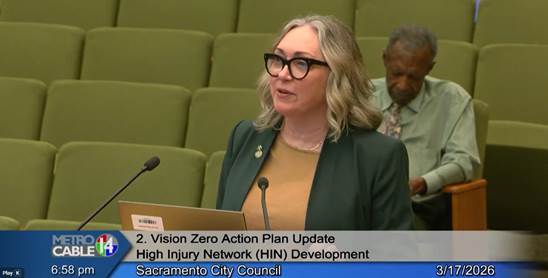
(Transportation Planning Manager Jennifer Donlon Wyant. Credit: Metro Cable 14 YouTube video.)
Transportation Planning Manager Jennifer Donlon Wyant highlighted both the city’s progress and the serious gaps that remain. “We did a lot.… but we are working hard to address and do good data analysis to work with communities,” she said.
The data underscored who is at risk on Sacramento’s streets. Pedestrians account for 31 percent of severe injuries and fatalities, and bicyclists account for 15 percent, despite comprising a much smaller percentage of travelers. Nearly half of all severe crashes, 48 percent, occur in disadvantaged communities, which make up only 31 percent of the city's road network.
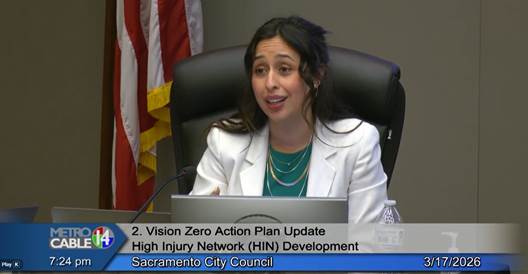
(Vice Mayor Karina Talamantes. Credit: Metro Cable 14 YouTube video.)
Reacting to the disparity, Vice Mayor Karina Talamantes called the numbers “terrible… but it is the reality of road conditions in Sacramento.”
Council members, reflecting on both the data and community feedback, pushed firmly to broaden the criteria used to identify high‑priority corridors. Councilmember Catie Maple made the city’s stance clear: “Yes, absolutely. For me that is a no‑brainer. Cycling, pedestrians, young people, older folks… those are the areas where we see the most crashes.” She added, “People feel generally unsafe in our streets. The data supports that… this is the right thing to do and overdue.”
The conversation then shifted toward how the city can intervene earlier—before tragedies occur. Councilmember Eric Guerra argued that the system must acknowledge danger even when collisions have not yet happened. “I don't call them near misses. I call them near hits,” he said, adding that the city must stop waiting until “someone has to get hurt or die before it gets into the priority list.”
Council’s discussion naturally led to enforcement. With limited staffing for traffic patrols, city leaders are increasingly eyeing technology for help. Police Chief Katherine Lester voiced strong support for camera enforcement, saying, “Traffic cameras—I am a huge proponent of traffic and speed cameras. We are limited in what we can do.” She described California’s new red‑light camera authority as “a game changer for us.”
Despite this, Sacramento is not yet included in the state’s speed‑camera pilot program—an omission city staff says they are working to change. As the legality of automated warnings came up, Councilmember Roger Dickinson asked, “Is there anything that would necessarily prevent us from just issuing warnings?” The city attorney cautioned that photographing drivers without the backing of citation authority could raise “privacy” concerns.
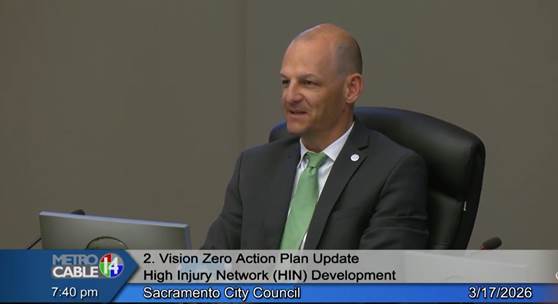
(Mayor Kevin McCarty. Credit: Metro Cable 14 YouTube video.)
As the discussion progressed, attention turned to the immense cost of rebuilding dangerous corridors. Mayor Kevin McCarty pressed staff for specifics, prompting Public Works to offer a sobering estimate: “We are a five‑billion‑dollar set of planned improvements.” Staff added, “My gut tells me probably $3 billion” would be needed just for the most dangerous, highest‑impact segments.
Though the price tag looms large, council members reinforced their resolve to keep pushing. Maple noted that Sacramento adopted Vision Zero in 2017 with a goal of eliminating traffic deaths by 2027. “It is 2026… I think it is true to say we haven’t seen the progress we hoped for,” she said. Guerra emphasized the long‑term cultural shift at stake: “If we can encourage young kids to learn to get to school [safely], then we create cultural change for the future.”
As the meeting concluded, McCarty captured the overall sentiment: “We are zeroing in on the streets that have the biggest negative impact.… Stay the course.” The directive reflected what was clear throughout the evening—Sacramento’s leaders are preparing to reshape the city’s approach to traffic safety, even if doing so requires major policy shifts, new technologies, and billions in investment.
Story photo created by Ai. Submit Sacramento County tips and story ideas to Sarah Denos at sarahkdenos@gmail.com.
0
0

Comments