
Photo Credit: Tumisu / Pixabay
(UNITED STATES) – Let’s discuss the questionable explanation for the issue with several US banks at noon EST on November 16. I won’t lie, lately it feels like my brain is on repeat…colleges, schools, water systems, FAA, and now banks.
When attempting to access their accounts online to cash checks or move money, customers received errors, especially those using apps for access. Most of the banks involved initially denied there was an issue, saying their services were working, including JPMorgan Chase, Bank of America, U.S. Bank, and Wells Fargo.
Despite its assertion that online services are working as they should, multiple Chase customers receive the error message: “Some services aren’t available. We’re working on them. Please try back later.”
The result was over 4,600 Chase, 1,900 Bank of America, 900 US Bank, and 800 Wells Fargo complaints flooding Down Detector. These complaints aren’t an accurate reflection of the number of actual customers without service.
Chase then says services at their physical locations are working. To me, this is an admission that the online services were not, indeed, working as they should. Zelle, an online banking service, also claimed everything was working as it should be. Yet customers couldn’t send payments.
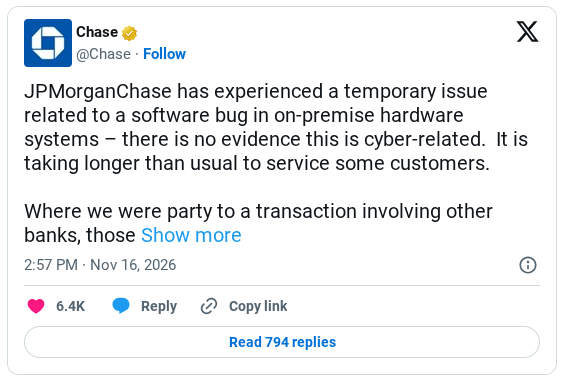
Photo Credit: X / Chase / Statement on November 16 errors
The incident prevented thousands of people from accessing their accounts, and complaints on Down Detector grew, even as the banks continued to deny the issue. Next came the addressing of the ‘non-existent’ issue. Here is a list of all the ‘reasons’ for the issue with the banks as given by a spokesperson at various intervals, and on various outlets:
Due to a technical issue, transactions are taking longer than usual to complete.
This is a technical issue, not a cyber issue.
It’s a bug, not a widespread cyberattack.
An update within the company's physical computer system inadvertently caused the issue.
Which is it? A bug, a technical issue, or an update? Fortunately, whatever it really was seems to be fixed. Banks are reporting normal operations as of this morning. Still, the lack of a non-ambiguous, concrete reason is troubling.
Photo Credit: Marin Bel / Pixabay
Maybe it was all three; after all, mixing legacy software and hardware with newer equipment can be complicated. Many larger entities (e.g., banks, educational institutes, federal agencies) use the same (or similar) software and hardware.
If we follow that train of thought, it's not surprising that it happened at multiple banks. Most of these entities fracture off into smaller companies, but generally use the same hardware and software to build their network infrastructure.
Banks in particular have to meet certain requirements that include updating obsolete software and hardware. On that note, legacy systems and software (online or otherwise) that meet security requirements with an upgrade or two often remain.
That doesn’t mean, however, that the systems will play nice with newer technologies. Unfortunately, if the pattern of technical failures holds, before the year is out, hospitals and clinics will be the next to experience sudden software/hardware incompatibilities.
Here’s hoping the fourth week of November doesn’t contain another massive technical failure incident.
To add to or correct any information in this report, please contact me at kristin.h@lead4earth.org.
Resources:
FDIC Information Technology (IT) and Cybersecurity (2025)
Legacy Banking Systems (2026)
0
0

Comments