
Photo Credit: iStock
(UNITED STATES) – The Federal Aviation Administration (FAA) enacted a nationwide ground stop on November 13, temporarily preventing all U.S. airline departures. While many outlets speculate it may have been cyberattack-related, the explanation is less exciting.
FAA systems became unstable when the FAA Telecommunications Infrastructure (FTI) became flooded with requests, creating inconsistencies between aircraft communications and radar feeds. According to the FAA, the system received approximately 1K connection attempts every 4-5 seconds.
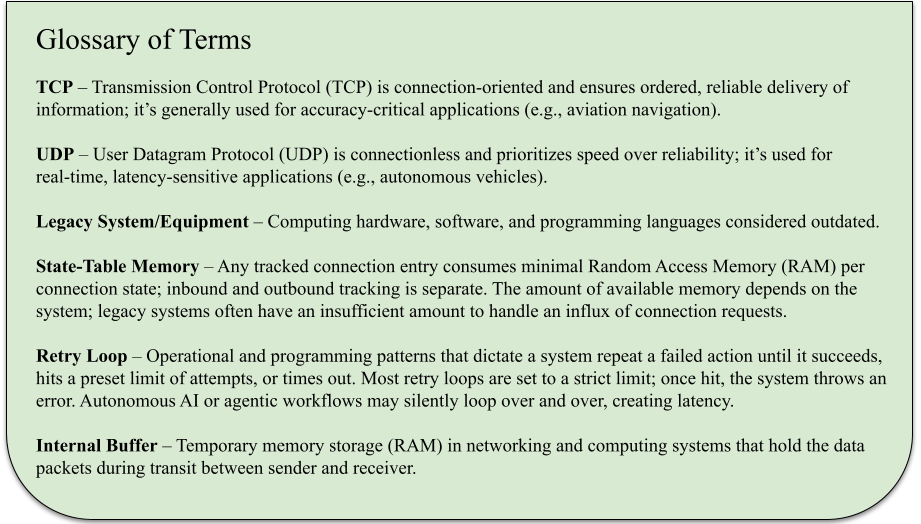
Normally, this isn’t considered an abnormal or network-crashing amount of requests; however, the FAA still runs several legacy systems. The routers in question were 2000s-era Cisco 600-Series with copper infrastructure, which triggered instability in 17 of 22 Air Route Traffic Control Centers.
Copper infrastructure is considered legacy as well, due to distance limits, inability to support multi-gigabit speeds, Electromagnetic interference (EMI), excessive heat and power generation, and security vulnerabilities. Most newer systems use fiber optics for better transmission range, over 10x the bandwidth capacity of copper, immunity to EMI/RFI interference, and overall durability.
Unlike Copper, fiber optics are immune to corrosion, electrical surges, and most forms of interference. It’s more expensive upfront, but it requires less power and maintenance long-term. Repeated connection attempts are hell on legacy device resources. Constant unanswered or open requests dismantle TCP/UDP states, causing legacy state-tracking memory to overflow.
Legacy devices have minimal state-table memory and often don't handle rapid connection churn or retry loops properly. Those limited resources, table capacity, and a lack of internal buffers become easily depleted; constant broadcast communication requests could easily overwhelm a nearly 22-year-old router using copper infrastructure.
The FAA said that none of the upgraded towers that received mods went down, but in the same release, noted that “the disruption was caused by a routine replacement at a remote facility.” Performing maintenance during active hours is uncommon, so why did it need to be replaced at that moment?
Was it legacy equipment or human error? It’s hard to say; what is certain is it wasn’t a cyberattack. The two locations noted in the FAA statement were Amarillo, Texas (a radar site) and El Dorado, Arkansas (a radio communications site) that used the same legacy equipment.

Photo Credit: Rene Rauschenberger / Plane in the sky
Admins resolved it after blocking the two locations and turning off the broadcasting function on 60 applicable legacy and new routers as a precaution. Why turn off broadcasting capabilities on the new routers if the legacy routers were the issue unless there was an incompatibility that was overlooked when the new routers were installed?
Despite some ambiguous and conflicting information in the statement released regarding the incident, all of the approximately 3,500 aircraft in the air at the time of the ground stop landed safely. This was partially due to the experienced staff and the fact that it wasn’t a full outage; safe channels were left open, as noted in the statement:
“The FAA has clear, established, standard procedures to ensure safety during incidents such as this. Throughout the disruption, certain radio frequencies and radar feeds remained operational, allowing air traffic controllers to maintain communication with and track aircraft. Our highly trained air traffic controllers and pilots continued to follow established safety protocols, and we implemented a nationwide ground stop out of an abundance of caution. As a result, every aircraft landed safely, and all passengers arrived safely.”
While all ended well, it seems this could have been avoided. Legacy systems and newer equipment don’t always see eye-to-eye; failing to recognize incompatibilities, performing maintenance during busy hours, and keeping legacy equipment past its prime is a bad idea. Yet hospitals, federal agencies, and many other industries do it.
With all the new cyberattacks happening to government entities and services, it's easy to see how this incident got lumped into that category. It appears to come down to outdated equipment, system incompatibilities, and odd servicing hours.
To add to or correct any information in this report, please contact me at kristin.h@lead4earth.org.
0
0

Comments