(FREMONT, CA.) – Fremont’s city council met on May 19 to receive an update on and discuss the progress made toward the city’s goal to vitalize and expand its downtown.
Preceding the council’s discussion on this topic, which is covered in a separate article, Economic Development Director Donovan Lazaro, Community Development Director Joel Pullen, and Community Service Director Kim Beranek gave a presentation providing background and a status update on this topic.
Kicking off the presentation with some background, Lazaro summarized the events and the city’s key efforts toward developing the downtown area following the Great Recession.
Some of their first major moves included designating 110 acres to be used for downtown in 2012, and another 430 acres in 2016.
Afterward, Lazaro reports that the city spent lots of money purchasing commercial properties.
They also made a new street grid to connect Capitol Avenue to Fremont Boulevard and built new utility infrastructure for their anticipated commercial and residential spaces.
Thanks to these various investments, the city was also able to open an event center in 2021, which has since attracted many people and events to its downtown district.
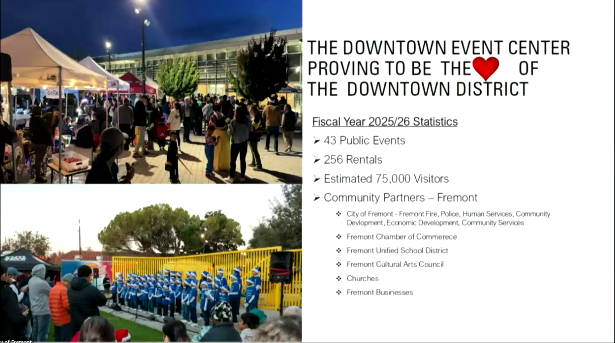
Photo Credit: https://fremontca.viebit.com/watch?hash=0a0o46177ECa6z0w
“The major land use planning efforts and capital expenditures by the city ultimately paved the way for the significant private investment that has followed,” says Lazaro.
As examples of these private investments, he cited two mixed-use residential projects and the construction of the Fremont bank headquarters.
Marking a transition between the past and the present, Lazaro concluded his section by mentioning the 17 new retail spaces that were completed, 16 of which are already leased.
This, he stated, proves that commercial spaces are in demand when they can be built.
Pullen picked up the presentation to relay the current situation regarding the construction of new residential and commercial spaces.
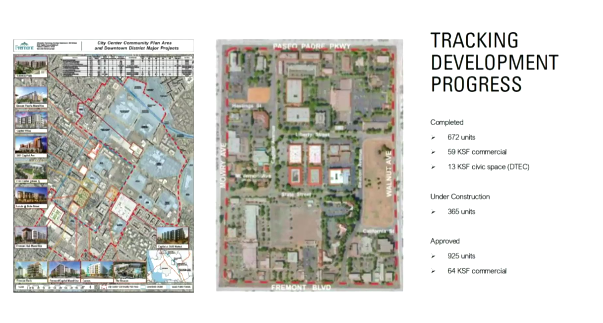
Photo Credit: https://fremontca.viebit.com/watch?hash=0a0o46177ECa6z0w
Pullen reported that there are already 672 residential units completed, with 365 currently under construction, and 975 approved for construction in six upcoming projects.
Those currently under construction include lots of townhouse and affordable housing options.
Manteca, CA. is also looking at significant development projects that would introduce new residential to the area.
On the commercial side, there are 59,000 square feet of commercial space already completed, with 64,000 square feet fully approved for construction in upcoming projects.
Growth can also be seen regarding visitation levels for this area.
Lazaro jumped in to report that Fremont’s downtown has had over 750,000 visitors over the last 12 months. This statistic, he pointed out, does not take into account employees, residents, or cars that were just passing through.
“That number is up 30% year over year, 110% over the last two years, and 240% since 2023.”
On a less positive note, Lazaro next addressed the challenges in the way of fully realizing Fremont’s vision for its downtown.
These include vacant lots that detract from the overall character of the area, and encampments that persist despite increased enforcement.
There are also uncooperative property owners and stalled projects due to high construction costs and state laws that incentivize housing projects above commercial ones.
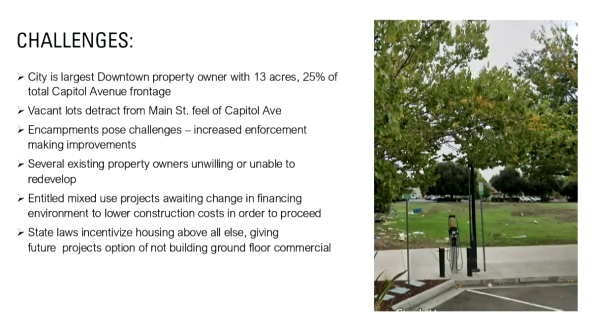
Photo Credit: https://fremontca.viebit.com/watch?hash=0a0o46177ECa6z0w
Some cities, such as San Ramon, CA., deal with greater forms of disagreement in the face of redevelopment. In this case, this disagreement led to a legal dispute.
To conclude the presentation, Lazaro, Pullen, and Beranek shared the existing five-point plan to address each of these challenges.
The most notable of these include the second and third points.
The second heavily emphasized building off of the event center’s current success and expanding the number and scope of events offered in this area.
Hopefully, with help from sponsorships and partnerships, Beranek shared that the city intends to bring in a farmer’s market, popups in vacant lots, and new art exhibits and programs.
The third is meant to both enhance and establish relationships with stakeholders and property owners in order to achieve these goals.
Points one, four, and five serve to improve the downtown environment by addressing complaints, improving property conditions by addressing trash and overgrowth, increasing downtown visibility through aggressive marketing, and maintaining and improving the safety and beauty of the area.
To add or correct any information in this report, please contact me at madison.v@lead4earth.org.
0
0

Comments