(PLEASANTON, CA.) – The topic of debt strikes the Pleasanton city council’s discussion once more.
But this time, instead of deciding to increase their Hotel Tax in order to better their budget deficit, the city council receives an analysis of their options for paying off their debt with California Public Employees' Retirement System (CalPERS).
Vice President of NHA Advisors Mike Meyer is at the city council meeting on Mar. 17 in order to report on this analysis.
As its name suggests, CalPERS provides money for pension and health benefits after retirement to public employees in California. The way it works is that it provides cities in California with most of the money flowing into the pensions of public employees. Cities working with CalPERS must pay a bit into the pensions themselves, although less than the amount given by CalPERS.
This money mostly comes from investment earnings that CalPERS makes, and they discount cities based on the assumption of how much money these investments will return.
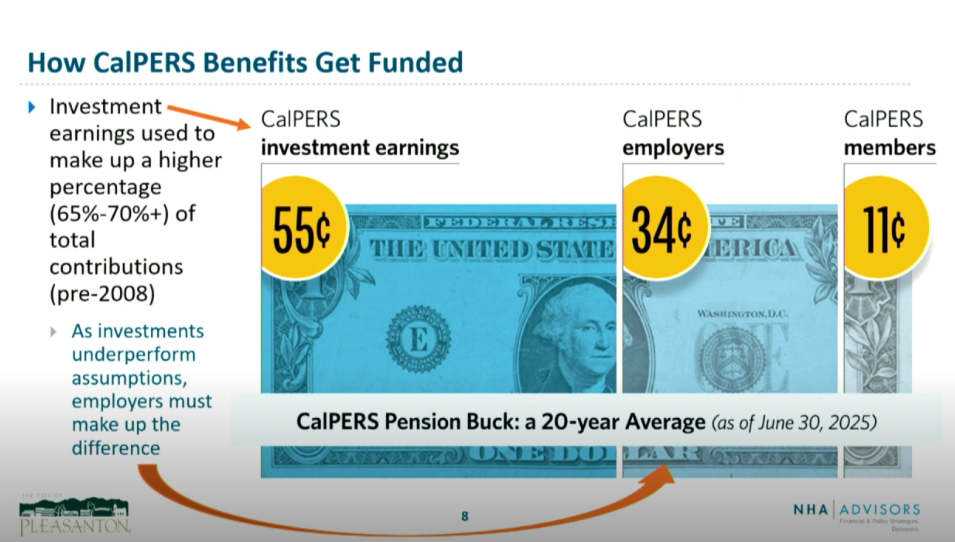
Photo Credit: https://pleasantonca.portal.civicclerk.com/event/603/media
This means that if their investments do poorly one year and do not meet the set assumption, the amount of money they can provide citizens is decreased. Additionally, cities must make up the difference between the set assumption and how much the investments actually returned.
However, CalPERS does not require cities to pay this gap immediately. Instead, the amount cities owe is spread out across 20 years. Each year, a new payment, or layer, can be added to the overall amount a city owes depending on how well CalPERS investments do.
The entirety of what a city owes to CalPERS is referred to as Unfunded Accrued Liability (UAL). Currently, Pleasanton’s UAL is $239 million. Both the funds to pay this UAL and their normal cost is drawn from the city’s general fund.
The graph below demonstrates how much the city must pay CalPERS each year in addition to the regular cost for their services.
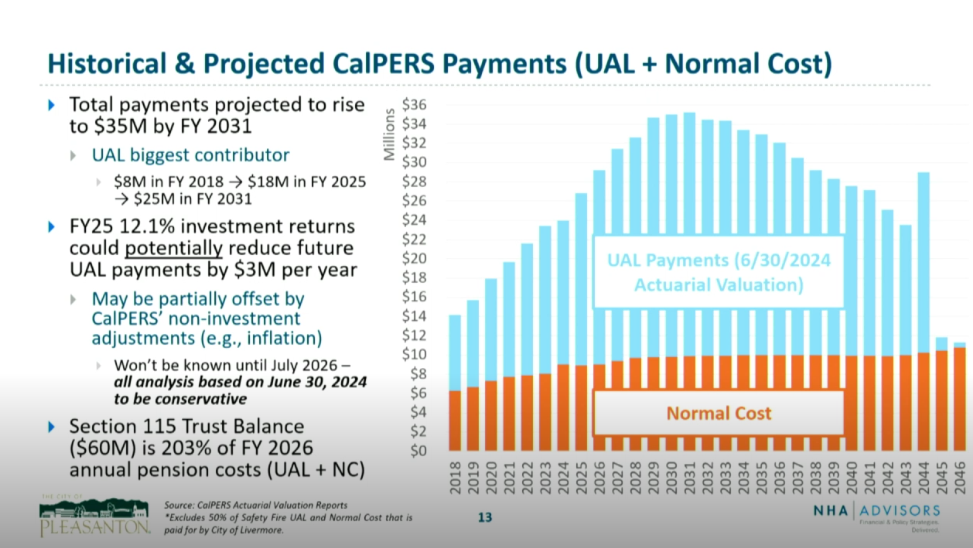
Photo Credit: https://pleasantonca.portal.civicclerk.com/event/603/media
After breaking down the graph and its information, Meyers introduces the plans and analyses his team concocted. Each plan utilizes a different amount of the Section 115 Trust Balance to help smooth the large curve seen in the graph above.
Other cities, such as Auburn, CA. are also dealing with rising pension costs and are turning to their 115 Trusts to help manage them.
"Really the goal with each of these analyses is to withdraw funds from the trust over time so that you can keep the net payment for the general fund at a lower level, a more predictable level,” says Meyers.
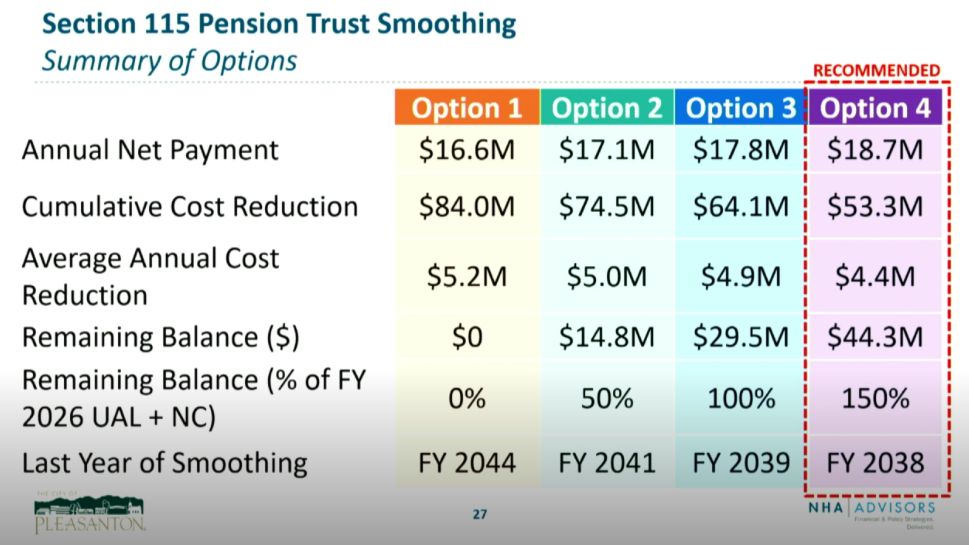
Photo Credit: https://pleasantonca.portal.civicclerk.com/event/603/media
Meyers and his team recommends city staff to pick option four, as it completes its job of making the UAL more manageable while also leaving a lot of the 115 Trust to use in case the UAL increases or as a backup for other things.
Before concluding the presentation, Meyers presents an alternative to option four.
"Once we felt pretty confident in option four, we [asked] ‘Is there a way to get to the same spot by taking a bunch of money right now and sending it to CalPERS and paying off selective pieces of that UAL?’”
Answering his own question, Meyers concludes that this scenario is possible.
If the city sent a large amount of money, also referred to as an Additional Discretionary Payment (ADP), to pay off specific chunks of the UAL, the fund would replenish over time due to interest. It would end up in the same spot it would be without the ADP.
Pursuing this strategy would also, however, restrict the council’s freedom in how they spend the 115 Trust money.
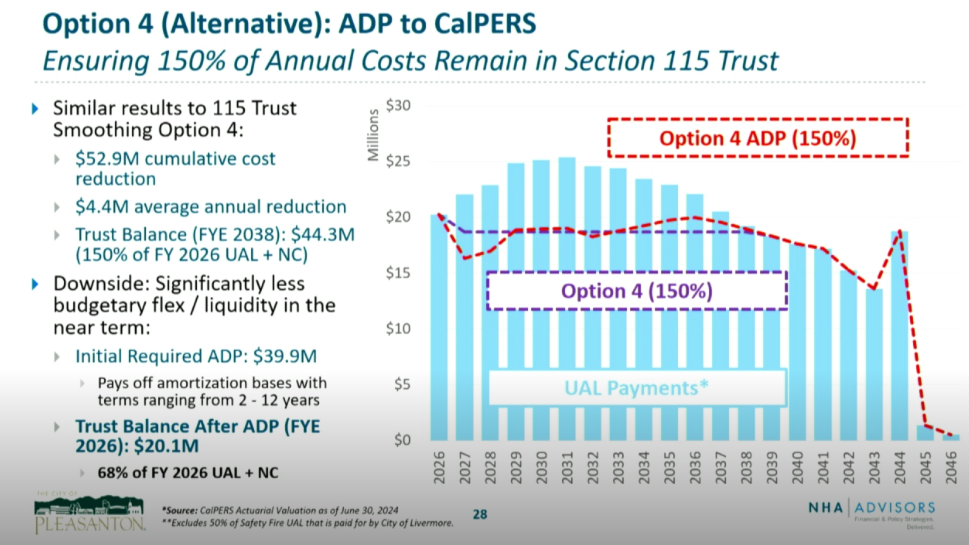
Photo Credit: https://pleasantonca.portal.civicclerk.com/event/603/media
This presentation gives the city council a lot to think about, raising many questions in the meantime.
The city council’s nearly hour and a half long discussion following this report is covered in a separate article that can be found here.
If you have any questions, please email me at madison.v@lead4earth.org or comment below.
0
0

Comments