(PLEASANTON, Calif.) – During their meeting on September 9, Pleasanton’s Planning Commission discussed whether or not to change the zoning of three different properties within Pleasanton.
Assistant Director of Community and Economic Development Derek Farmer kicked off this item with a brief presentation. He opened by stating that, if approved, the zoning of these sites would be changed in order to allow residential development on them.
This commission recently approved a different residential project, but instead of being high-density housing like the three sites presented on September 9, these will be single-family residences.
The properties in question are located at 3825/3875 Hopyard Rd, 4515 Rosewood Drive and 5960 Inglewood Drive. The acreage of all three sites amounts to 35.71 acres.
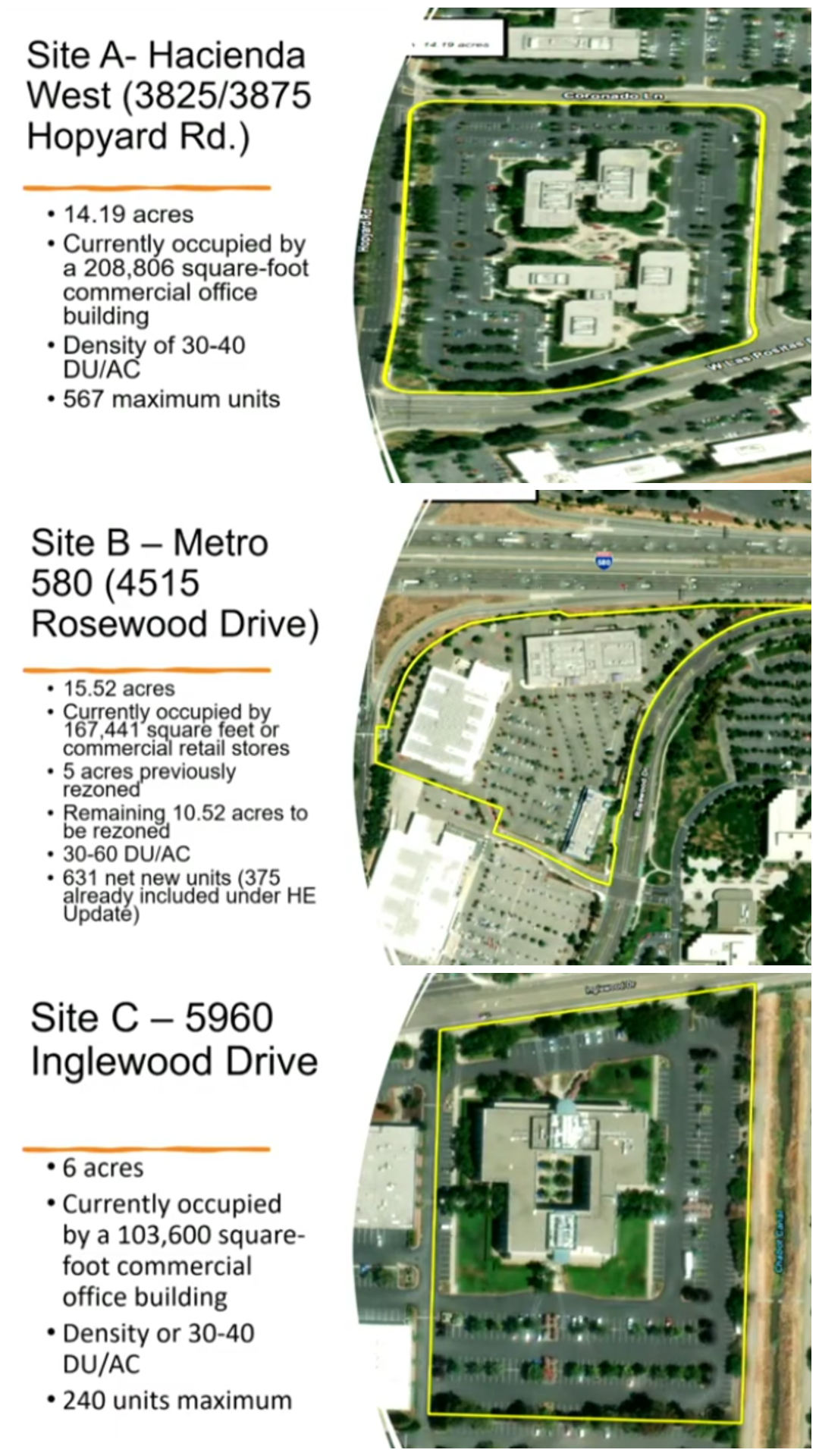
Photo Credit: YouTube / City of Pleasanton Public Meetings
According to Farmer, these sites were chosen as a result of a legal settlement agreement between the City of Pleasanton and the Housing Action Coalition (HAC). Thanks to the commission’s questions, the context behind this agreement was gradually revealed throughout the meeting.
Chair Brandon Pace, for example, eventually mentioned that this entire situation arose when Pleasanton was tasked by the state with designating sites within their city for high-density housing. Once the city came up with these sites, they later received correspondence from the HAC claiming that the sites Pleasanton picked were inadequate. Due to this alleged inadequacy, the HAC threatened to sue unless it was addressed.
Pace expressed his frustration with the HAC and their lawsuit.
“Once again we have someone outside the city who doesn’t understand what the city’s values are, what the priorities are, who has come in and demanded we make a bunch more changes to our city. [...] Almost everyone is frustrated with this impacting their neighborhoods.”
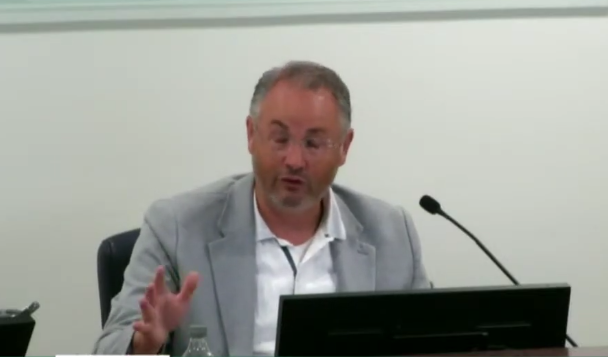
Photo Credit: YouTube / City of Pleasanton Public Meetings / Photo of Chair Brandon Pace
Thus, the city worked out the settlement agreement with HAC in order to avoid the lawsuit and satisfy the state’s requirement of designating sites for high-density housing.
The topic of inadequacy was one of the first to be discussed as Commissioner Ken Morgan began the question portion of the meeting following Farmer’s presentation. Morgan’s question was what the HAC would have wanted Pleasanton to do differently when choosing their sites. To this, city staff responded that the HAC was more concerned with the sites being inadequate rather than the actions of the city of Pleasanton.
Morgan later asked a similar question, wondering if the HAC was suing Pleasanton specifically so the three properties could be considered.
How and why the lawsuit came about occupied much of the time during the meeting. Commissioner Dave Jagoe eventually redirected the conversation, stating that everyone was discussing anything but the three sites, which was what they were there to vote on.
While the other commissioners agreed with this point, they still found purpose in discussing other related topics. Both Commissioner Anurag Jain and Morgan expressed that they would have preferred more public comment on the matter before selecting these three sites.
Jain stressed that he especially believed that asking these questions was necessary to create transparency for the community.
“We don’t have a choice right now. So we can either agree with them or we can vote no and then we get to go through all of this again,” said Jagoe.
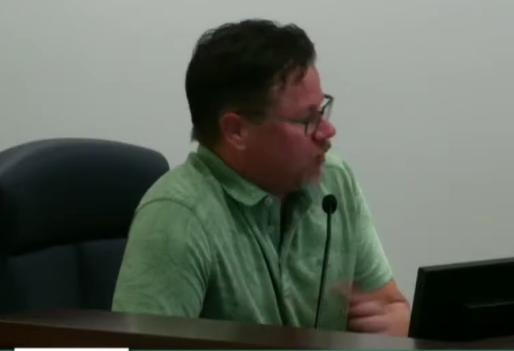
Photo Credit: YouTube / City of Pleasanton Public Meetings / Photo of Dave Jagoe
Pace acknowledged both Jagoe and Jain’s points before directing the commission to begin discussing the three sites specifically. The commission’s general opinion was positive, with none having problems with any of the sites.
Jain, however, made a comment on the process by which these sites were determined. “Just re-zoning a site doesn’t create units. While the city can re-zone things, we don’t build the units. So the actual construction is always with a private party [or] developer.”
This, he explained, is a problem because it means that even though the sites might be re-zoned, it does not guarantee that the housing intended for the site will be built. Jain stated that if no developers come to build on the site, the city would not have the funding to put the zoning change to use and begin construction.
“This whole process is just flawed,” he stated.
OpGov.News reached out to the city to gain more insight into the opinions of Jain and the other commissioners. This article will be updated as more information becomes available.
With no problems to discuss, the commission moved on to voting.
The motion to change the zoning on the three properties was passed unanimously. The commission also unanimously passed a second motion that intended to encourage the city council to discuss whether or not to include these sites in the city’s 7th housing cycle.
To add or correct any information in this report, please contact me at madison.v@lead4earth.org.
0
0

Comments