(PLEASANTON, CA.) – Pleasanton’s City Council meeting on July 27 lasted for over six hours.
Occupying around half of the meeting was the topic of a 189-home residential project called Arroyo Lago.
The point of their discussion during this meeting was to decide whether to pass documents necessary for its advancement, such as an environmental review. More importantly, the council had to decide whether to accept the Pre-Annexation and Development Agreement.
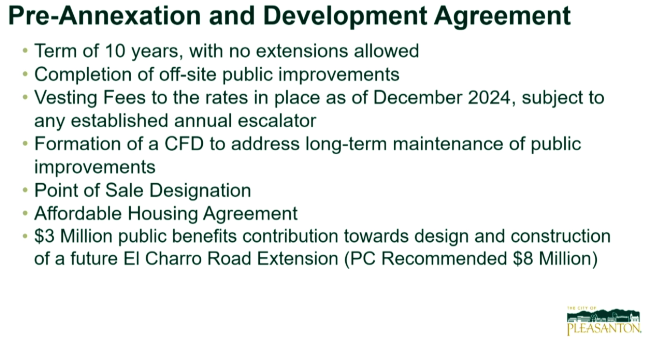
Photo Credit: https://pleasantonca.portal.civicclerk.com/event/811/media
Arroyo Lago’s site is currently controlled by Alameda County. If the development agreement is accepted, it would then be closer to being a part of Pleasanton instead of the County.
This is what is referred to as annexation throughout the meeting.
If the city decides to block Arroyo Lago’s annexation, the developers would simply complete the project through the county, as they already approved the project. This alternative is not ideal, though, because the annexation of Arroyo Lago entails benefits for both the developer and the city.
For the developer, the project would be connected to Pleasanton’s sewage, garbage disposal, and other utilities. The city, on the other hand, would receive property taxes and a $3 million contribution toward the extension of El Charro Road.
Kicking off this three-hour-long section of the meeting was a brief presentation that included the project’s history.
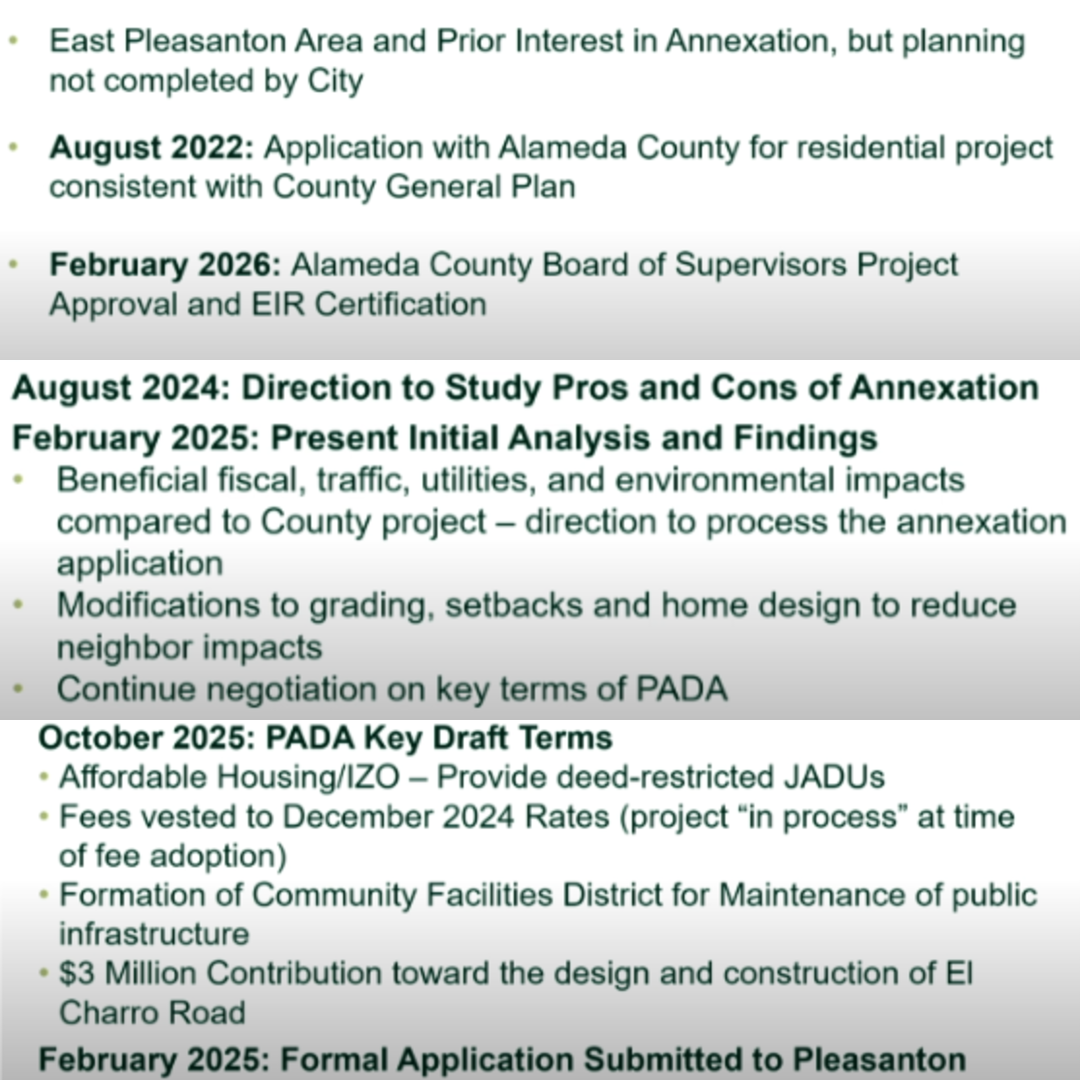
Photo Credit: https://pleasantonca.portal.civicclerk.com/event/811/media
Following the presentation, the council began to ask clarifying questions.
Up first was Councilmember Jeff Nibert, who referenced the pending agreement between the Zone 7 Water Agency and the project developers.
This agreement would allow Arroyo Lago to connect to Zone 7’s water utilities. These include drains, drinking water, and more.
What Nibert was concerned about was what happens if this agreement does not go through by March 31, 2027.
Previously, the council was provided with a Plan B that addressed the above possibility. They would also later vote on whether or not to accept this plan.
Nibert expressed concern that if the developers had to fall back on this Plan B, it would cause problems with the original plan.
City Engineer Michael Stella said that if Plan B had to be enacted, it would not affect the council’s favored aspects of the project.
Mayor Jack Balch later summed up Plan B as a way to make sure the project does not stray from its original design if the agreement fails.
Council member Julie Testa was also concerned about this, and asked staff why the council is being asked to approve a project with uncertain water utility plans.
Staff answered that they were attempting to provide the council with other options. They also expressed that the council can wait, but that the project was already approved by Alameda County, and the developers could choose to go through them instead.
Testa had stronger concerns regarding the developer’s contribution of $3 million toward the extension of El Charro Road. Due to the development of many residential projects located in Pleasanton, Pleasanton’s roads have a higher potential to become overcrowded. The extension of El Charro is meant to alleviate some of this pressure.
Unfortunately, Pleasanton lacks the funding to make this happen, and so they are turning to developers to contribute at least $8 million each to the road.
Testa expressed repeatedly that the developers of Arroyo Lago should be contributing their “fair share” of $8 million instead of $3 million.
“Should we be approving projects that can't pay their fair share that [will end up] going to future taxpayers?”
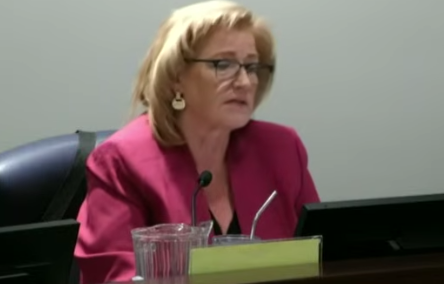
Photo Credit: https://pleasantonca.portal.civicclerk.com/event/811/media
Though her stance is in support of the public by speeding up the extension of El Charro and preventing the costs from falling on residents, multiple council members expressed that the developer could just take the project to the County.
In this case, Pleasanton receives no money and no benefits at all. The developer himself also asserted that his $3 million contribution would not be changing.
“Despite all the continued indecision of this city over the years, we're going to stick to the deal that we committed to last October, and we're hoping that you do the same. We're not taking money off the table. We're committed to it.”
In the end, the environmental review and the Development Agreement minus the $3 million dollar contribution were passed unanimously.
The contribution was instead passed three to two in a separate motion, with Testa and Nibert dissenting.
To add or correct any information in this report, please contact me at madison.v@lead4earth.org.
0
0

Comments