Photo Credit: Madison Vinas
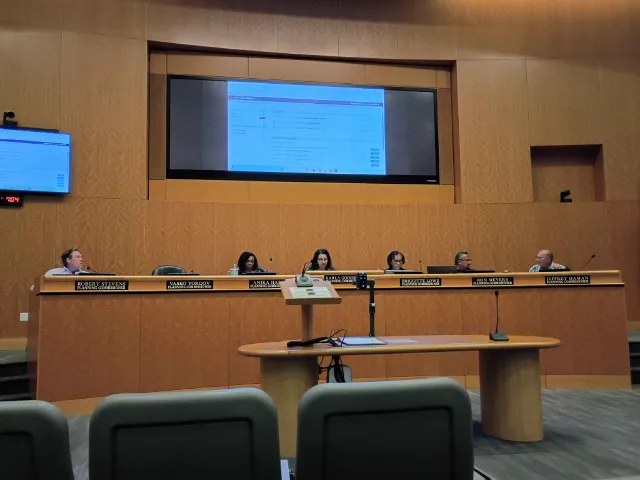
(HAYWARD, CA.) – A project for a new mental health rehabilitation facility hit Hayward’s planning commission on August 27.
Presented by Associate Planner Taylor Richard, the commission first received a presentation on a project
located at 3788 Depot Rd. The site consists of two separate plots of land divided unevenly by Whitesell Street and amounts to 0.97 acres.
About 0.7 of these acres will be occupied by utilities, but the rest will contain a three-story building with offices, programming rooms, 83 patient beds and indoor open spaces such as activity and gathering areas.
This three-story building would be located on the Eastern portion of the property and would also be surrounded by a 14-foot-tall decorative fence.
After mentioning this, Richard commented that a fence of such height is normal in the area the project is located due to surrounding structures having industrial uses.
Adding up to 23 parking spaces in total, there would be three parking spaces with the three-story building and 20 more spaces located on the western portion of the property.
With this information, the commission was tasked with deciding whether or not to accept the zoning variations found below.
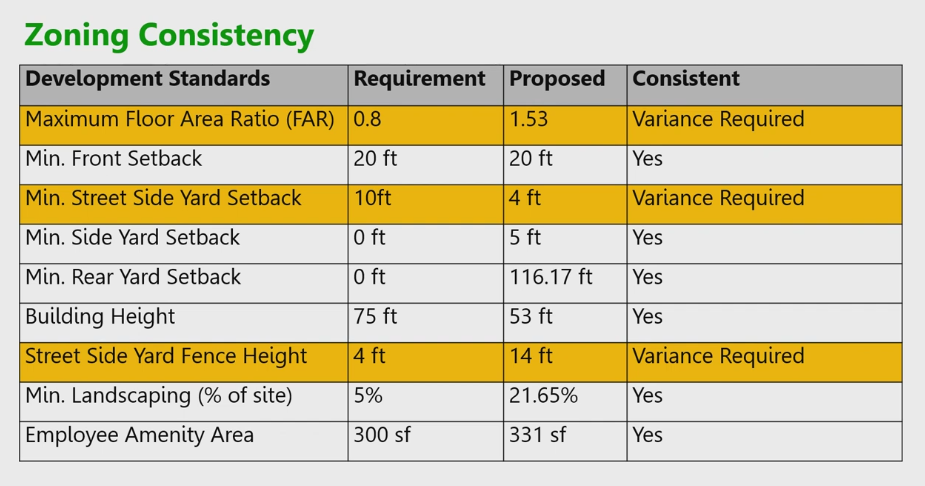
Photo Credit: City of Hayward / YouTube
After sharing this list, Richard commented that the project is otherwise fully consistent with both Hayward’s general and land use plans. With this final detail, Richard expressed that staff’s recommendation is to accept these variations and move forward with the project.
Before the matter was passed to the council, CEO of Bay Area Community Services (BACS) and applicant Jamie Almanza took some time to introduce herself during public comment.
“My name is Jamie Almanza. I'm the CEO of Bay Area Community Services and its development corporation. We are incorporated as 501c3 not-for-profit organizations. We have [been] serving our great city of Hayward since 1981. We have a total of 15 programs and projects throughout the city of Hayward [and] in unincorporated Hayward as an organization.”
Following her introduction, the commission was able to ask questions.
The major concerns the commission had regarded security and the fence surrounding the three-story building.
The first to bring these up was the first speaker, Commissioner Ron Meyers. He inquired about both why the fence was so tall and how the concept of security related to the building being a mental health rehabilitation facility.
Richard answered the first inquiry, reiterating her earlier point that many structures in the area have similarly tall fences.
The second question, however, was answered by Almanza, who explained that security meant two things in relation to the mental health facility. These are primarily the security of the community at large, or those outside the facility, and security for the employees and patients within the facility.
Commissioner Jeffrey Haman had similar concerns regarding security, inquiring what security measures specifically will be in place. According to Almanza, these are some of the security measures the facility will have in place:
All residents will be evaluated before admission according to California law
Residents cannot leave the site at any time, and all entrances and exits will be controlled
Many design elements follow standards similar to those found in a hospital
She also mentioned that the fence was “overdesigned” with patient and community safety in mind.
Commissioner Briggitte Lowe was curious as to what this meant.
Architect Lilian Mitchel explained that the fence had a dual purpose, one being safety with its height and anti-climb features and the other being recovery with its bright and therapeutic designs.
The commission also had general questions regarding the community’s feelings about the project. To these they were assured that the community felt positively about the project and that the applicant was working to make sure all of their concerns were addressed.
After all of their questions were answered, the comment and voting portion of the item commenced.
There were very few comments, but Commissioner Robert Stevens decided to hint at at a matter that recently sparked an angry reaction from the community.
“First off, I'm sort of depressed because this land use would have fit a nice data center, a nice 25 or 30 megawatt data center. That would have been great.”
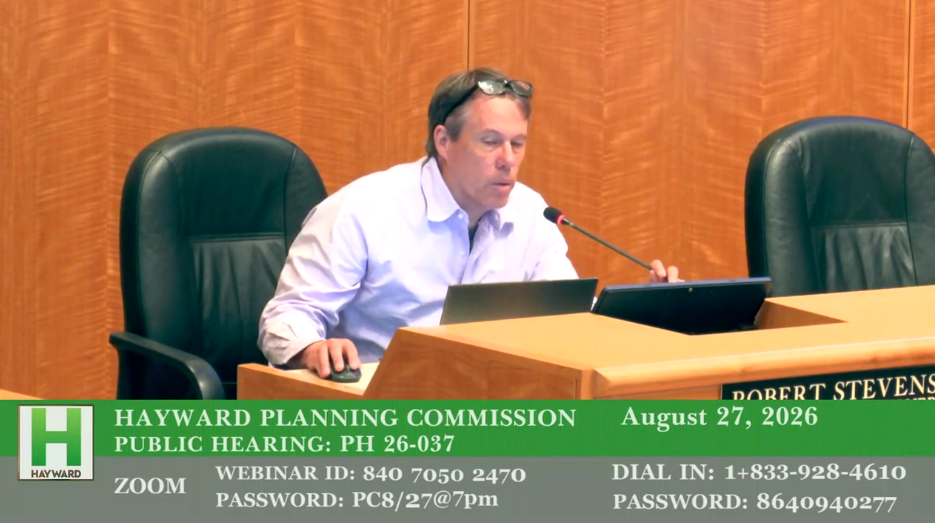
Photo Credit: City of Hayward / YouTube
Following this comment, he applauded the architect, before voting on whether or not to accept the project’s variations was initiated. This motion was passed unanimously with no further discussion.
OpGov.News was able to get in touch with Almanza after the meeting and inquired where exactly this facility's patients would be coming from.
To this, Almanza explained that all admissions to the facility would be submitted to, reviewed by, and denied or accepted by Alameda County.
To add or correct any information in this report, please contact me at madison.v@lead4earth.org or leave a comment below with your thoughts.
0
0

Comments