(CHARLOTTE, NC.) – The Metropolitan Transit Commission held its final meeting on May 27, formally approving a fare modernization policy and reviewing Charlotte Area Transit System (CATS) operational performance data as governance responsibilities prepare to transfer to the Metropolitan Public Transportation Authority (MPTA).
The meeting marked the dissolution of the commission’s oversight structure, with remaining administrative functions transitioning to the newly formed authority.
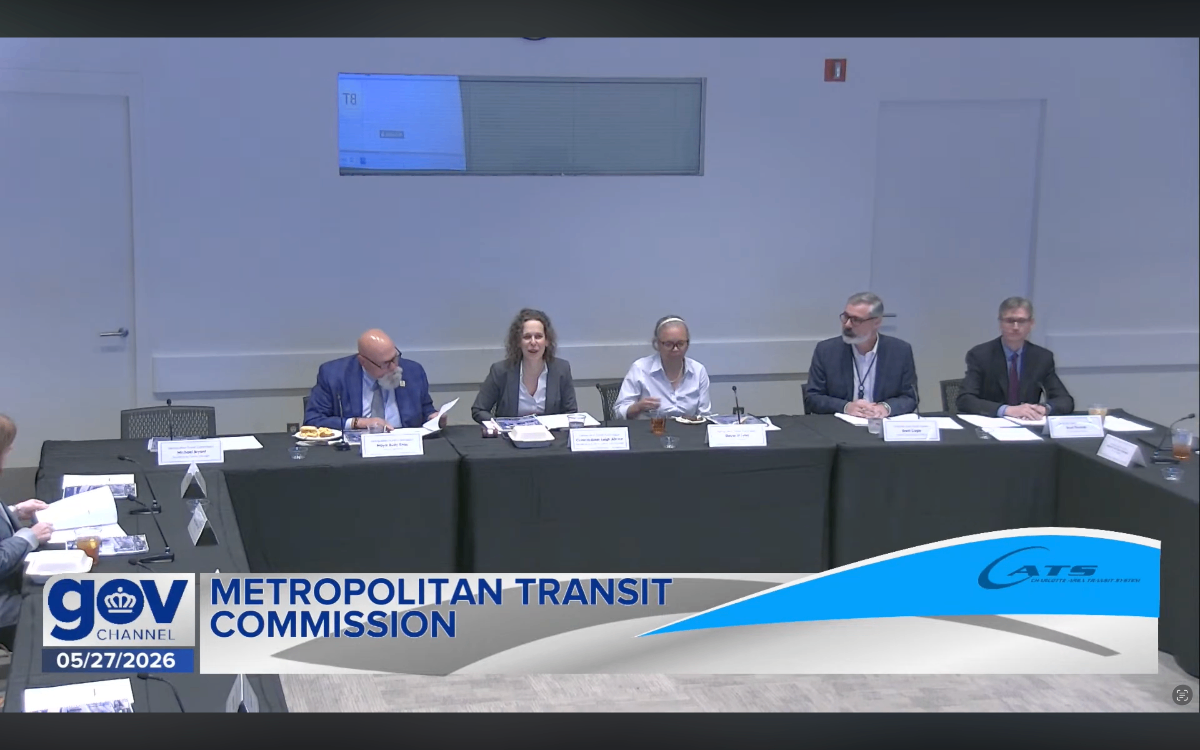
Commissioners and regional stakeholders gather for the final oversight session before administrative functions officially transfer to the new Metropolitan Public Transportation Authority.
Photo Credit: City of Charlotte/YouTube
Commissioners also approved the integration of the Public Transit Advisory Committee (PTAC) into the MPTA framework to preserve a formal public input channel under the new governance system.
Much of the meeting focused on system performance reporting from CATS, which showed uneven ridership trends across service modes.
Microtransit recorded a 156% increase in ridership, while express routes rose 6%. Local bus ridership declined 2.2%, and the LYNX Blue Line saw a 9.3% decrease attributed to construction-related disruptions impacting reliability and travel times.
These ridership patterns align with federal transit reporting frameworks maintained through the National Transit Database, administered by the Federal Transit Administration, which tracks monthly and annual ridership performance across U.S. transit agencies. The dataset is commonly used to benchmark shifts in bus and rail usage during infrastructure disruptions and service changes.
Blue Line on-time performance was reported at 81.29% for the month, reflecting continued operational impacts tied to construction along the corridor.
The operational report also included multiple safety incidents from April, including a pedestrian fatality on the rail system, several bus collisions, a pedestrian collision involving a bus, and an onboard altercation. The incidents were included as part of the monthly system report presented to commissioners, with no immediate policy action taken in response during the meeting.
Transit safety and national performance comparisons are typically tracked through federal transportation datasets compiled by the U.S. Department of Transportation’s Bureau of Transportation Statistics, which aggregates modal safety trends and infrastructure performance across metropolitan systems.
The meeting also included approval of a fare modernization policy aimed at expanding digital payment options, introducing electronic two-hour passes, simplifying fare categories, and broadening fare-capping systems across the transit network.
Transit staff said the changes are intended to streamline fare collection and reduce system complexity for riders.
Public engagement feedback was described as generally supportive, and a Title VI equity analysis found that no mitigation measures were required.
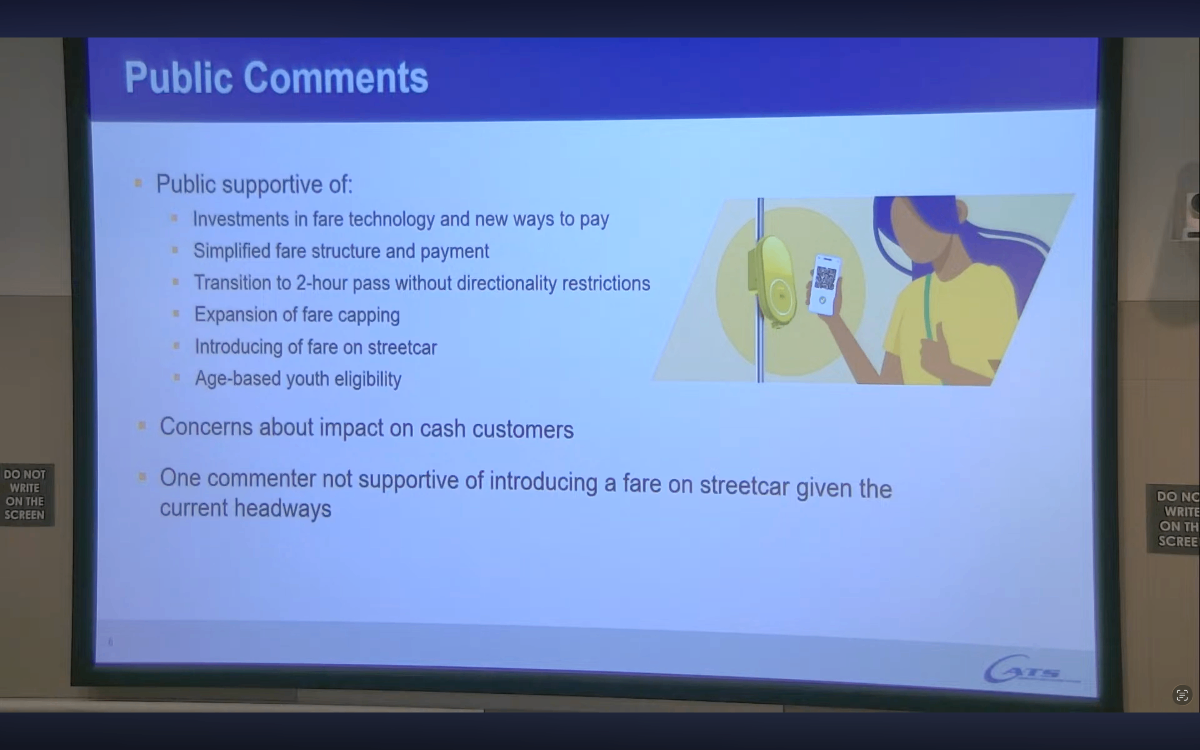
A presentation slide details public feedback on the fare modernization policy, highlighting general support for digital payment upgrades alongside concerns regarding cash access.
Photo Credit: City of Charlotte/YouTube
Prior public input included concerns about continued access for riders who rely on cash-based payment systems.
The session occurred alongside broader infrastructure and governance transitions seen across other jurisdictions, including Charlotte Douglas Airport’s ongoing operational restructuring under a renewed lease agreement with American Airlines, as reported in “CLT Lease Deal Extended between American Airlines and Charlotte Douglas Airport.”
Commissioners also received an update on emergency preparedness planning, including a full-scale exercise scheduled for June 6 at the Charlotte Transportation Center. The drill will simulate a terrorist-related scenario and involve coordination between the Transportation Security Administration (TSA), Charlotte-Mecklenburg Police Department, Charlotte Fire Department, and additional regional partners.
Public comment during the meeting included continued advocacy for proposed Red Line commuter rail stations at West Craighead Road and North Graham Street.
Representatives from community organizations, including the Hidden Valley Community Association and Sustain Charlotte, reiterated support for the stations, citing mobility access, economic development potential, and improved connectivity to jobs, education, and health care.
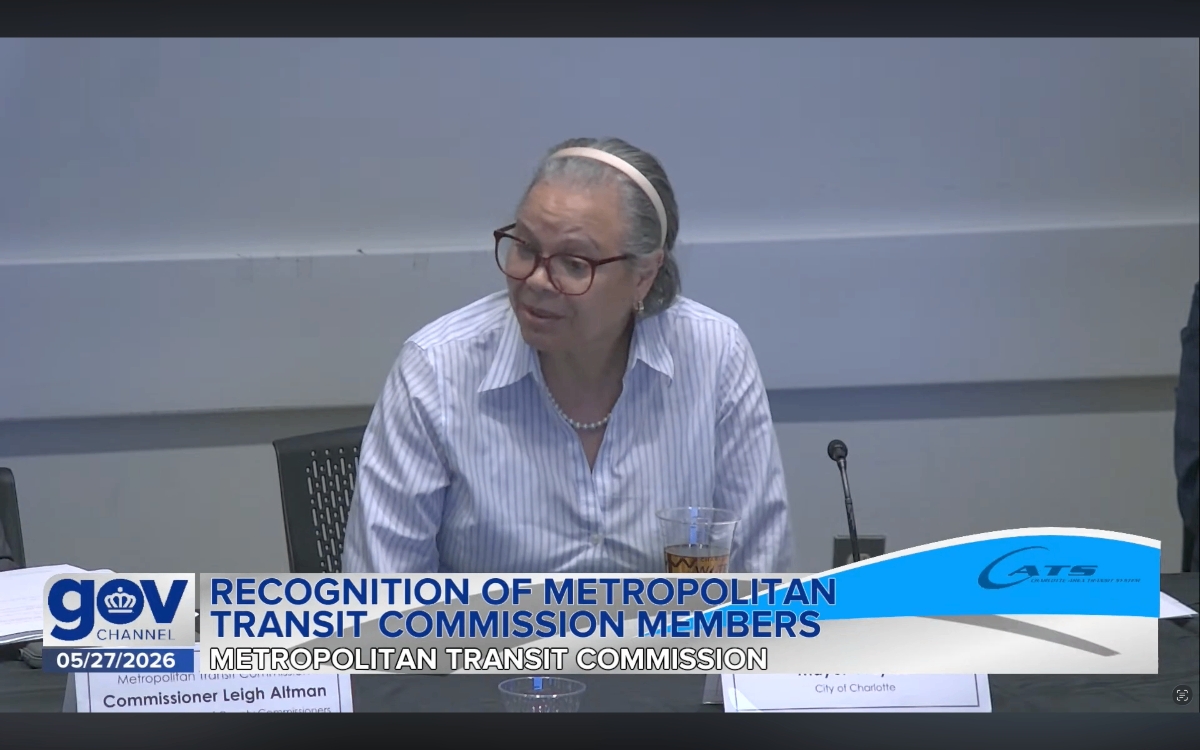
Charlotte Mayor Vi Lyles addresses the board during a formal recognition of the Metropolitan Transit Commission members as leadership reflects on the historic final session ahead of its dissolution.
Photo Credit: City of Charlotte/YouTube
The discussion reflected broader infrastructure debates occurring in other jurisdictions, including Escambia County, where a data center planning meeting drew scrutiny over procedural transparency and public engagement, as reported in “Data Center Meeting No Quorum, No Comment” by Pepper Mc’Quiffins .
The May 27 meeting concluded with remarks from commissioners and transit leadership reflecting on the final session of the MTC before its formal dissolution. Officials noted the transition to the MPTA as the next phase of regional transit governance.
As the commission adjourned, administrative authority formally transitioned to the new structure, closing out the Metropolitan Transit Commission’s role in overseeing Charlotte-area transit operations.
To add to or correct any information in this report, please contact me at victoria.o@lead4earth.org.
Thumbnail Photo Credit: City of Charlotte/YouTube
0
0

Comments