(CHARLOTTE, NC.) – The Metropolitan Public Transportation Authority (MPTA) board approved key measures to support its transition into an independent transit agency during its July 8 meeting, authorizing technology transition contracts, adopting its fiscal year 2027 service changes, and approving an updated Title VI Program.
Trustees also debated transparency, equity, and long-term transit planning.
The approvals move the authority closer to its Jan. 1, 2027, transition from Charlotte Area Transit System governance to an independent regional agency. While most agenda items passed, several trustees questioned financial oversight, public accessibility to committee meetings, and how major decisions are communicated before reaching the full board.
One of the meeting's most significant actions authorized Interim Chief Executive Officer Brent Kaggel to execute technology transition contracts needed to establish independent information technology and operational systems before the transition deadline.
Several trustees requested more detailed financial reporting for future contract approvals, asking staff to provide clearer budget information as implementation continues. Staff said the contracts are necessary to ensure the authority is fully operational by the beginning of 2027.
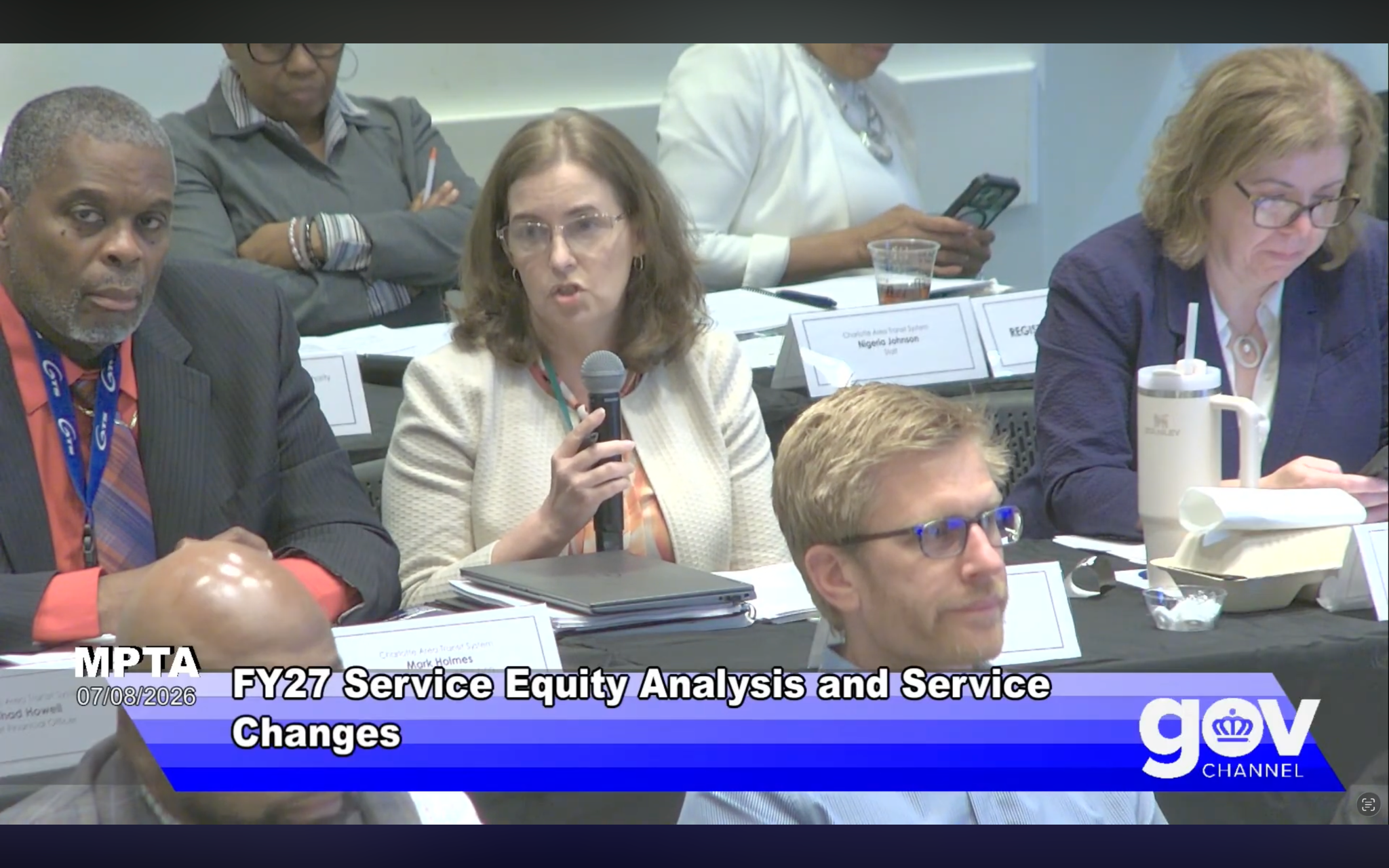
Staff presenters brief the MPTA trustees on the upcoming FY27 Service Equity Analysis and proposed transit service changes.
Photo Credit: City of Charlotte/YouTube
The board also unanimously approved an updated Title VI Program, a federal requirement for agencies receiving Federal Transit Administration funding. Trustees requested that the policy be reviewed annually as the authority's governance structure continues to evolve.
Public comment focused largely on the board's previous decision to implement fares on the Gold Line streetcar. Speaker Carson Con urged trustees to reconsider the policy, arguing the fares would disproportionately affect residents experiencing homelessness and low-income riders.
"The Gold Line fare modernization plan is an attack on the city's poor," Con said.
Con questioned whether the projected revenue generated from fares justified the financial burden on vulnerable riders and announced plans to pursue a petition seeking another board vote.
Trustee T. Anthony Lindsay also requested that written comments submitted by Manifa Drayton be entered into the official meeting record.
The board later approved the FY27 Service Equity Analysis and accompanying service changes following discussion about the Gold Line fare policy, microtransit connections, and the discontinuation of Rock Hill service after an interlocal agreement was not renewed.
The debate over equitable access sparked wider discussions among board observers regarding how modern infrastructure aligns with community zoning.
For instance, adjacent policy discussions have increasingly leaned on expanding Accessory Dwelling Units (ADUs) to curb displacement near major transit corridors.
In recent municipal workshops highlighted in the report “Affordable Housing Committee All About Accessory Dwelling Units,” written by Angela Underwood, local boards have gone "all out" on promoting ADUs. Leaders are actively pushing to get the word out to homeowners, viewing these secondary structures as a crucial, low-impact tool to expand affordable housing stock near developing transit hubs.
Planning decisions also generated intense discussion during committee reports. The Planning and Capital Committee voted 7-0, with two recusals, to continue refining the Red Line commuter rail project's Locally Preferred Alternative and voted 7-1, with one recusal, to recommend adding the Camp North End station.
A proposal to include a Craighead station, however, failed on a 4-5 committee vote despite public support from neighborhood advocates who argued the station would improve accessibility and encourage future development.
This friction between massive infrastructure expansion and neighborhood growing pains isn't unique to local rail lines. Large-scale residential developments meant to satisfy regional housing needs are seeing similar resistance from residents worried about rapid transformation.
The MPTA's July 8 regular meeting marks a critical milestone as the authority prepares to fully transition to an independent regional agency by January 1, 2027.
Photo Credit: City of Charlotte/YouTube
A parallel challenge in regional growth is unfolding as private developers push for denser, transit-adjacent communities. As detailed in “Lennar Partners with Sunset Development for 255-Home Project in San Ramon,” written by Kathleen Parra, a major 255-home neighborhood project is moving forward. However, the sudden influx of high-density housing is facing intense pushback from concerned residents who worry about local infrastructure capacity and shifting neighborhood aesthetics.
Throughout the meeting, trustees repeatedly returned to concerns about transparency. Board members discussed the lack of livestreaming for committee meetings and delays in distributing meeting materials before votes. Staff agreed to evaluate options for improving public access and providing agenda packets earlier so residents and trustees have additional time to review materials.
Transit operations staff also briefed the board on a July 3 incident involving a disabled Gold Line streetcar that temporarily disrupted Blue Line service.
Trustees requested additional information about passenger notifications during service interruptions, particularly during periods of extreme heat, and asked staff to evaluate equipment reliability moving forward.
As part of the authority's transition planning, staff outlined a phased hiring strategy that includes filling more than 35 critical positions while relying on managed service providers for information technology, finance, and human resources during the startup period.
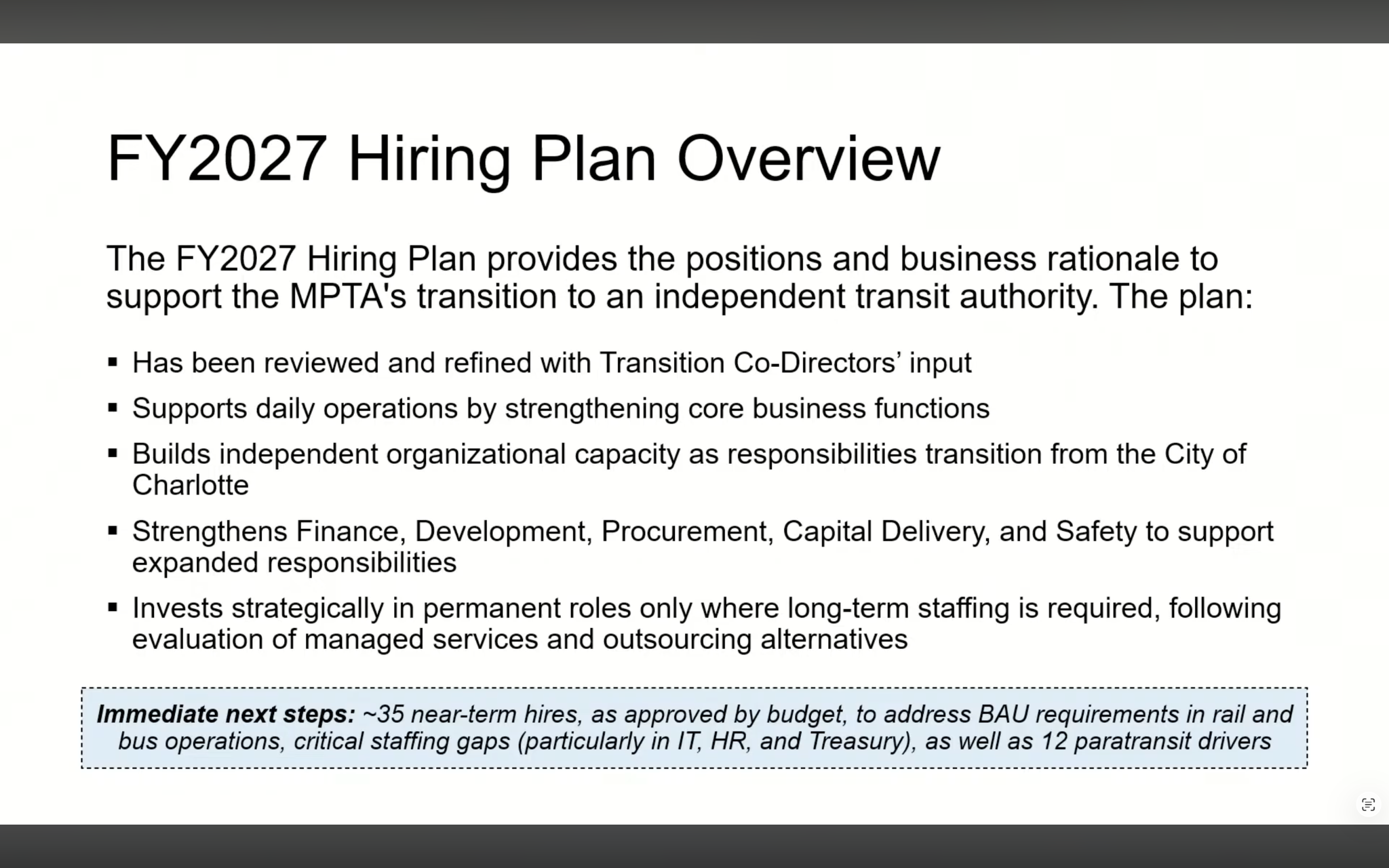
The proposed FY2027 Hiring Plan outlines a phased strategy to fill roughly 35 near-term positions to build independent organizational capacity before the 2027 deadline.
Photo Credit: City of Charlotte/YouTube
Trustees also reviewed the timeline for hiring MPTA's first permanent chief executive officer, with stakeholder outreach and executive committee interviews expected to continue before finalists are presented to the full board later this fall. Presenters noted that the recruitment process is multifaceted, focusing heavily on finding the right cultural and operational fit for the evolving organization.
"But also part of the hiring process is to look at what the Board needs," an unnamed staff presenter explained during the recruitment briefing.
The meeting concluded with several trustees requesting a formal process for tracking board follow-up items and establishing clearer procedures for MPTA's representation on the Charlotte Regional Transportation Planning Organization board.
As the authority prepares to become fully independent next year, the July 8 meeting reflected both the operational milestones still ahead and the broader discussions surrounding governance, public accountability, and the future of transit service throughout the region.
To add to or correct any information in this report, please contact me at victoria.o@lead4earth.org.
Thumbnail Photo Credit: City of Charlotte/YouTube
0
0

Comments