(FREMONT, CA.) – On Mar. 30, Fremont’s recently created Charter Advisory Committee meets for the second time.
Led by Assistant City Manager Christina Briggs and City Attorney Rafael Alvarado, the meeting begins with a brief recap of the committee’s first meeting and the committee receives a presentation detailing different city governance models and numerous public comments.
Reiterating the main idea of their first meeting, Briggs explains that the purpose of this committee and their meetings are to review data gathered by city staff.
The committee members will go on to discuss and question the provided data, eventually making a recommendation to the city council regarding whether or not Fremont should become a charter city.
Given primarily by Briggs, the presentation further summarizes the committee’s first meeting on Mar. 23.
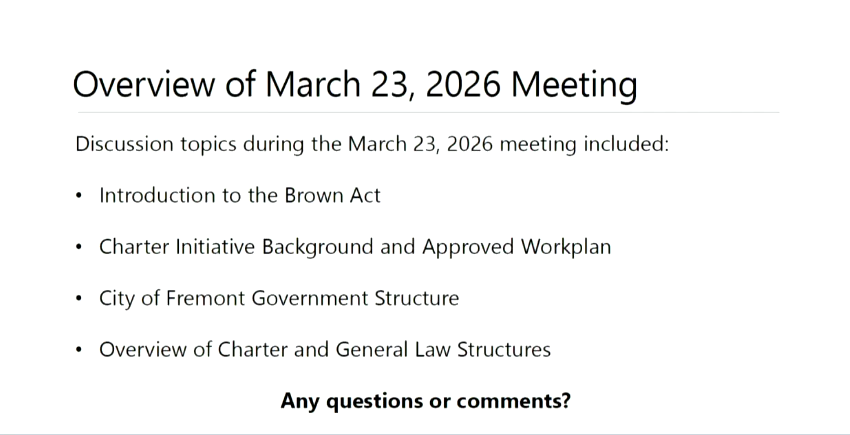
Photo Credit: https://fremontca.viebit.com/watch?hash=lts4wTki9IjKDZl0
It also details three main types of governance models: Mayor-Council, Strong Mayor and Council-Manager.
Sacramento, CA., a charter city operating under the Council-Manager structure, recently experienced a realignment of its fire district into three new structures reminiscent of this division of labor.
In a Council-Manager government, the city council sets policies and appoints a city manager to execute them. The city manager also sometimes appoints other city officials like the city attorney and clerk.
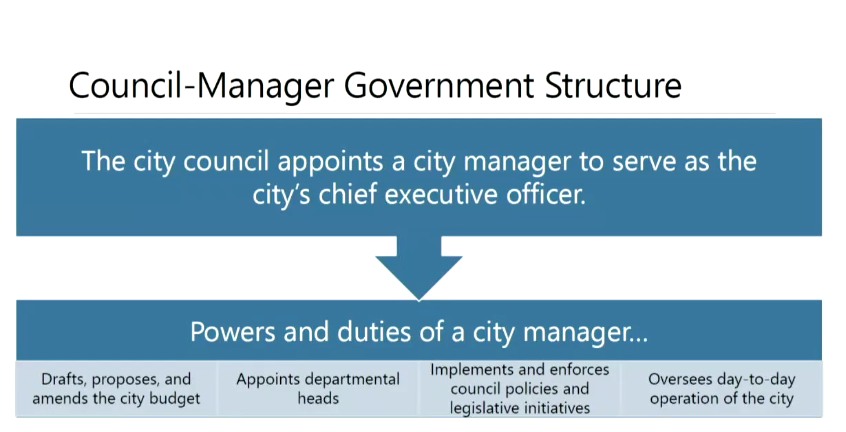
Photo Credit: https://fremontca.viebit.com/watch?hash=lts4wTki9IjKDZl0
Briggs expands on an analogy previously made by Alvarado regarding the flow of power in this structure.
“So as Rafael indicated, the city council appoints the city manager to serve as the city’s CEO. [...] If we’re using that analogy, the city council functions as the board of directors.”
The most common type of government, one of its strengths includes that the role of city manager is nonpolitical and non-partisan, meaning it acts as a buffer between set policies and how they are actually put into action.
In a Strong Mayor government, the mayor has the most political and administrative authority.
They can hire a city administrator, many department heads, present a budget to the city council, and sometimes have the power to veto city council legislation.
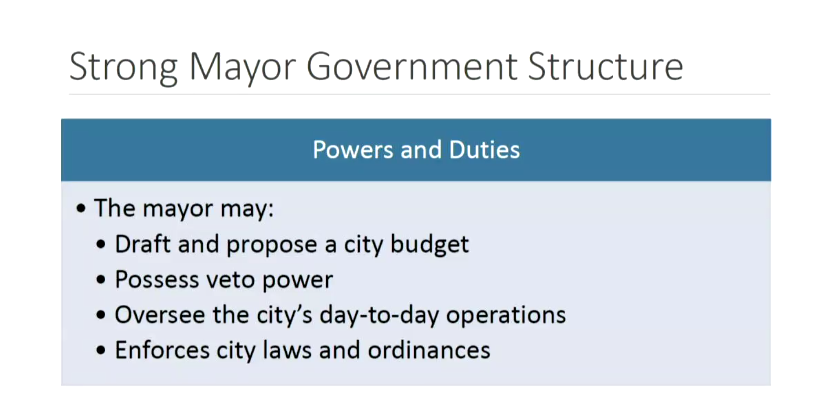
Photo Credit: https://fremontca.viebit.com/watch?hash=lts4wTki9IjKDZl0
This form of government often advocates for a strong executive branch of government.
Unlike the Council-Manager structure, however, it is much more prone to partisanship or corruption influencing the city’s business.
San Francisco, CA., a city operating under this government structure, recently had a lengthy discussion regarding an amendment that would prevent elected officials from running again after the end of their term.
In a Mayor-Council government structure, the powers given to the city manager and the mayor above are split more evenly between the mayor and the city council.
While the mayor still holds much power in appointing city staff, these appointments must be confirmed by the city council.
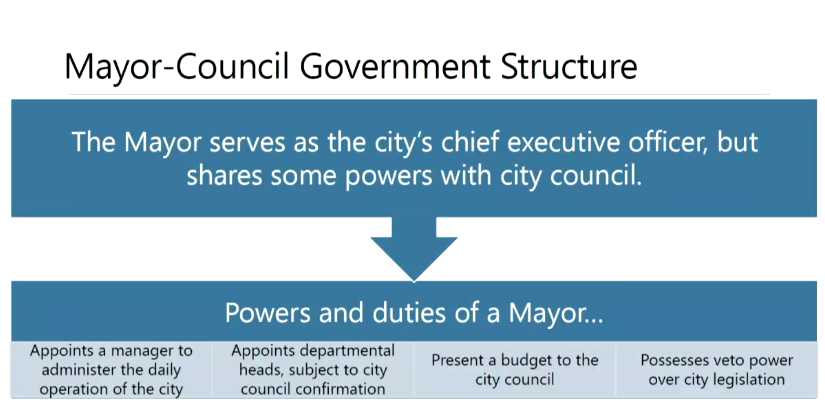
Photo Credit: https://fremontca.viebit.com/watch?hash=lts4wTki9IjKDZl0
In addition to these three main types of structures, there are some charter cities that deviate from these.
Though the term has no real legal definition, these government structures are typically referred to as “hybrid” structures.
Revealed later during the committee discussion period of the meeting, the information in the presentation is meant to show the committee the different options they have if they wish to change their form of government.
Briggs also explains to the committee what changes to the city government would or would not require Fremont to become a charter city.
“[The] council does not need to adopt the charter in order to change its appointment [of city staff] structure. If you want to change the form of government completely [...] then you’ll need a charter because that is [beyond] the scope of [state] law.”
This discussion period is very loosely guided by staff, some committee members asking clarifying questions and others simply sharing their ideas for consideration.
Committee member Ben Yee, for example, stresses the need for transparency when communicating city government hiring processes to residents.
He explains that many residents believe Fremont follows the Strong Mayor structure instead of their actual Council-Manager status.
With not much left to discuss, the discussion ends well past the projected ending time of the meeting.
The meeting does not end, however, before numerous public comment regarding Fremont residents’ feelings about the city’s sudden consideration of becoming a charter city.
Covered in a separate article, resident feelings range from neutral, to skeptical, to negative.
If you have any questions, please email me at madison.v@lead4earth.org or comment below.
0
0

Comments