(CHARLOTTE, N.C.) — At this week’s Charlotte City Council meeting, members engaged in hours of debate across transportation, housing, and economic policy, exposing growing concerns about equity, accountability, and the clarity of city decision-making.
While staff presented detailed proposals on transit funding, street vending regulations, and affordable housing investments, council members repeatedly challenged how those plans were developed—and who ultimately benefits.
Transit debate raises equity and funding concerns
Discussion of the Charlotte Area Transit System (CATS) FY 2027 Budget Outlook revealed familiar tensions around funding priorities and long-term strategy.
City staff emphasized a balanced budget, safety improvements, and continued work on the Red Line, but council members questioned whether transit investments are being equitably distributed across communities. Concerns also emerged over the proposed use of revenue bonds and whether the city is taking on future financial risk without sufficient transparency.
“We do feel that the budget helps us build on the progress that we’ve made and to enable us to start delivering the promises that were voted for as part of the sales tax referendum back in November,” said Brent Cagle, interim director of CATS.
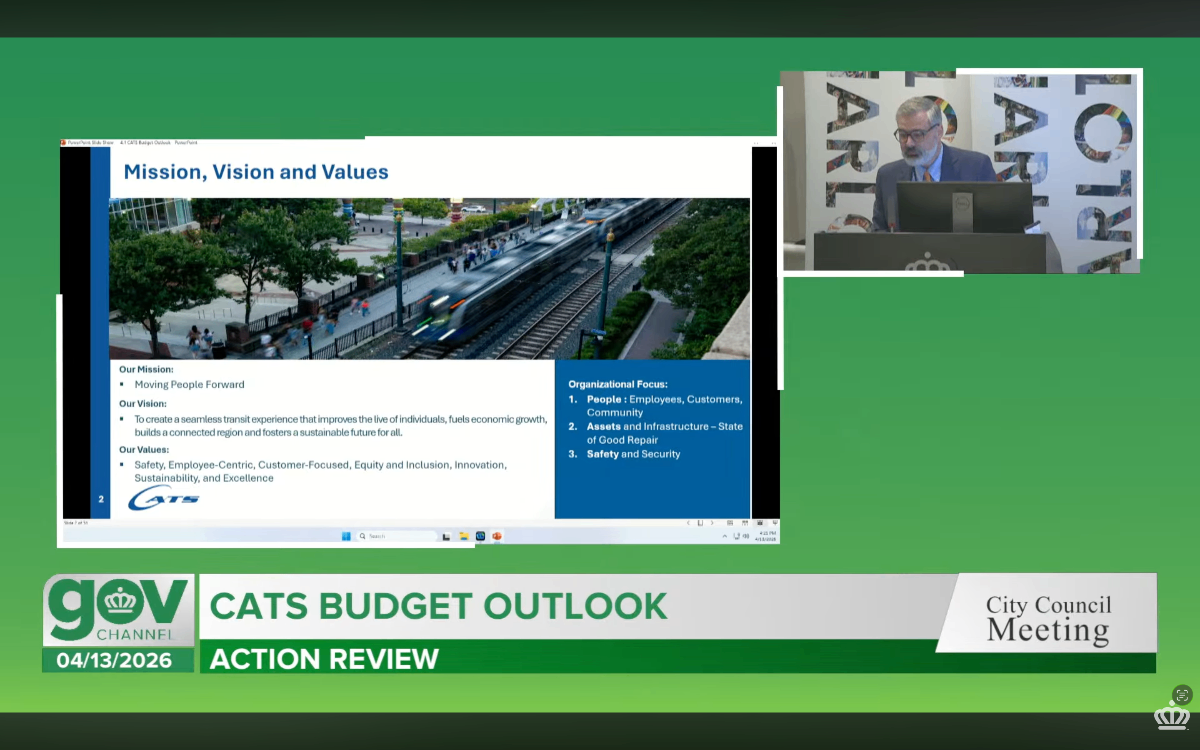
While Cagle highlighted progress on the Red Line and safety improvements, the council pushed for more transparency regarding revenue bonds and the long-term financial risks associated with the city’s transit strategy.
(Photo Credit: City of Charlotte/YouTube)
These concerns reflect broader national patterns. Research published in Transportation Research Interdisciplinary Perspectives finds that transit service changes often disproportionately impact low-income and minority communities when equity is not explicitly built into planning.
Similarly, the Brookings Institution has found that infrastructure investments in U.S. cities frequently reinforce existing disparities in access to jobs and opportunity.
Together, the findings underscore why council members are increasingly pressing for clearer justification behind transit decisions.
Street vending proposal sparks pushback on criminal penalties
A proposed set of citywide street vending regulations generated some of the strongest reactions of the meeting, particularly over a recommendation to include a Class 3 misdemeanor penalty.
Several council members opposed the measure, arguing that criminal enforcement would disproportionately affect small vendors, many of whom operate with limited resources or come from marginalized communities.
Instead, members pushed for a more accessible permitting system and non-carceral enforcement strategies. The proposal was ultimately referred back to the committee for further revision, signaling a shift toward policies that prioritize economic inclusion over punitive measures.
Similar tensions around enforcement and public trust are emerging elsewhere. In Folsom City Council Approves Salary Hike Amid Budget Woes, Sarah Denos reports that officials in Folsom faced criticism after approving salary increases while budget constraints threatened essential services—highlighting how decisions perceived as misaligned with community needs can erode public trust.
Ride-share regulations highlight local business concerns
Revisions to the Passenger Vehicle for Hire ordinance prompted debate over how to regulate an evolving transportation market increasingly shaped by ride-share companies.
While staff proposed updates to licensing, safety requirements, and vehicle standards, they declined to recommend universal upfront pricing—a feature widely used by companies like Uber and Lyft.
Some council members expressed concern that without similar policies, local operators could be placed at a competitive disadvantage. The discussion highlighted an ongoing challenge for cities: modernizing regulations without further consolidating power among large technology platforms.
Housing discussions expose structural challenges
Affordable housing policy remained a central issue, with the council reviewing recommendations from the Housing Trust Fund.
Although funding for several developments moved forward, concerns were raised about developers applying for funding before securing rezoning approval, creating uncertainty in project timelines and outcomes.
“As a reminder that policy sets three primary goals: economic mobility, neighborhood affordability, and residential stability, and your policy incorporates five investment priorities around vulnerable populations, location priorities, resident services, partnerships and leverage, and innovation,” said Rebecca Hefner, director of Housing & Neighborhood Services.
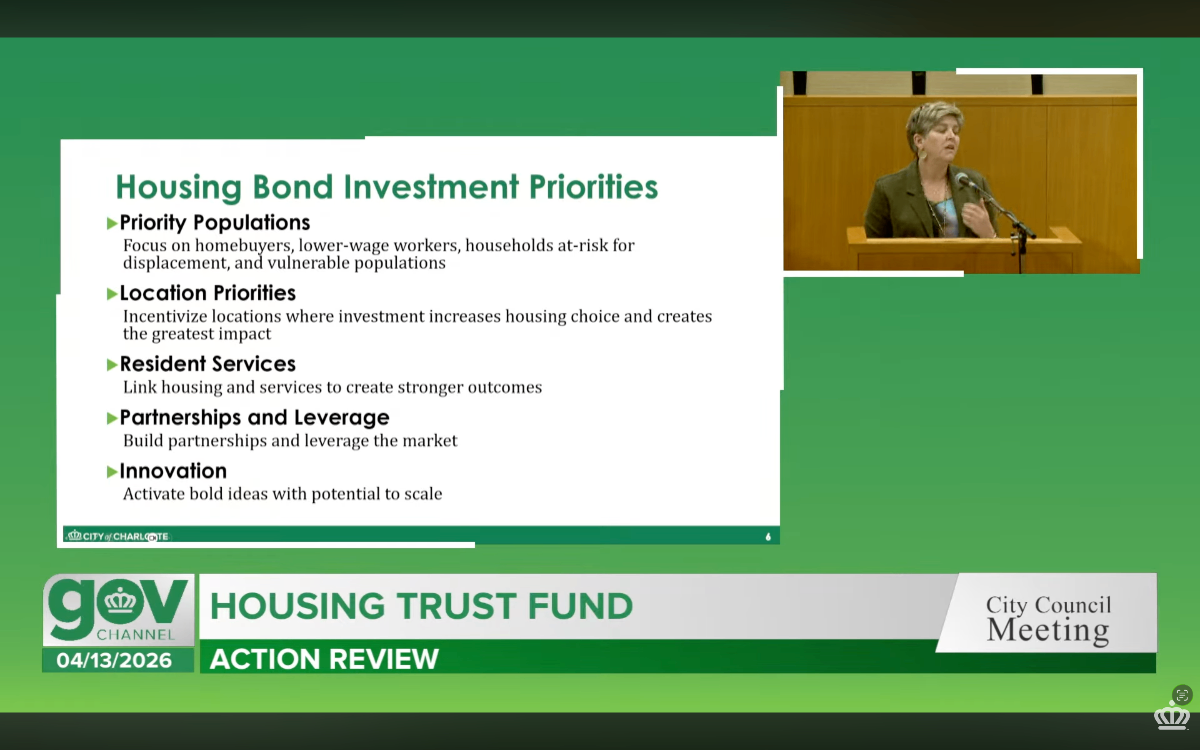
The presentation outlined goals for economic mobility and neighborhood affordability, though council members raised questions about the concentration of affordable housing in lower-opportunity areas and the risks of reinforcing segregation patterns.
(Photo Credit: City of Charlotte/YouTube)
Council members also pointed to the continued concentration of affordable housing in lower-opportunity areas, calling for a reassessment of location policies to avoid reinforcing patterns of segregation.
Growth pressures tied to housing and development are playing out nationwide. In A City Growing Faster Than Its Residents, Trees Can Keep Up, Angela Underwood reports on rapid development in Pensacola, where officials approved a seven-story multi-family project alongside land development code changes.
While framed as progress, the piece highlights ongoing concerns about whether infrastructure and community priorities are keeping pace with growth—echoing Charlotte’s debate over how and where development should occur.
Stellar Awards debate reveals gaps in city policy
An update on the upcoming Stellar Awards event brought unexpected scrutiny to the city’s approach to funding major events.
Council members expressed frustration over the lack of a clear financial request, a compressed planning timeline, and the absence of a consistent framework for evaluating such proposals.
Rather than approving support outright, the council voted to refer the issue to a committee to develop a more structured policy—highlighting the need for clearer processes before major financial decisions are made.
Routine items move forward amid broader tensions
Despite the extended debate on several agenda items, the council approved several routine measures, including amendments to the Solid Waste Services Ordinance and resolutions related to water and sewer financing.
The Charlotte Future 2040 Community Area Plans were also adopted, though not without discussion surrounding emerging concerns such as data center development and its potential impact on residential communities.
Proclamations recognizing National Arbor Day and National Library Week offered brief moments of consensus during an otherwise contentious meeting.
Accountability and process take center stage
Across each agenda item, a consistent theme emerged: council members are placing greater emphasis on transparency, equity, and process.
Rather than focusing solely on outcomes, members repeatedly questioned how decisions are made, how policies are communicated, and whether residents are adequately represented in those processes.
As Charlotte continues to grow, these debates suggest a shift in governance—one where proposals are no longer judged only on feasibility, but on their fairness, clarity, and long-term impact.
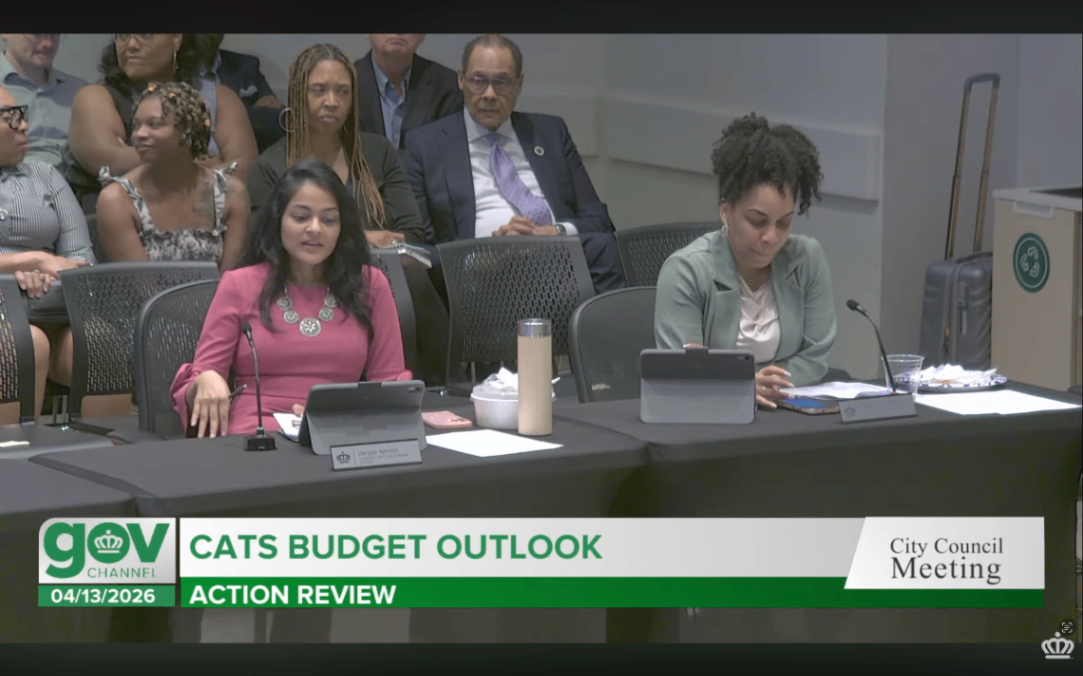
During the meeting, council members expressed concerns over whether transit investments are being equitably distributed across the city’s low-income and minority communities.
(Photo Credit: City of Charlotte/YouTube)
What’s next
Several key items, including street vending regulations and event funding policy, have been sent back to the committee for further development.
As those discussions continue, council members face increasing pressure to align policy decisions with community needs—while ensuring that growth, investment, and regulation are guided by transparency and accountability.
The full meeting agenda and materials are available through OpGov.news at the City of Charlotte Meeting.
You can reach Victoria Osborne at victoriao@lead4earth.org.
(Thumbnail Photo Credit: City of Charlotte/YouTube)
0
0

Comments