(CHARLOTTE, N.C.) – A Charlotte City Council meeting that began as a team-building session quickly evolved into something far more revealing: a public acknowledgment that internal distrust, communication breakdowns, and questions about transparency are shaping not just policy outcomes — but the culture of governance itself.
While Charlotte leaders debated public safety, homelessness response, transit restructuring, and the I-77 South toll lane expansion, the deeper through-line was governance — who feels heard, who feels protected, and whether residents trust institutions to act in their interest.
Charlotte’s tensions are not unfolding in isolation.
Across the country, OpGov.news has documented similar patterns: citizens demanding answers, officials defending the process, and councils wrestling with how to balance transparency, equity, and authority.
Trust Inside the Dais
The meeting opened with a facilitated conversation focused on rebuilding trust among council members. Several acknowledged that the body often functions more as “a group of individuals” than a cohesive team.
Members described inconsistent communication, lingering resentment, and political friction that they said spills into public debate. A committee was formed to draft clearer decorum rules and improve internal processes.
Council Member Joi Mayo said improving collaboration starts with stronger relationships among council members.
“We just talked about the importance of building relationships with different members of council so that we can get to high performing teams,” Mayo said.
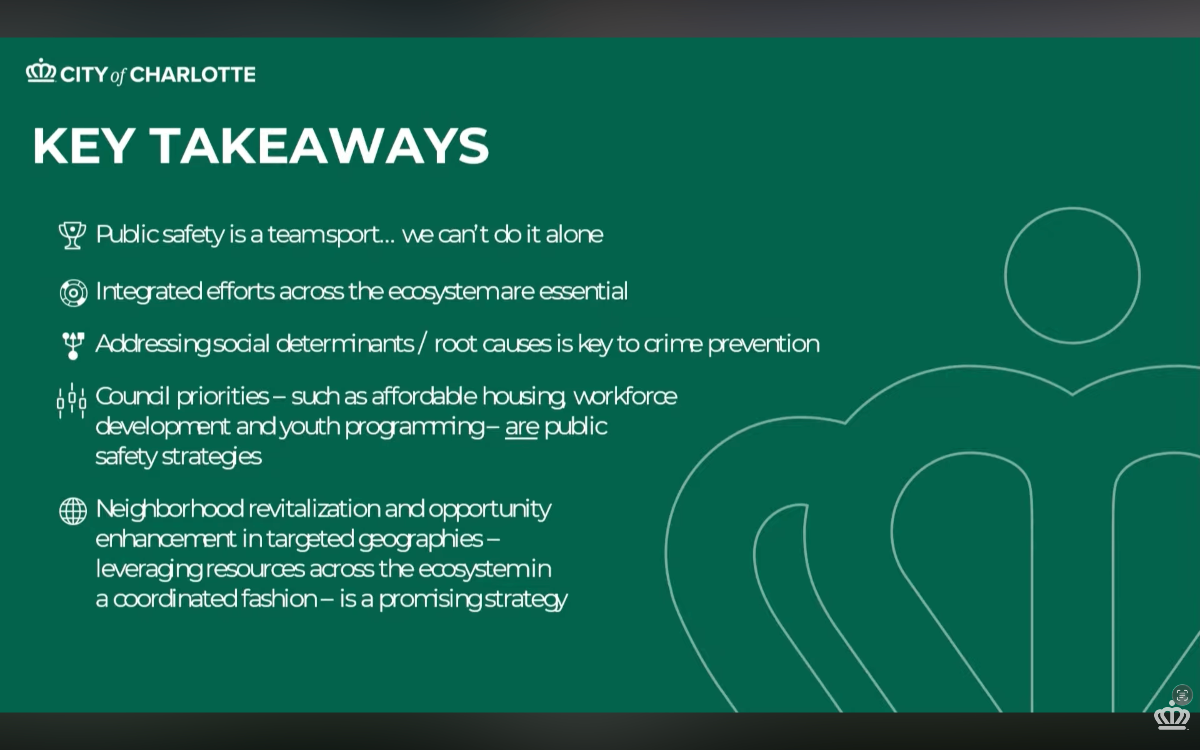
A slide presented during a Charlotte City Council meeting outlines the city’s “holistic public safety” strategy, emphasizing coordinated efforts across housing, workforce development, youth programming, and neighborhood revitalization as key components of crime prevention.
(Photo Credit: City of Charlotte/YouTube)
But the dynamic in Charlotte echoes governance struggles seen elsewhere.
In Sacramento, a contentious council meeting over housing affordability and public safety revealed deep public frustration with decision-making transparency and fiscal priorities. There, residents questioned billboard deals, homelessness governance changes and police funding decisions — not just the policies themselves, but how they were advanced.
The parallel is striking: whether the issue is rezonings in Charlotte or homelessness restructuring in Sacramento, the recurring concern is procedural trust.
Public Safety: Crime Down, Confidence Uneven
Charlotte-Mecklenburg Police reported violent crime down 21% and property crime down 6% compared with 2024, though homicides ticked slightly upward.
Council members pressed for more data on 911 response times and whether crisis response teams can expand to 24/7 coverage. Others raised concerns about privacy as surveillance tools and AI expand.
While Charlotte highlighted progress, other cities are grappling with different public safety tensions.
In Pensacola, public outrage erupted after a woman was severely injured in a dog attack, with residents accusing local officials of deflecting responsibility and failing to provide clear answers. The controversy centered less on crime rates and more on institutional response — whether agencies were accountable when systems failed.
The connective thread between Charlotte and Pensacola is not an identical policy, but citizen expectations: residents increasingly demand responsiveness, transparency, and visible corrective action.
Homelessness, Youth, and Economic Strain
Charlotte staff outlined a “holistic” safety strategy integrating housing, youth employment, and mental health response.
Council members requested clearer data on CARES team deployments and equitable district coverage. A goal to secure 1,000 summer youth career experiences by 2026 was introduced, requiring business partnerships and nonprofit coordination.
Across the country, homelessness and affordability debates are similarly dominating local chambers. Sacramento’s February meeting showed how deeply intertwined housing, public safety, and fiscal deficits have become intertwined with residents questioning long-term structural planning.
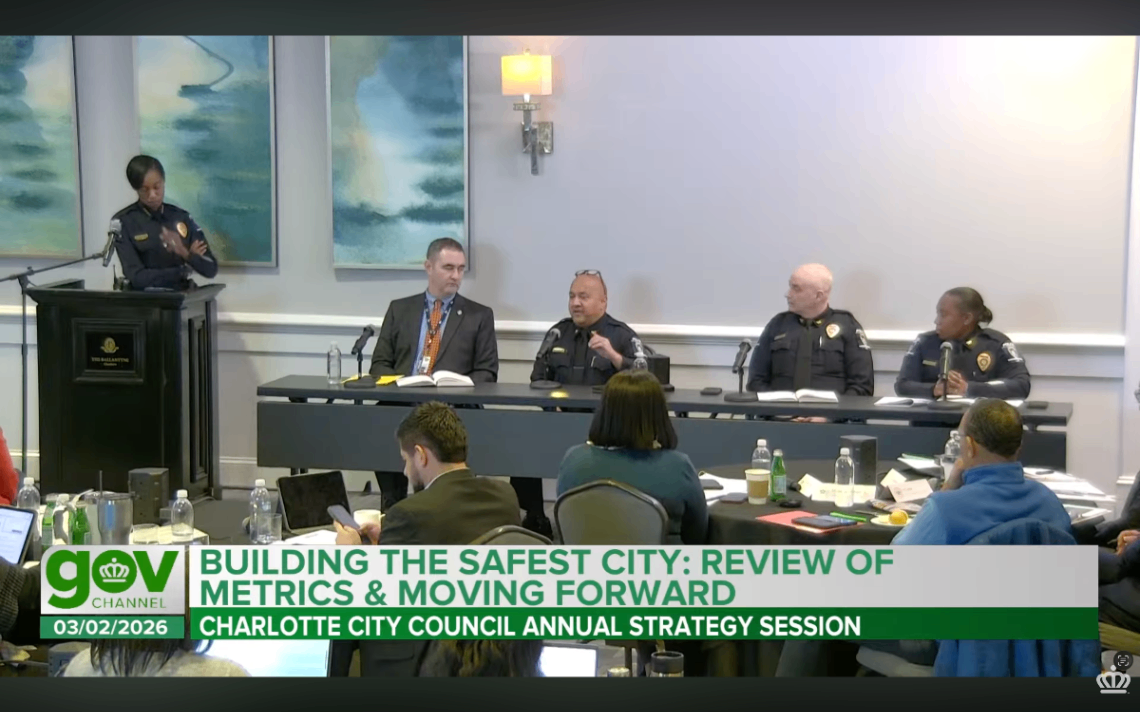
Despite a 21% drop in violent crime, council members pressed for more transparent data on response times and equitable coverage for 911 crisis teams to bridge gaps in public confidence.
(Photo Credit: City of Charlotte/YouTube)
Local debates increasingly reflect national economic strain: budget shortfalls, infrastructure debt, and competing equity priorities.
Transit Debt and the I-77 Flashpoint
The restructuring of the Charlotte Area Transit System (CATS) into a new Metropolitan Public Transit Authority surfaced financial realities: legacy debt tied to transit assets will remain with the city for years, some through 2040.
But the most contentious moment came during the discussion of the I-77 South toll lane expansion.
Residents and council members criticized elevated toll lane proposals, citing displacement concerns and environmental impact. Comparisons were made to other cities that are removing highways rather than expanding them.
Council Member Kimberly Owens said the city still needs clearer evidence that managed toll lanes would provide meaningful benefits to residents.
“I am cautiously optimistic about the data that I would like to see and that the community deserves to see how much benefit there is to Charlotte with these managed lanes,” Owens said.
Federal research underscores why these debates are intensifying. The Urban Institute’s Infrastructure Equity in Motion report found that historically, transportation funding has disproportionately benefited wealthier or majority-white communities unless equity criteria are intentionally built into grant structures.
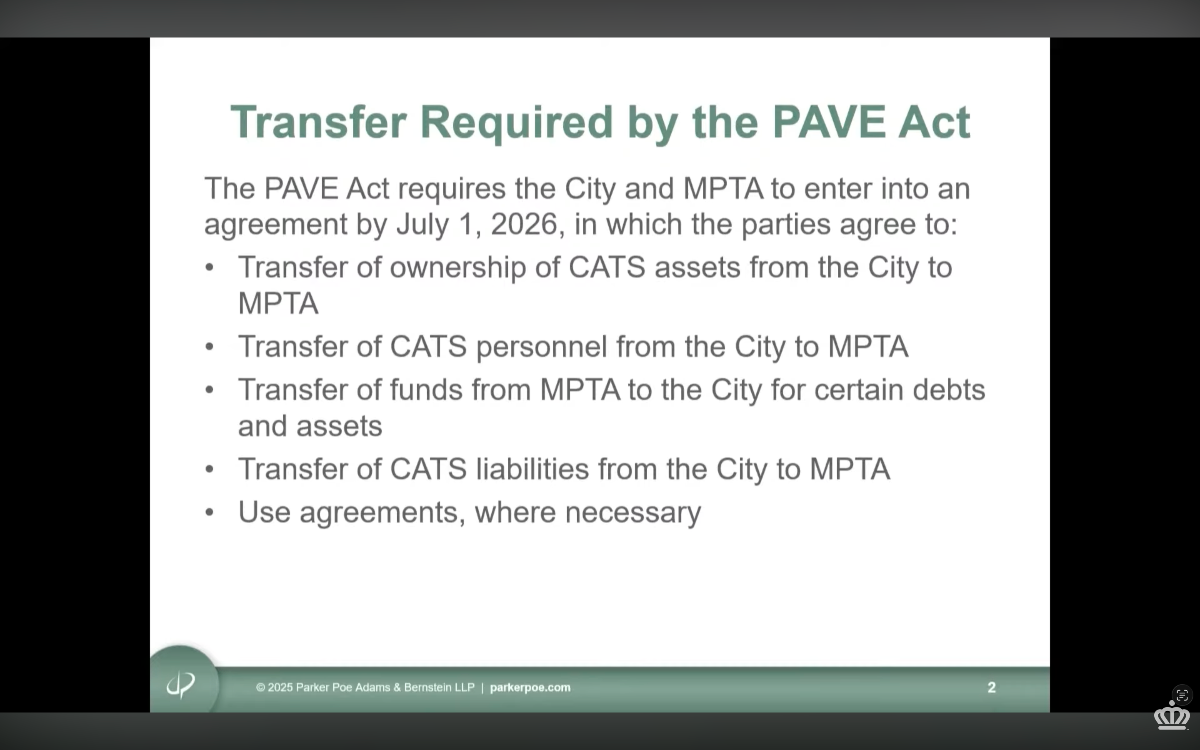
The transition has fueled debate over long-term fiscal transparency, as the City will remain tied to legacy transit debts through 2040 even after assets are transferred.
(Photo Credit: City of Charlotte/YouTube)
In Charlotte, critics argued that without robust community engagement and safeguards, large infrastructure projects risk repeating past displacement patterns.
A National Pattern of Local Strain
From Sacramento’s scrutiny over housing governance, to Pensacola’s public anger over agency accountability, to Charlotte’s internal trust reckoning, one theme is consistent:
Local government is under pressure not just to govern — but to prove it is governing fairly.
OpGov.ai reporting across regions suggests that city councils are becoming the frontline arenas for national tensions: policing reform, immigration debates, infrastructure equity, fiscal transparency, and public comment rules.
Even in Charlotte’s own recent OpGov.news primary coverage — as highlighted in “On Primary Day, Kate Barr Frames NC-14 Race Around Gerrymandering and Economic Reform” — structural trust in institutions remains central to political messaging.
The issues may differ city to city, but the underlying question remains the same:
Do residents believe the system works for them?
Looking Ahead
Charlotte ended its meeting acknowledging that policy success alone will not rebuild confidence. Governance culture, communication clarity and community inclusion may determine whether progress is sustainable.
As cities nationwide confront similar tensions, Charlotte’s debate illustrates a broader reality: the health of local democracy may hinge less on individual votes — and more on whether institutions can restore trust before divisions deepen further.
The full council meeting transcript and materials are available on OpGov.news at Charlotte City Council Meeting.
Make sure to comment below what you thought about the Charlotte City Council meeting this week!
You can contact Victoria Osborne at victoria.o@lead4earth.org.
(Thumbnail Photo Credit: City of Charlotte/YouTube)
0
0

Comments