(CHARLOTTE, N.C.) — At two recent committee meetings, Charlotte City Council members advanced major economic development and public safety initiatives, but the discussions also revealed a growing tension between policy action and public transparency.
While city leaders celebrated a major corporate investment and debated new safety strategies, the absence of public input and limited critical discussion raised concerns about how decisions are being presented—and who is included in the process.
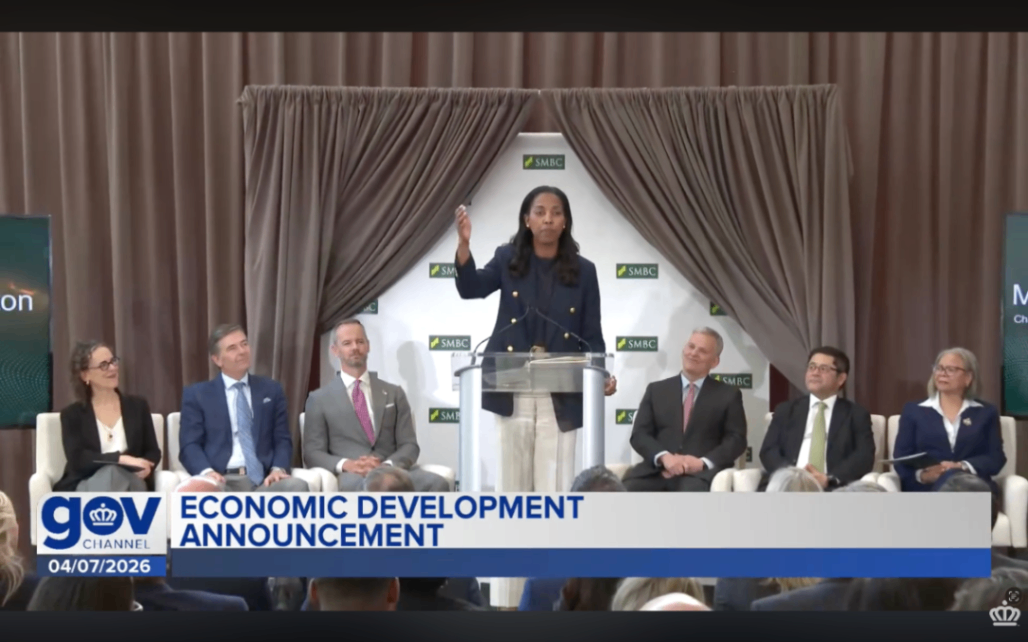
City leaders gather for a coordinated announcement regarding SMBC’s new U.S. headquarters in Charlotte—a project bringing 2,000 jobs that moved forward despite questions about the lack of public deliberation and transparency.
(Photo Credit: City of Charlotte/YouTube)
Economic development announcement highlights growth—and messaging
At the April 7 council meeting, officials gathered to announce that Sumitomo Mitsui Banking Corporation (SMBC) will establish its second U.S. headquarters in Charlotte.
The project is expected to bring 2,000 jobs over the next six to seven years, with salaries significantly above the county average, alongside a roughly $50 million investment and long-term projections of billions in statewide economic impact.
Speakers—including Josh Stein, Mayor Vi Lyles, and local economic leaders—offered uniformly positive remarks emphasizing job creation, regional growth and collaboration.
Charlotte’s rapid growth is not going unnoticed by local leaders.
“We are witnessing this rare convergence of abundant talent migration, transformational public investment, bold private capital, all positioning Charlotte and our center cities as one of the most compelling destinations in America,” said Michael Smith, President & CEO of Charlotte Center City Partners.
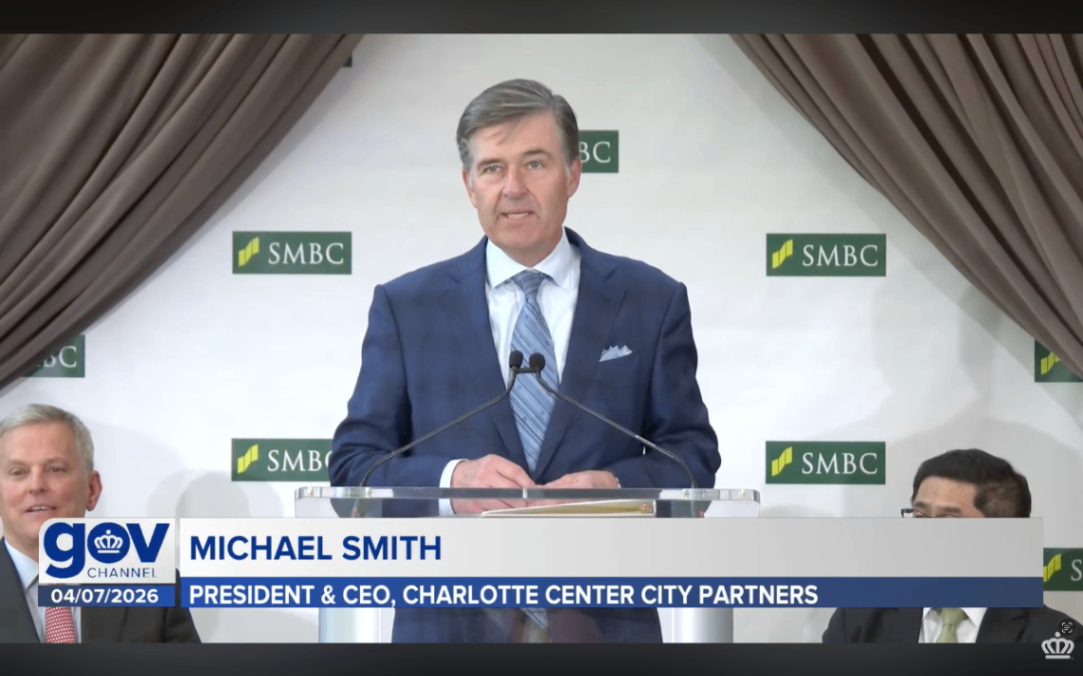
Michael Smith, President & CEO of Charlotte Center City Partners, characterizes the city's current growth as a "rare convergence" of talent migration and bold private capital during a recent economic development session.
(Photo Credit: City of Charlotte/YouTube)
However, the meeting functioned largely as a coordinated announcement rather than a deliberative session. No opposing viewpoints, public comments, or
detailed discussions of incentives, such as the state’s Job Development Investment Grant, were presented.
Development momentum reflects broader national trends
Charlotte’s positioning as a business hub mirrors patterns seen in other fast-growing regions.
In Manteca Gearing Up For Various Land Development Projects by Yikaileau Washington, officials in California similarly highlight economic expansion and new development as key indicators of growth, even as long-term community impacts remain less explored.
These types of announcements often emphasize opportunity while leaving questions about accountability, incentives, and equity largely unaddressed.
Public safety debate highlights enforcement challenges
In contrast, the Safety Committee meeting featured more extensive discussion, particularly around nuisance properties and enforcement strategies.
Officials identified approximately 20 high-activity “hot spots” generating hundreds of service calls annually. Council members pushed for stronger enforcement tools, including updated ordinances targeting vape shops and illegal gambling operations.
At the same time, concerns were raised about unintended consequences. Efforts to shut down nuisance properties may displace vulnerable populations, creating a difficult balance between enforcement and equity.
Similar tensions are playing out elsewhere. In Contention At Gilbert Council Meeting Over New Developments by Teri Tracy, residents expressed frustration over feeling excluded from decisions, reinforcing how public engagement remains a central challenge in local governance.
Red light cameras return as a data-driven debate
One of the most debated proposals was the potential reinstatement of red light cameras.
Supporters pointed to data showing reductions in crashes, while broader research supports those findings. A review by the Cochrane Collaboration found that red light cameras can reduce injury crashes by up to 30%, particularly right-angle collisions.
However, the same research indicates an increase in rear-end crashes, highlighting the trade-offs that complicate policymaking.
Cost also remains a concern, with estimates reaching hundreds of thousands of dollars annually, prompting calls for further analysis before implementation.
Transit safety investments driven by perception
The Charlotte Area Transit System (CATS) presented an updated safety plan, including increased patrols and enforcement measures.
That perception gap is something law enforcement officials directly acknowledge.
“But you can imagine if you live or shop in that area and you’re seeing the police called to that specific area over a hundred times a year, how that would make
you feel and your perception of safety in that area,” said Stephen Fischbach, Major at Charlotte-Mecklenburg Police Department.
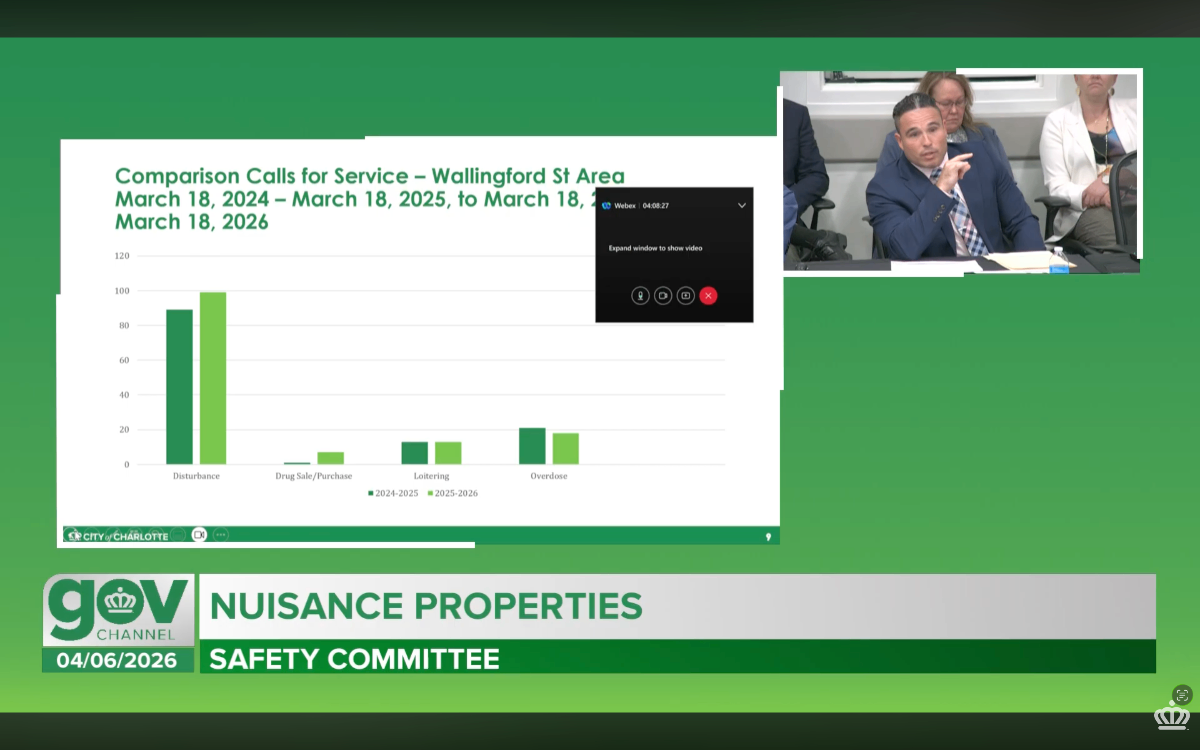
Major Stephen Fischbach explains how high volumes of service calls at "hot spot" properties can negatively shape a community's perception of safety and influence local policy decisions.
(Photo Credit: City of Charlotte/YouTube)
Despite data showing that violent crime on transit is relatively rare, the city plans to significantly increase its safety budget.
This reflects a broader trend in policymaking, where perception plays a major role. Research from the Urban Institute shows that access to and confidence in public systems can shape usage and economic opportunity, even when underlying risk remains low.
Missing public input raises accountability concerns
Across both meetings, a consistent issue emerged, not just what was discussed, but what was missing.
The April 7 meeting functioned as a public-facing announcement with no visible opportunity for public input or critique, while the Safety Committee lacked documented public comments and detailed transcripts.
For decisions that shape economic development, safety and public spending, the absence of visible civic participation raises concerns about accountability.
Transparency is a key component of effective governance. Without clear records of discussion and public engagement, it becomes difficult for residents to understand—or trust—the decisions being made on their behalf.
What’s next
As Charlotte continues to grow, officials face increasing pressure to balance economic expansion with transparency–ensuring that major investments and public safety strategies are not only effective, but also publicly accountable.
The full meeting agendas and materials are available through OpGov.news at the City of Charlotte Meeting (Safety Committee Meeting) and City of Charlotte Meeting (April 7th).
You can reach Victoria Osborne at victoriao@lead4earth.org.
(Thumbnail Photo Credit: City of Charlotte/YouTube)
0
0

Comments