(CHARLOTTE, NC.) – The Charlotte City Council reviewed a wide range of zoning petitions during its latest meeting on August 17th, approving several residential and redevelopment projects while deferring others for additional work involving environmental buffers, data center restrictions and neighborhood concerns.
The meeting included proposals for multifamily and single-family housing, manufacturing development, a surface parking lot and the reconstruction of the historic Excelsior Club, highlighting the ongoing effort to balance growth with local infrastructure demands.
Among the deferred items was Petition 2026-019 from ACRO Development Services, which sought to expand the Hendrick campus for manufacturing and defense-related contracts. Council members requested additional information about preserving an undisturbed buffer and ensuring the property would be restricted from future data center development.
Bridget Grant, representing ACRO Development Services, said portions of the property, particularly lower-lying areas, would remain undisturbed, while current pasture land would receive new landscaping. Grant agreed to discuss the requested buffer requirements with Hendrick and accepted the deferral.
The discussion followed months of debate over how Charlotte should regulate data center growth, including a previously approved 150-day moratorium on new telecommunications and data storage facilities to allow staff to review land-use, environmental and infrastructure impacts.
The development discussions also drew reaction from residents on social media.
In a comment on Nextdoor, Michele Blount of Spring Valley questioned whether the city's actions were producing meaningful solutions, writing, “Really tackling them or reasonable workable solutions (laughing emoji).”
Several residential projects moved forward after developers agreed to reduce unit counts or add specific conditions.
Petition 2025-077 from Short Development Group was reduced from 40 to 36 multifamily units.
The number of affordable units increased from four to six, with those units restricted to households earning up to 80% of area median income for 15 years. The developer also agreed to limit a southern retaining wall to 5 feet in height.
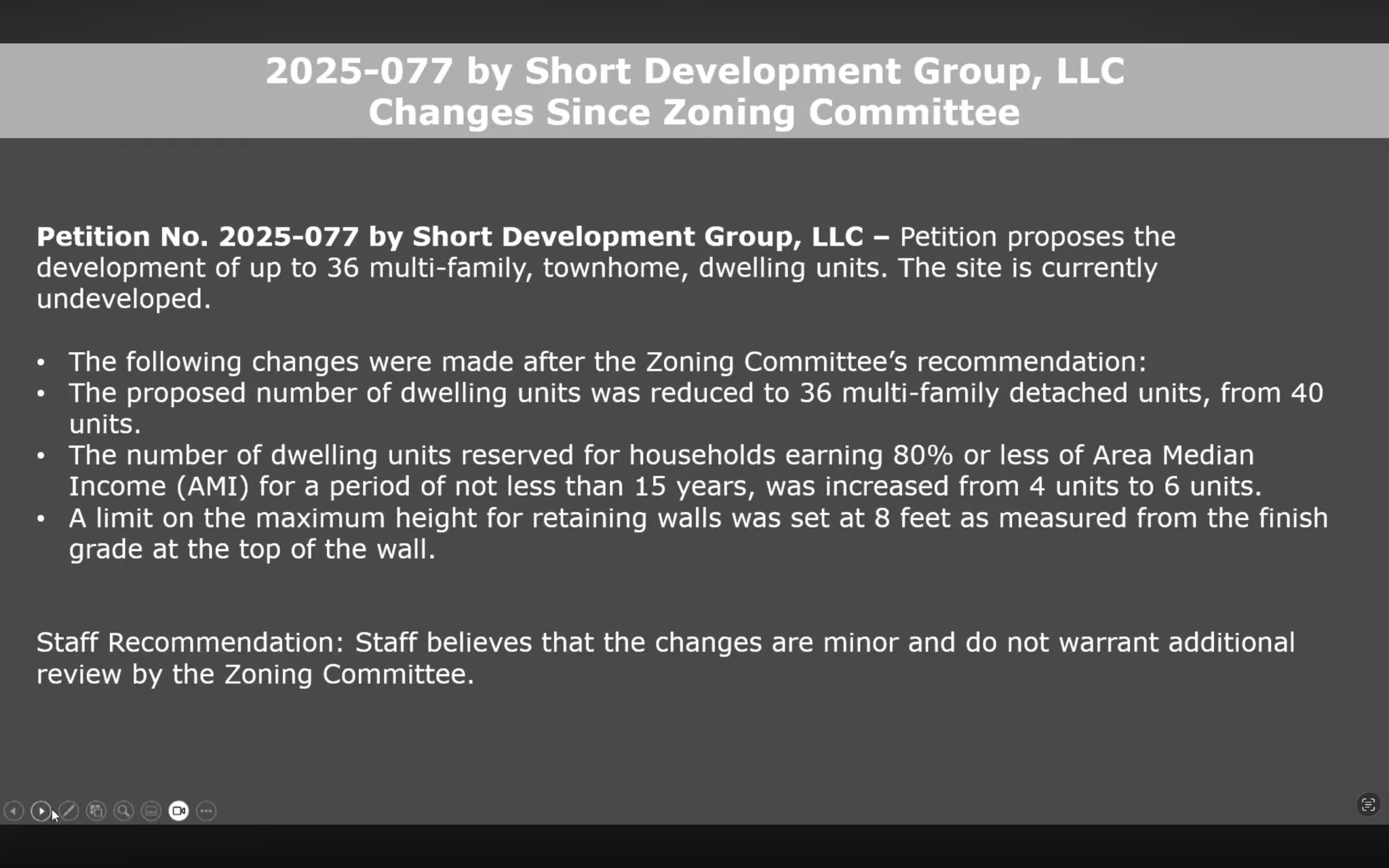
A presentation slide details approved modifications to Petition 2025-077, including unit reductions and increased affordable housing commitments.
Photo Credit: City of Charlotte/YouTube
Petition 2026-001 from MPV Properties and Mission Properties was reduced from 176 to 170 units, with the developer agreeing to install noise-reducing windows due to the property's proximity to a railroad.
Petition 2026-017 from Kevin Curran was also significantly reduced from 7.85 acres and nine homes down to 1.22 acres and four single-family detached homes to align with N1A zoning standards.
The council's discussions followed other recent zoning meetings where members have examined how density and development flexibility fit into Charlotte's broader housing plans.
The debate over single-family development generated mixed public feedback, including opposition in the meeting's YouTube live chat.
One commenter, identified as @Matthew-wi5im, wrote, “Booooo no more single family zoning.” The reaction highlighted competing priorities between residents advocating for higher density and those focused on preserving neighborhood character.
Policy regarding manufactured housing also prompted extended discussion during review of Petition 2026-029 from Rachel Regalado.
The proposal sought to rezone a manufactured home park to N1C zoning for six single-family homes, which Regalado stated aligned with the city's 2040 policy map and existing neighborhood development while retaining one manufactured home on site.
Council Member LaWana Mayfield questioned the continued loss of land capable of accommodating manufactured homes and raised broader concerns about affordable options.
The council referred the issue to the Housing and Neighborhood Services Committee for further review on preserving land for manufactured and modular housing, following earlier July discussions on a proposed $125 million affordable housing bond.
In commercial zoning, Petition 2026-031 from Charlotte Pipe and Foundry received extended scrutiny.
The proposal sought approval for a surface parking lot to serve a product knowledge facility, but planning staff opposed the petition based on fit within the surrounding neighborhood.
Colin Brown, representing the petitioner, noted that additional parking was necessary and discussed potential shared parking with Little Church on the Lane, alongside proposed landscaping, tree preservation, shielded lighting, stormwater management, and previous pavement evaluation.
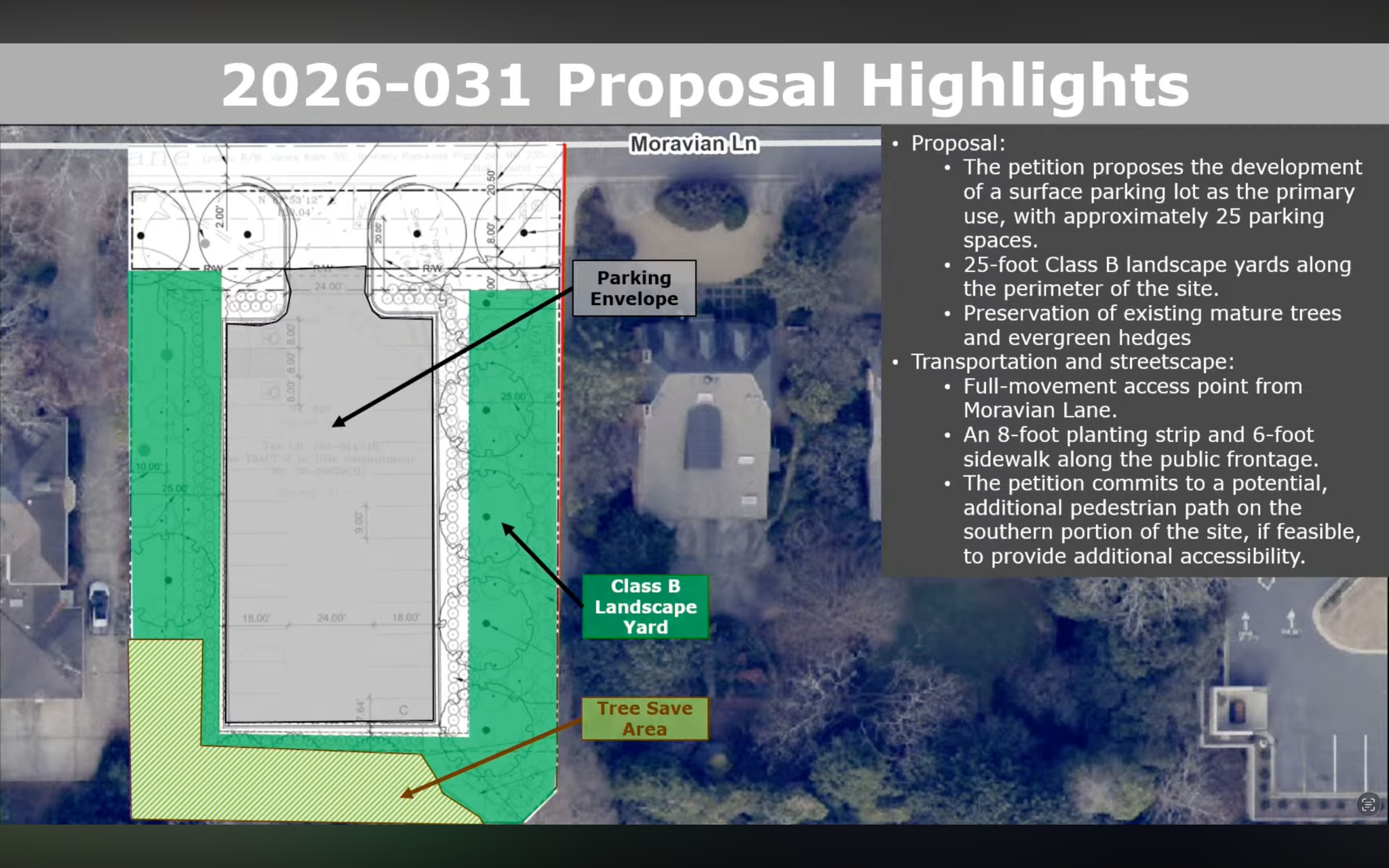
Site plans outline the proposed surface parking lot and landscape buffer requirements for Petition 2026-031 on Moravian Lane.
Photo Credit: City of Charlotte/YouTube
Other projects received broader council support. Petition 2025-123 from Sanders Partnership, proposing 212 single-family homes, was praised for community engagement and plans for a 3-acre park and greenway easement on land previously considered for a landfill.
The historic Excelsior Club reconstruction under Petition 2026-037 received unanimous support.
The project resolves an existing zoning nonconformity to rebuild the historic community gathering space while incorporating Americans with Disabilities Act standards and public open space.
Educational capacity questions were also raised during the meeting.
The council approved Petition 2026-026 from the Nativity of the Holy Virgin Orthodox Church, a downzoning to accommodate construction of a new sanctuary, where Council Member Renee Johnson questioned the consistency and transparency of school utilization data provided for conventional rezonings.
In another action, the petitioner for Petition 2025-011 (Garrison Road Holdings) agreed to convert an ML-1 request to Tier 1 conditional rezoning, prohibit data centers, and evaluate an undisturbed tree-save buffer along property boundaries.
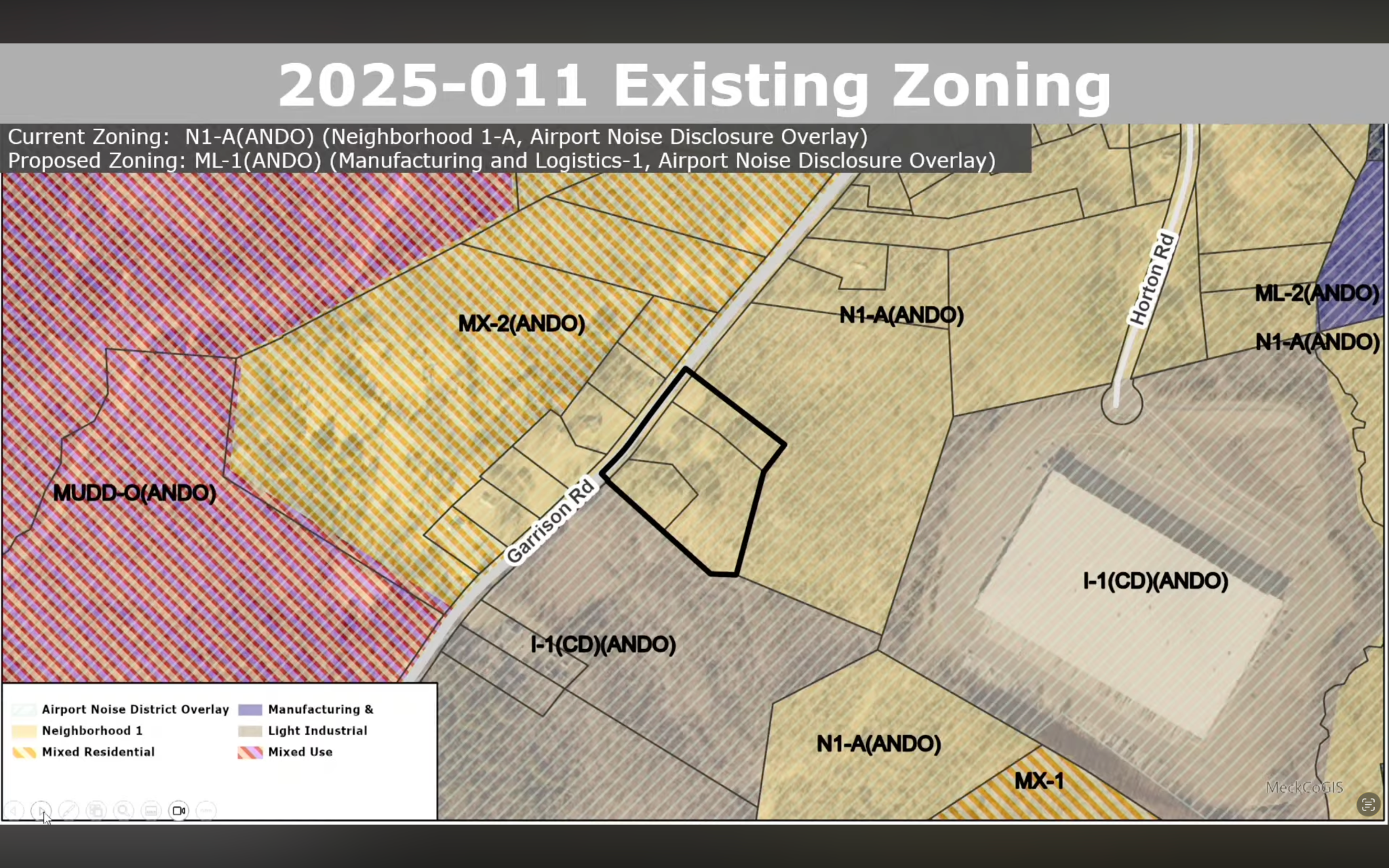
A zoning map illustrates parcel boundaries and surrounding noise overlay districts for Petition 2025-011 along Garrison Road.
Photo Credit: City of Charlotte/YouTube
The series of decisions demonstrated how individual zoning cases tie into broader policy questions surrounding growth, housing access and regional infrastructure.
OpGov.News has tracked similar governance challenges in other jurisdictions where major capital investments and municipal construction projects intersect with community debate over growth and corridor capacity.
In “Garden State Parkway Will Undergo Nearly $200 Million Project,” reported by Alexis Nigro, OpGov.News examined a $193 million infrastructure reconstruction along the Garden State Parkway in Ocean County, New Jersey.
The project will replace 11 bridges and redesign high-crash interchanges to address critical corridor safety deficiencies. Similar to Charlotte's evaluation of cumulative traffic impacts, the initiative highlights the substantial capital required to modernize regional transportation links under steady growth.
In “Vancouver Council Approves Construction Contract For McGillivray Project,” written by Rory Holbrook, OpGov.News detailed the Vancouver City Council’s approval of a $5.5 million contract for the SE McGillivray Boulevard Safety and Mobility Project.
The plan reallocates vehicle travel lanes to establish protected mobility lanes and upgraded pedestrian crossings along a key residential corridor. The vote passed despite neighborhood concerns over reduced street capacity, mirroring Charlotte's debates over balancing multimodal infrastructure with local traffic congestion.
To add to or correct any information in this report, please contact me at victoria.o@lead4earth.org.
Thumbnail Photo Credit: City of Charlotte/YouTube
0
0

Comments