
Photo Credit: Kristin Hassel / Loons in Northern Minnesota
(MINNESOTA) - The demand for faster, smarter, more capable AI models is creating a need for more AI Data Centers as newer models are built. AI technology is built into cars, glasses, home security systems, smartphones, and more. It’s been especially useful for the streamlining of systems processes, making businesses operate more smoothly.
The AI boom began in 2012, but didn’t hit full maturity until 2017, and all the new gadgets and AI models require resources to keep growing. What people may not fully understand yet is that the more data you feed it, the bigger the enterprise gets. As AI evolves, it will require larger, more streamlined data centers, better components, more energy, and massive amounts of cooling power. So, where do these resources come from? Well, they’re mostly natural.
The Great Lakes area can provide all of the above, and the climate in several States surrounding the Lakes, including Minnesota, Wisconsin, and Michigan, is ideal for the temperature control needed for critical AI systems. Minnesota has plans for at least 13 AI data centers, including an $800 million Meta AI Data Center in Rosemount. Michigan is planning for 24+ new AI data centers, while Wisconsin is adding a further 40+ to their existing 45+.
It’s no coincidence that the past eight years have seen the reopening of the Dakota Pipeline (2017), the revocation of the ban prohibiting mining in the Boundary Waters Canoe Area (2026), and the rapid growth of AI data centers across the U.S. These centers require enormous amounts of power, water, and alloys (primarily copper-nickel).

Photo Credit: Pixabay / Paulos
Supporters of the creation of these data centers say they bring jobs, as does the mining and operation of oil pipelines. But what about the Earth? The damage from mining, including waste leakage into soil and waterways, may be irrevocable.
Carbon emissions from operating primarily natural gas-powered centers will take their toll. Once this happens, the effects on wildlife will become more noticeable. Eventually, these emissions will become more apparent in human health.
Many believe the answer to current issues with the environmental devastation caused by AI’s growing needs can be solved with clean energy solutions like wind, solar, and nuclear power (I disagree, but more on that later). All of these sources of clean energy require less water, can help run advanced cooling systems, and help mitigate carbon emissions.
Technological companies are also promising a goal of ‘zero-net’ carbon emissions, and some states have already set a requirement for AI data centers to use a specific percentage of clean, renewable energy. As optimistic as that is, the clean energy solution isn’t realistic or sustainable.
Renewable, clean energy technology isn’t anywhere near as advanced as it could be, and is lagging years behind the leaps and bounds AI has made. There aren’t enough metal recycling facilities, wind turbines, or solar-powered energy sources to keep AI data centers running at full capacity, especially with new ones breaking ground constantly. Putting more resources into creating these clean energy sources would, in some cases, remove resources from AI technologies.
In short, clean energy technology resources can’t keep up with AI’s growing demands.
Some advocate for the use of nuclear power, citing its ability to run cleanly. Yes, it’s true that nuclear power doesn’t create carbon emissions. Still, historical failures like Chernobyl haunt the industry to this day. Researchers will tell you that it was human error and poor equipment (summarized). You’ll hear about the new handling methods for uranium and nuclear waste, how nuclear reactors are now surrounded by steel casings reinforced with concrete, and how AI could run and monitor the reactors. I’m not buying it as a clean energy source.
The sheer amount of damage that could be done by an uncontrolled or improperly cleaned radiation leak is catastrophic. Even a leak contained within steel and concrete isn’t safe long-term, as nuclear radiation is capable of eventually weakening and degrading those materials and seeping out. Not to mention the health issues, including potential lung and kidney disease, miners would face after extensive time digging for the amount of uranium that would be required to build the nuclear reactors.
Extracting uranium releases radon gas into the environment, and mining waste contaminates the soil and water, all of which are ruinous to the populations surrounding the area; both flora and fauna. We could talk about the potential for an AI-run system linked to something like this to be hacked, but the focus here is on the environment.
A massive demand for the critical components and resources required to create AI and AI data centers has left companies scrambling to produce enough to meet the need. Azure, Amazon, and Google have already invested $300+ billion combined into AI in 2025, and they want their components yesterday.
Business Growth Consultant for Enterprise Minnesota Greg Hunsaker was quoted as saying, “If they need something, it becomes the very first thing you get done, and you get it to them when they want it.” Hunsaker admits that favoritism can cause companies to lose smaller long-term clients who are essentially forced to wait, but “it's where the money is.”
Perhaps this is why nuclear power, more mines, reopening pipelines, and building AI data centers in cooler climates seem like attractive options. But these are temporary gains that will end up creating long-term damage that, in many cases, isn’t fixable. Researchers at Cornell University estimate that AI data centers will create 24-44 million metric tons of carbon emissions, and consume up to 731-1,125 cubic meters of water per year by 2030. For reference, that's around 50 million new gas engine cars driving the roads, and water consumption equal to the entirety of Lake Shasta (California) in five years.
Advocates of AI say it could ‘eventually’ rectify the damage caused by itself in the future, but there is no band-aid for this type of devastation. You could say I’m a naysayer, but I work in tech and have a great respect for the strides the industry has made. Still, I direct you to the very thing of which I speak, AI, for an answer to the question "Can AI potentially repair the damage AI data centers have already done to the environment?” It will give you all the if’s, all the potential ways it can help reduce damage eventually, then it will tell you a simple truth – no.
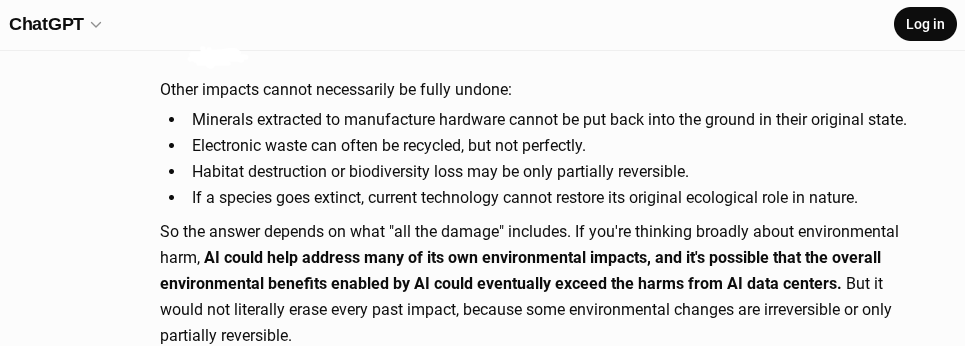
Photo Credit: Kristin Hassel / ChatGPT Session
Yes, AI has its applications, but do we really need glasses that shop for us? Don’t we already have devices that can do that? Do we need to embed AI into every piece of technology and make it part of our everyday lives? Its impact on nature is obvious, and will become even more obvious, as will the use of AI to perform menial tasks for us once people begin losing the ability to think critically and perform basic functions that require more than a voice command.
We have the potential to lose jobs, life skills, and cognitive strength, and to devastate our planet with AI. So, I ask, what is being able to send voice commands to your glasses, TV, car, watch, or phone worth to you? Are you willing to sacrifice a large chunk of the Earth? Better yet, would you feel proud telling future generations why, if you are? I’m not saying don’t get a smart watch, TV, phone, or glasses, but moderation is good. Do we really need to continue to feed AI our personal data or everyday information? This question is especially important when the continued flow of data results in larger data centers and more environmental damage.
There has to be a line drawn before AI’s evolution becomes more important than the very thing that sustains life…our planet.
To add to or correct any information in this report, please contact me at kristin.h@lead4earth.org.
0
0

Comments