(ASBURY PARK, N.J.) — Deputy Mayor Amy Quinn says her priorities for Asbury Park have evolved during her 13 years on the City Council, with residents now increasingly concerned about property taxes, affordable housing and the future of the city's historic Casino.
Quinn, an attorney who has worked with the Community Health Law Project for nearly two decades, discussed those issues and her record in an Oct. 23 video interview with Open Governance News ahead of the Nov. 3 mayoral election.
Open Governance News by Lead for Earth Youtube / Quinn sits down with reporter Angelica Niedermeyer for an interview at Boho House on Cookman Avenue.
Asked what she would do differently as mayor and how residents would see change during her first year, Quinn said the city’s needs have shifted since she first joined the council in 2013.
At that time, residents were primarily concerned about crime and redevelopment, she said. Today, conversations at neighborhood meet-and-greets increasingly focus on the Casino, affordable housing and taxes.
“I don’t know if I would do anything differently, but I think time has changed,” said Quinn.
Casino redevelopment and Convention Hall
The future of the historic Casino emerged as one of Quinn's major priorities. The property, which has faced years of stalled reconstruction and public frustration, recently received a $75 million tax credit through the New Jersey Economic Development Authority (NJEDA), according to the interview.
“I think what people want to see is a new redevelopment agreement with the Casino that has really clear and concise guidelines and deadlines,” Quinn said.
OpGov.news has previously reported on the legal dispute surrounding the Casino, including competing interpretations of redevelopment agreements and whether the city has grounds to pursue litigation against the developers. In a July investigation, the publication examined a legal opinion by retired New Jersey Supreme Court Justice Lee A. Solomon, which identified potential remedies available to the city, but did not determine whether a contractual default had occurred. City officials have defended their decision not to immediately sue, while critics have challenged the city's interpretation of the agreements and called for legal action.
On Aug. 19, 2026, the Asbury Park City Council approved Resolution 2026-358, creating the Casino Property Advisory Committee. The city then appointed members in September to help inform discussions about the property's future. Its members include Councilwomen Eileen Chapman and Yvonne Clayton, Todd Gordon, William Acevedo and Celia Morrissette of Save Our Structures Asbury Park.
According to The Coaster, the Casino Property Advisory Committee will recommend ways to preserve and improve the Casino, Carousel, heating plant and breezeway. The five-member committee, comprising two council members and three city residents, will review redevelopment agreements, restoration costs, potential grants and options for repurposing the buildings. The committee can also request information directly from Madison Marquette and is required to submit a written report with recommendations within six to nine months.
Quinn, who is not on the committee, said she believed it had held one meeting and was expected to meet monthly. She said she hoped the committee would communicate both its vision and the public's priorities to city officials as negotiations with Madison Marquette continue.
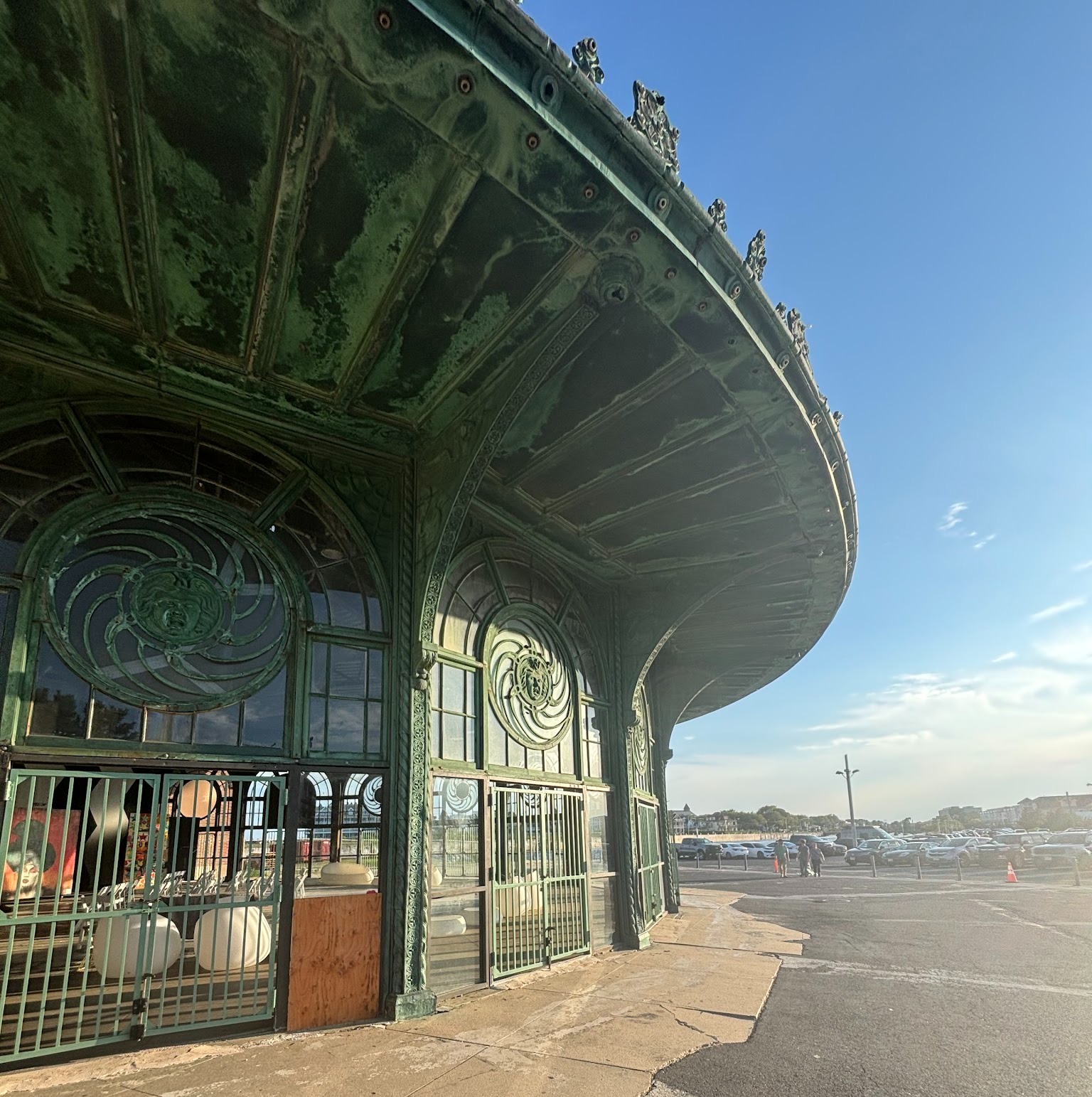
Photo Credits: Angelica Niedermeyer/ Asbury Park Carousel
Quinn favors transforming the Casino into an arts and culture hub rather than a high-end wedding venue, an option she said the developer has discussed.
“I want to see it open,” said Quinn, adding “I want to see Asbury's past represented in it and the future represented in it and make sure that we acknowledge how important diversity, arts and culture are in that hub.”
She contrasted the Casino's uncertain future with progress at Convention Hall, where separate funding sources are supporting improvements.
“With the tax credits and Convention Hall, there was never any question on what people wanted to see,” Quinn said. “They wanted to see it renovated and brought back to life and the tax credits are going to do that. But with the Casino, I think there needs to be a dialogue with the community on what we envision.”
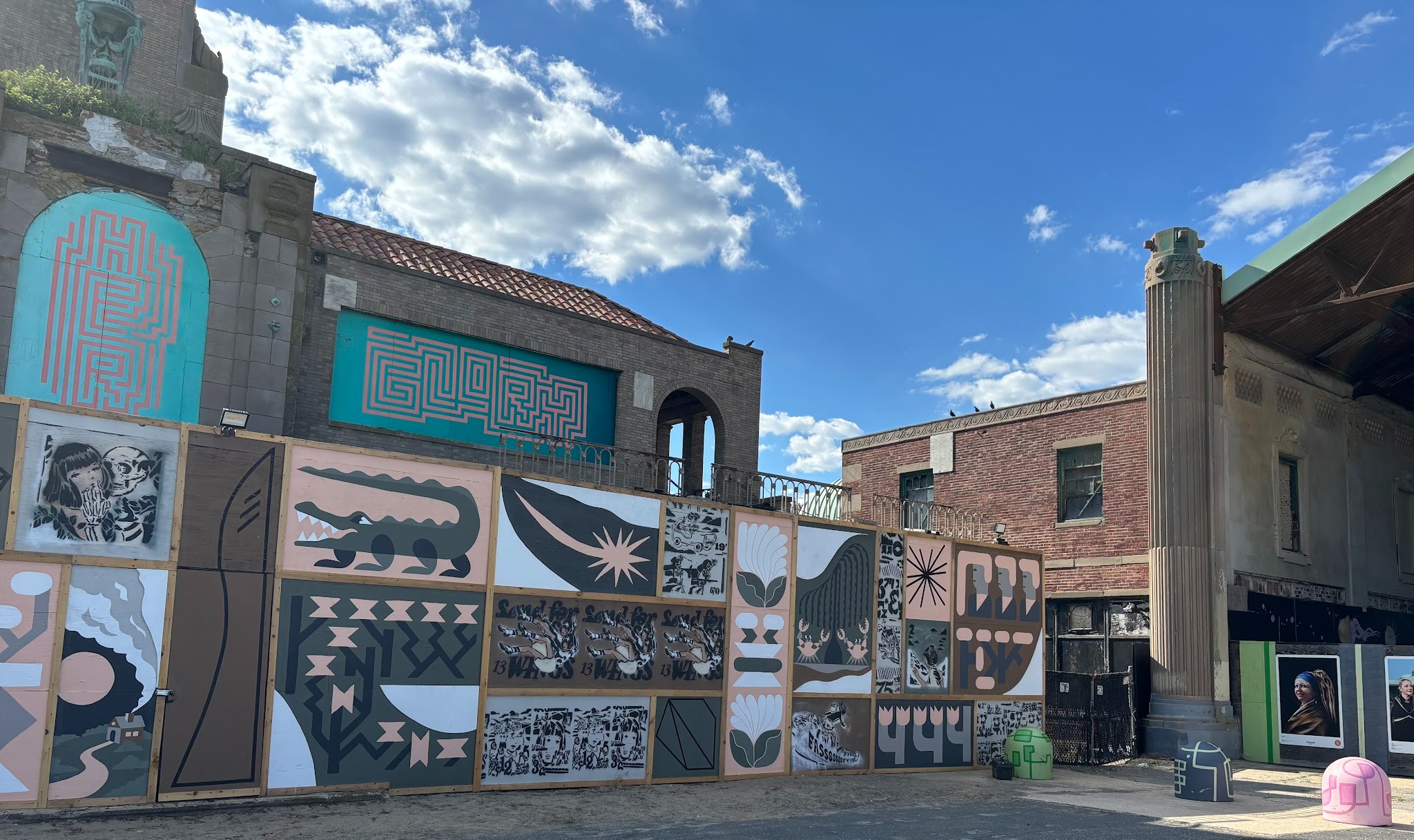
Photo Credits: Angelica Niedermeyer/ Asbury Park Casino Art
“Convention Hall is in a place that is moving forward and even now you're seeing the work being done for the $13 million grant which is totally separate,” Quinn said, mentioning the work there now is funded by the Murphy administration.
A $13 million grant from the Murphy administration, provided through the Boardwalk Preservation Fund, is funding weatherization work at the Paramount Theatre, Quinn said. She expected that work to conclude by the end of 2026, after which scaffolding would come down and separate work associated with the tax-credit application could begin.
Quinn said she felt encouraged by the Convention Hall project, but acknowledged concerns that the work might not lead to the changes residents want.
“Yeah, I think it's our fear too,” she said when asked about the public's concern over whether the project would deliver meaningful change.
She said the city supported the funding application in part because the developer would have to complete the work before receiving the money.
Waterfront development and accountability
Reflecting on her council tenure, Quinn acknowledged that some waterfront buildings have not met the architectural standards she believes the city should have demanded.
“I hear a lot about the design of some buildings in the waterfront and some of those buildings I voted ‘no’ on,” said Quinn. “What I think we should have held the developers to a higher standard is for the gray boxes. I acknowledge that. I am going to deal with that in 2027.”
Quinn said the city sometimes faces legal pressure when it pushes back against development proposals. Efforts to address residents' concerns about building heights can also involve compromises over architectural design. She said future development should better acknowledge Asbury Park's history, citing the colors and designs of the city's carousel as potential inspiration.
Questions about redevelopment accountability also extend to the professionals advising the city.
The city appointed Maraziti and Falcon as waterfront redevelopment counsel under Resolution 2023-29, adopted Jan. 1, 2023. The resolution explicitly identified the appointment as a “restricted (a/k/a ‘non-fair and open’) process” under New Jersey's Local Unit Pay-to-Play Law, N.J.S.A. 19:44A-20.4 et seq.
The designation was also included in the professional services agreement signed by the city and the law firm. Section 5, titled “Political Contribution Disclosure,” states: “This contract was not awarded through a ‘fair and open process’ pursuant to N.J.S.A. 19:44A-20.4, et seq.”
The agreement further states that the attorney was awarded the contract “based upon the merits and abilities of the Attorney to provide the services as described herein.”
Under the agreement, Maraziti and Falcon was required to disclose reportable political contributions and attest that neither Maraziti, the law firm, its subsidiaries and assigns, nor principals controlling more than 10 percent of the firm had made contributions during the preceding year that would affect the attorney's eligibility for the contract. The agreement also restricted certain political contributions during the contract term.
OpGov.News reviewed the 2023 appointment resolution, the signed professional services agreement and a November 2022 proposal submitted by Maraziti and Falcon seeking the waterfront redevelopment counsel position. The firm's submission included political contribution disclosure forms and other required certifications. The resolution stated that the firm had certified it made no reportable contributions to a political or candidate committee in Asbury Park during the preceding year.
Subsequent appointment resolutions, including one adopted in January 2025 and another identified in 2026 reporting, described the selection process as “Fair and Open.”
When asked about Joseph Maraziti's appointment and whether the firm had been selected through a competitive process, Quinn said the city uses an open and fair process that permits campaign donations.
She said she had voted both ‘for’ and ‘against’ redevelopment counsel appointments, citing frustration over waterfront development.
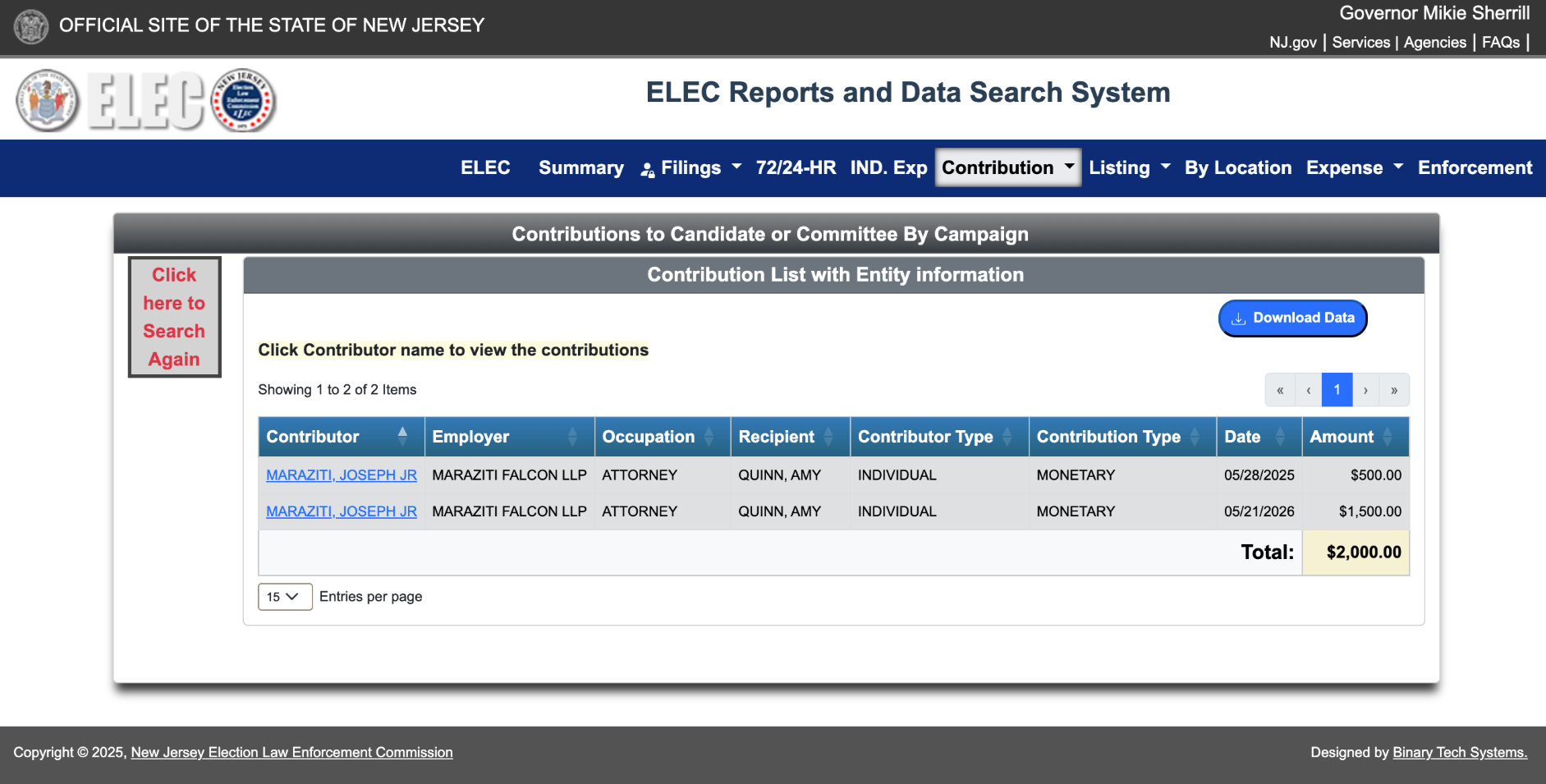
Photo Credits: OFFICIAL SITE OF THE STATE OF NEW JERSEY WEBSITE
According to New Jersey Election Law Enforcement Commission reports cited in the interview, Maraziti contributed $2,000 to Quinn's campaign between 2025 and 2026. Quinn said she refunded the contribution in 2026.
“It was totally a personal decision,” Quinn said. “I refunded Joe Maraziti this year because I just wasn't comfortable taking a donation from him at that time.”
Asked whether safeguards should prevent campaign contributions from attorneys doing business with the city from influencing municipal decisions, Quinn emphasized performance and accountability.
“If you're doing a good job, it's up to you if you want to donate,” she said. “If you're not doing a good job, donating is not going to save you. You're going to be out anyway.”
Quinn also addressed whether the city should reconsider payments in lieu of taxes, or PILOT agreements, associated with waterfront redevelopment.
She said she did not believe the waterfront needed PILOTs but acknowledged that withdrawing from an agreement established in 2012 could trigger litigation.
“That's a tough decision for me to get out of. I think there's no question that it's going to result in litigation,” she said.
Quinn said city officials regularly consider litigation but must weigh the potential expense and duration of legal proceedings.
School funding, taxes and PILOT reform
Quinn identified the state's school funding formula as a central issue affecting Asbury Park property taxpayers.
She said the city's 2012 Project Finance Agreement was developed following an arbitration involving waterfront redevelopment infrastructure costs. Under the arrangement, a portion of funding otherwise associated with the school district was directed toward waterfront infrastructure.
Quinn said the arrangement reflected the circumstances of 2012, when the school district received substantial state aid and officials did not expect the agreement to significantly increase residents' tax burden.
That changed, she said, after state school funding reforms reduced aid to the district.
Quinn said the district lost between $35 million and $40 million under the state's S2 funding formula in 2018, leaving local taxpayers to absorb more of the costs.
“That is being picked up by the taxpayers of Asbury Park and that is hurting, including myself, the taxpayers of Asbury Park,” she said.
She said she has been speaking with state Sen. Vin Gopal and Assemblywomen Luanne Peterpaul and Margie Donlon to ensure Asbury Park's concerns are represented in discussions with the administration of Gov. Mikie Sherrill.
Quinn believes the Gov. Mikie Sherrill administration understands the funding formula problem and is launching a statewide school funding outreach effort.
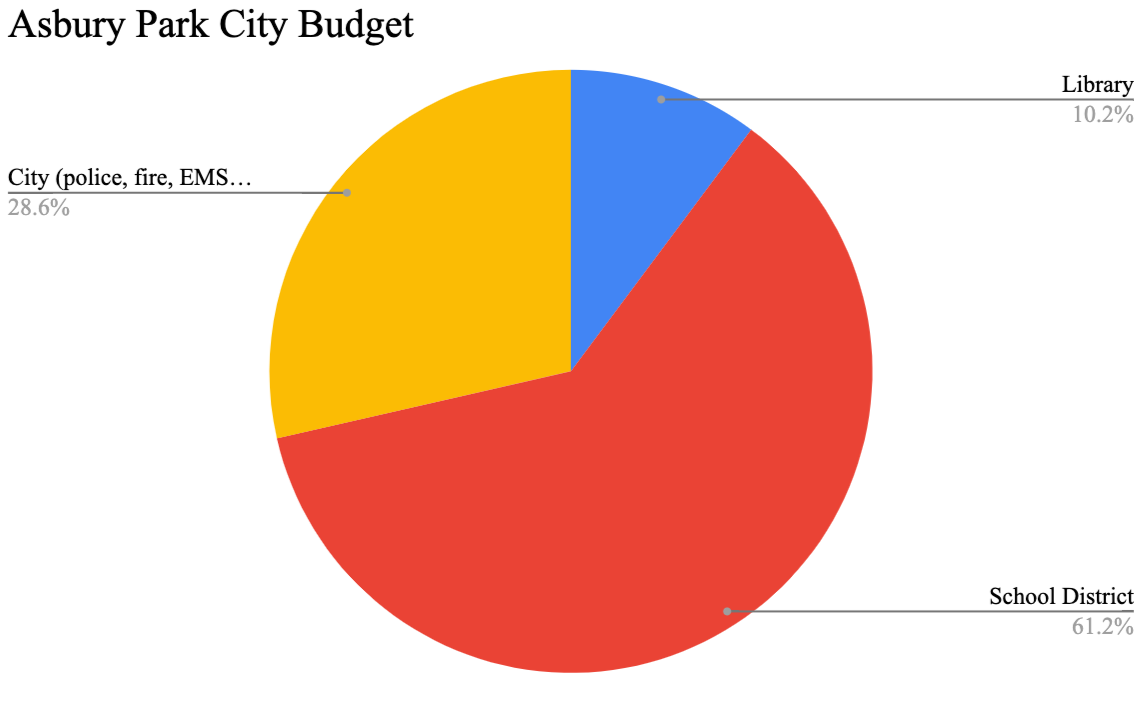
Photo Credits: Open Governance News /Asbury Park City Budget
Quinn explained 10 to 13 percent goes to the county library, approximately 28 percent goes to the city of Asbury Park including police, fire, EMS, roads, and city workers and then the 60 percent is the Asbury Park School District.
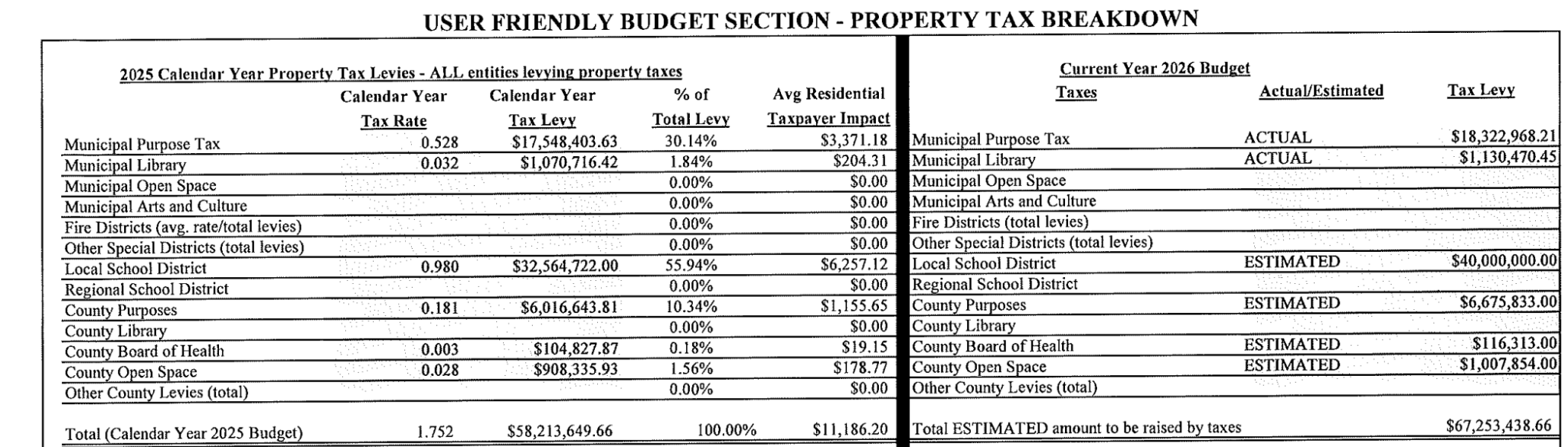
Photo Credit: City of Asbury Park / 2026 User Friendly Budget
Quinn proposed exploring ways to repurpose or sell unused school buildings and share grant services, working with school board members and state officials.
“What I would love to do is sit down with members of the school board and our elected officials and hopefully members of the Mikie administration and talk about how the buildings that aren't being repurposed, is there a way to sell those buildings and either split that with the city of Asbury Park and the school district,” Quinn said.
Quinn also supports Senate Bill S1807, sponsored by Sens. Troy Singleton and Benjie Wimberly. The legislation would require municipalities to share PILOT revenue with school districts and improve information-sharing concerning tax abatements.
However, Quinn said PILOT reform alone would not resolve the city's long-term school funding challenges.
“One of the issues with PILOTs is the city gets its portion and then the school portion is diverted to infrastructure,” Quinn said. “The city is reluctant to give a portion of that money to the school district because what has always been said to us is that added revenue to the Asbury Park School District would result in decreased state aid.”
For Quinn, reforming the overall school funding formula is therefore a higher priority than simply redistributing PILOT revenue.
She also proposed exploring whether vacant school buildings could be sold, with proceeds potentially shared between the city and school district. She said she would like to work with school board members and state officials on that possibility.
Affordable housing and the West Side
Quinn said Asbury Park should pursue more affordable housing, including developments outside the waterfront.
She said waterfront redevelopment agreements did not require affordable units within those projects, although money was set aside for affordable housing.
Changing the agreements would require the consent of the master developer or other parties, or litigation, she said.
Outside the waterfront, Quinn said the city has incorporated an affordable housing minimum of approximately 20 percent and that she would like to increase that share.
“What I hope to do in the first year or so is get those numbers up,” she said. “So, we want to see 25 percent, 35 percent, 45 percent.”
Quinn also highlighted plans for the Home Plate property, identified as Block 74, lots 1, 9 and 10, near Memorial Avenue and Springwood Avenue.
The City Council approved selling the property to the Housing Authority for $1 at its Oct. 14 meeting, according to the interview.
Quinn said the proposed development could include approximately 185 affordable housing units, with retail space on the ground floor.
She also emphasized residents' interest in bringing practical services and businesses to Springwood Avenue, including grocery stores, laundromats and banks.
The issue has become part of the mayoral campaign's discussion about the West Side's future. At a recent League of Women Voters forum, Quinn questioned a proposal raised by opponent Dan Sciannameo to establish an arts district in the area.
“I am not hearing on the door that people want to see an arts district there,” Quinn said. “I'm hearing about food stores, laundromats and banks.”
Homelessness and parking
Quinn said Asbury Park's social services department works with unhoused residents to connect them with short-term shelter and other assistance.
She argued that the responsibility for providing shelter should be shared across Monmouth County rather than falling disproportionately on Asbury Park.
“We have a pretty robust social services department that goes out and communicates with the homeless population and tries to get short-term shelter,” Quinn said. “We need more shelters or temporary housing for people who don't have it throughout Monmouth County. It is not just Asbury Park's responsibility.”
Quinn said the lack of a Code Blue shelter in western Monmouth County has contributed to the strain on Asbury Park's services. She criticized the county's planning for a problem she said officials know is occurring.
“My frustration with that is not with Asbury Park, but at the county level and their lack of planning for this issue that we absolutely know is occurring,” Quinn said.
Parking is another issue Quinn said deserves further discussion, particularly given concerns about affordability for residents and workers. She acknowledged that parking enforcement can be overly aggressive, but noted that parking revenue supports municipal expenses, including street paving, bike lanes and other infrastructure.
Quinn also pointed to alternative transportation options, including scooters and the city shuttle. She said officials were discussing the possibility of adding a tracker to help riders determine when the shuttle would arrive.
Two parking decks are also under discussion for the waterfront, Quinn said, while a public-private partnership could potentially support a parking structure downtown. She noted that developers have limited financial incentives to build parking decks because they are generally not profitable on their own.
Quinn also cited the state-operated parking lot on Bangs Avenue, saying hundreds of spaces often go unused and that restrictions limit how the city can promote the lot.
The limits of the mayor's role
Quinn said many of her priorities, including school funding, PILOT reform, affordable transportation and improvements to Wesley Lake, depend on cooperation with other elected officials.
She emphasized that becoming mayor would not give her unilateral authority to implement policy.
“I can't advance anything as mayor,” Quinn said. “I have one vote, as does the deputy mayor, as do all the council members.”
She said the city's form of government requires council support for major initiatives and that relationships with state lawmakers and the governor's administration are important to securing funding and advancing local priorities.

Photo Credits: AQ For AP Campaign Website.
“Those relationships helped get us tax credits,” Quinn said. “They helped get us the $13 million that is being worked on right now with Convention Hall.”
As the Nov. 3 election approaches, Quinn's agenda centers on moving the Casino redevelopment forward, improving school funding, expanding affordable housing and addressing residents’ concerns about taxes and parking. Whether those priorities translate into policy will depend not only on her leadership, but also on the council, developers and state officials whose cooperation she says is necessary.
Early voting begins Oct. 24 through Nov. 1 and election day is Nov. 3. For more information on election details, see here.
To add to or correct any information in this report, please get in touch with me at angelica.n@lead4earth.org
Thumbnail Photo Credits: Open Governance News by Lead for Earth Youtube
Resolution-2023-29
Resolution-2023-29.pdf
2023 - Maraziti Falcon - Waterfront Redevelopment Counsel
2023 - Maraziti Falcon - Waterfront Redevelopment Counsel.pdf
Maraziti Falcon - Waterfront Redevelopment Counsel - John Maraziti
Maraziti Falcon - Waterfront Redevelopment Counsel - John Maraziti.pdf
0
0

Comments