(ASBURY PARK, N.J.) — Asbury Park's long-running dispute over the future of its historic Casino shifted Wednesday from competing legal opinions to a public explanation of the City's legal strategy, as officials defended their decision at the city council meeting not to immediately pursue litigation, while attorney Thomas DeSeno argued they have repeatedly changed their interpretation of the redevelopment agreements.
The dispute centers on whether Asbury Partners, owned by iStar, ever became contractually obligated to complete approximately $33.6 million in repairs identified in the 2004 Clarke Caton Hintz report prepared under Section 3.05 of the 2002 Redeveloper Agreement. Retired New Jersey Supreme Court Justice Lee Solomon previously concluded the City retains potential remedies under the redevelopment agreements but did not determine whether a contractual default occurred, leaving attorneys to disagree over whether later agreements modified or eliminated those obligations.
OpGov.News has examined the underlying redevelopment agreements, obtained the Clarke Caton Hintz report, and interviewed attorneys representing competing interpretations of those documents over the past several weeks.
Those competing legal interpretations came to a head Wednesday during a City Council meeting at Asbury Park High School, where more than 150 residents, preservation advocates, former elected officials and attorneys gathered to urge the City to pursue legal action against Asbury Partners over the deteriorating Casino complex.
Although many speakers urged the City to sue, the City's outside redevelopment counsel, Joseph Maraziti, spent much of the evening explaining why he believes the City currently lacks a legally supportable basis to pursue the specific remedy of reclaiming the Casino.
"For an attorney to bring a lawsuit, you must have facts and law that are presentable to a court," Maraziti told the audience. "In my opinion, we don't have either here."
City Says It Has Not Ruled Out Litigation
Mayor John Moor opened the meeting by acknowledging widespread frustration over the condition of the Casino while emphasizing that City officials have not foreclosed litigation.
"We want to get this Casino back on track," Moor said. "Madison is not the right organization to do that."
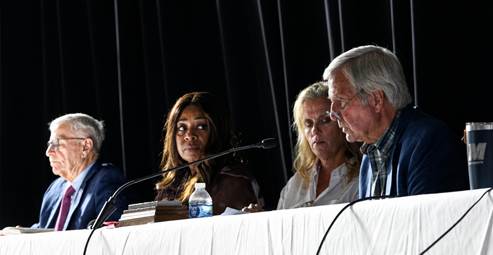
(Mayor John Moor speaks during a special Asbury Park City Council meeting where officials publicly explained the City's legal strategy regarding the long-stalled Casino redevelopment. Credit: APTV YouTube video.)
Moor described Madison Marquette as "impossible to work with" but questioned whether filing an uncertain lawsuit should be the City's first response.
"I don't know if I could morally vote on something that could potentially, on a long shot, put the City in worse financial shape because of legal fees and everything else," he said.
Instead, Moor said the City is pursuing multiple avenues simultaneously.
He said officials have consulted Clarke Caton Hintz, directed the City's Construction Department to review records documenting improvements made to the Casino property should the City eventually pursue its contractual buy-back rights, and are evaluating additional options that cannot yet be discussed publicly.
Moor also said preserving the City's effort to obtain historic tax credits for Convention Hall remains an important consideration.
Near the conclusion of the meeting, Moor emphasized that while litigation remains an option, he does not believe the City has reached that point.
"Can you get me to a lawsuit? Yes," Moor said. "Am I there? No."
He said he remains unwilling to commit taxpayers to what could become years of expensive litigation until officials determine it represents the strongest legal path available.
"I'm cautious before I gamble with all of your money on a lengthy lawsuit," Moor said. "As much as I do not like Madison Marquette because they're tough to work with, if we do not get those tax credits, Convention Hall is going to fall," he added.
Maraziti Details City's Legal Analysis
Maraziti devoted much of the evening to explaining why he believes the redevelopment agreements do not currently support litigation seeking to re-acquire the Casino.
According to Maraziti, Section 3.5 of the 2002 Redeveloper's Agreement required two separate steps: completion of a professional rehabilitation report and a subsequent written agreement establishing a construction schedule within 120 days after the report was submitted. (Read separate article here.)
He argued that while the Clarke Caton Hintz report was completed, the required follow-up agreement was never executed.
"The mere issuance of the report is not the obligation of Asbury Partners," Maraziti said. "There had to be a second agreement to undertake $33 million worth of work, and that never happened."
Maraziti also argued that the 2007 Estoppel and Consent Certificate supports that interpretation because it states there were no existing defaults under the redevelopment agreements at that time.
He warned that attorneys are ethically prohibited from filing lawsuits lacking sufficient legal and factual support and cautioned that unsuccessful litigation deemed frivolous could leave the City responsible for the opposing party's legal fees.
DeSeno Says City Has Changed Its Legal Position
Attorney Tom DeSeno rejected Maraziti's legal analysis, arguing the dispute is no longer simply about differing interpretations of redevelopment agreements but whether the City is accurately representing Justice Solomon's conclusions.
"When a judge says something is blue, lawyers can debate whether he meant navy blue or royal blue," DeSeno said. "But when the judge says blue and somebody stands up and says he said green, that's not interpretation. That's misrepresentation."
DeSeno also argued that the City's legal position has shifted repeatedly in recent months.
According to DeSeno, Maraziti has advanced three different legal theories regarding which redevelopment agreement governs the City's remedies—first relying on the 2010 Subsequent Developer Agreement, later emphasizing the 2006 Dispute Resolution Agreement, and now focusing on the 2007 Estoppel and Consent Certificate.
DeSeno contrasted those changes with his own legal analysis, telling the Council he has maintained the same interpretation of the redevelopment agreements, while arguing the City's evolving legal position undermines confidence in its current conclusions.
Maraziti disputed that characterization throughout the meeting, maintaining that additional documents reviewed after Justice Solomon's initial opinion materially changed the legal analysis and ultimately led him to conclude the City lacks a viable legal basis to pursue the Casino buy-back remedy.
Former Councilman Challenges City's Reading of Agreements
Former Councilman Jim Keady, who served on the Council when both the 2006 Dispute Resolution Agreement and the 2007 Estoppel and Consent Certificate were negotiated, also disputed the City's interpretation of those documents.
"I believe I'm the only person in this room who was in the room when the 2006 Dispute Resolution Agreement was negotiated and signed, and the Estoppel Agreement in 2007," Keady said.
Keady argued the City's current explanation does not reflect the intent of the Council that negotiated those agreements and urged current officials to pursue litigation.
Planning Board member Daniel Sciannameo also urged the Council to use Justice Solomon's opinion as leverage to begin litigation, arguing that filing suit itself could force meaningful negotiations with the developers.
"You have the opening," Sciannameo told the Council. "You start the lawsuit, you bring them to the negotiating table."
Sciannameo, whose recent Planning Board recusal after publicly criticizing the Casino redevelopment during another city council meeting became the subject of a separate OpGov.News investigation, argued the City should use Justice Solomon's opinion as leverage to begin litigation.
"It is your responsibility as the Council to do this," he said.
Public Records Search Continues
As part of its continuing investigation, OpGov.News submitted multiple OPRA requests seeking records related to the 2004 Clarke Caton Hintz report prepared under Section 3.05 of the 2002 Redeveloper Agreement.

The City produced what it identified as the complete Clarke Caton Hintz report, including its appendices and accompanying rehabilitation schedule, and reported it located no separate Becker & Frondorf construction cost estimates beyond those materials.
In response to additional requests, however, the City reported it found no responsive records documenting the report's transmittal, receipt or internal distribution. The City also asserted attorney-client and deliberative process privileges over certain requested records seeking internal discussions of the report, while denying other requests as overbroad under the Open Public Records Act.
Developers Have Not Responded
OpGov.News reached out July 3 to representatives for Asbury Partners, Madison Marquette and Safehold Inc., seeking comment on the competing legal interpretations of the redevelopment agreements and the companies' current views of their contractual obligations regarding the Casino and Power Plant.
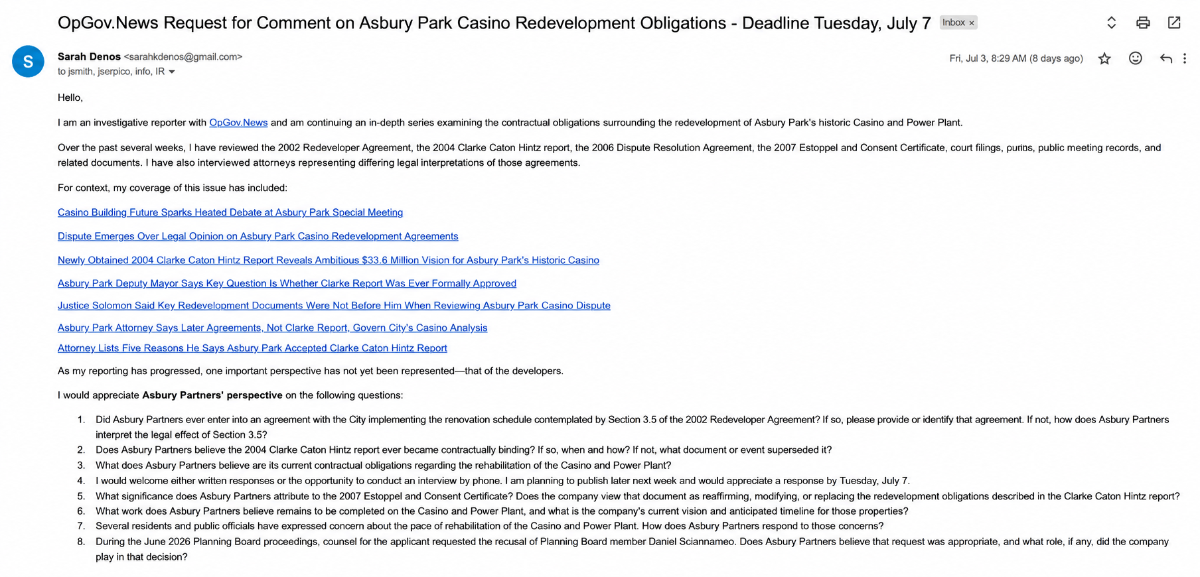
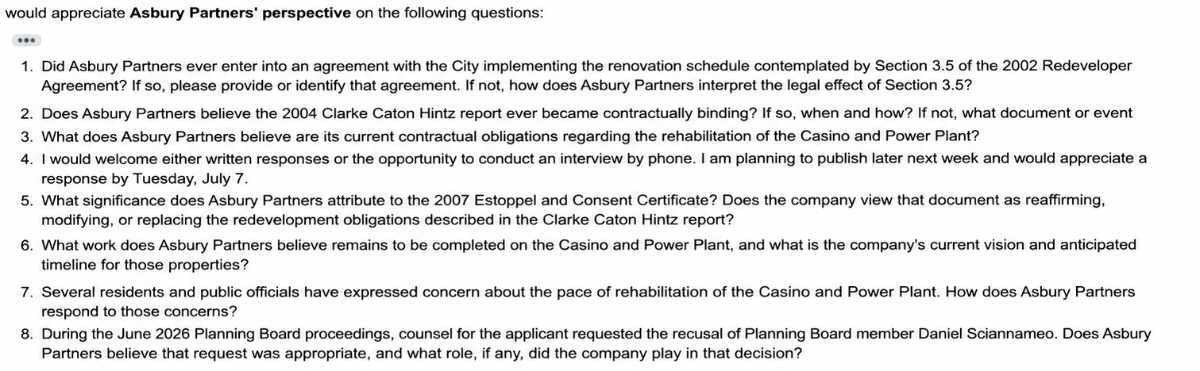
Among other questions, OpGov.News asked whether Asbury Partners believes it ever entered into the follow-up agreement contemplated by Section 3.05 of the 2002 Redeveloper's Agreement, whether the 2004 Clarke Caton Hintz rehabilitation report ever became contractually binding, how the companies interpret the 2007 Estoppel and Consent Certificate, what they believe their current contractual obligations are, and what redevelopment timeline they anticipate for the Casino and Power Plant.
OpGov.News also sought responses to public criticism regarding the pace of redevelopment and requested interviews with company representatives.
As of publication, OpGov.News has not received an initial response from representatives of Asbury Partners, Madison Marquette or Safehold Inc. OpGov.News emailed the representatives once again as a reminder that we are seeking comment from them related to the issue. If, for any reason, these email requests are not received, representatives may contact OpGov.News using the email address provided at the end of this article.
Representatives of the developers also did not attend Wednesday night's meeting to address residents' questions or respond publicly to the competing legal interpretations discussed during the hearing.
New Details Revealed About Justice Solomon Opinion
The meeting also produced several new disclosures about the City's handling of Justice Solomon's legal opinions.
During questioning from residents, City Attorney Kevin Starkey acknowledged he initially recommended redacting portions of Justice Solomon's April 23 opinion before releasing it publicly because he believed portions could affect potential litigation.
According to Starkey, the Mayor and Council rejected that recommendation.
"I was overruled by the mayor and council," Starkey said. "They said, 'We want full transparency with the public. We don't want to hide anything from them. Don't redact it and put it out.'"
Mayor John Moor also said he would review whether an earlier City statement asserting Justice Solomon found "no viable path" for the City to retake the Casino should be clarified after residents (and DeSeno) noted those words do not appear in Solomon's written opinion.
Residents Press for Immediate Action
Several speakers argued Justice Solomon's opinion already provides the City with sufficient legal grounds to initiate litigation and force negotiations with the developers.
Others pledged private financial support for litigation through a nonprofit organization established to help preserve the historic structures.
Former Councilman Jim Keady framed the issue as a political decision rather than simply a legal one.
"Do you want to fight to save the Casino?" Keady asked. "It's a yes or no."
Throughout the evening, residents questioned why legal action had not been taken despite years of redevelopment delays and continuing deterioration of the landmark buildings.
Officials Say Other Strategies Are Being Considered
Despite repeated calls for litigation, the Council took no action authorizing a lawsuit.
Instead, Moor and several Council members said they continue discussing other strategies in executive session, while evaluating both litigation and non-litigation options.
Although officials repeatedly said alternative strategies are under discussion, they declined to publicly identify those options.
As a result, the meeting clarified the competing legal theories that have dominated months of public debate but left unresolved the question residents repeatedly returned to throughout the evening: if not litigation, what concrete strategy will the City pursue to preserve the Casino before further deterioration occurs?
OpGov.News has submitted a follow-up question to the Maraziti seeking additional details about the non-litigation strategies discussed during the meeting and will update this story if additional information is provided.
STORY UPDATED 7/13/26: After publication, redevelopment attorney Joseph Maraziti told OpGov.News that his comments during Wednesday's meeting were limited to the City's ability to pursue the specific "buy-back" remedy discussed that evening and should not be interpreted as meaning the City has no other options. "The simple answer is YES, there are other tools and remedies available to the City to deal with the intolerable failures of Madison Asbury Retail/Madison Marquette to act as proper stewards for those important structures that are unique to Asbury Park," Maraziti wrote in an email. He added that the City is considering "a variety of other approaches," consistent with comments made by Mayor John Moor during the meeting, but declined to elaborate, saying, "At this time, it would be inappropriate to discuss internal deliberations."
If you’d like to add or correct anything in this report, feel free to reach out to me or leave a comment below. If you have any Asbury Park story tips or ideas, please reach out to Sarah Denos at sarahkdenos@gmail.com.
0
1

Comments