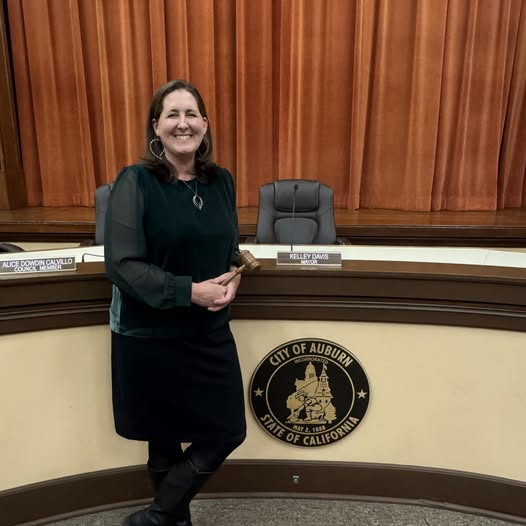
Photo Credit: Kelley Davis for Auburn City Council / Facebook
(AUBURN, CA.) – A dispute over the handling of a candidate filing arose at Auburn City Hall last week after public speaker Wayne Nader accused the council of “bending...the election law.” He said that he was "very concerned and disappointed in that decision."
According to Nader, the council met at a “special meeting to make an exception” the week before to accommodate the re-election campaign of Kelley Davis, though she missed the original deadline for submitting nomination papers.
Nader’s comments drew a response from Council Member Dowdin Calvillo, who said, “I know we’re not going to engage in back and forth conversation, but just to correct the record, the city did meet in closed session last week. We took no action.”
The only council meeting listed for the previous week was on August 19. Its agenda identifies a closed-session item concerning litigation. If Nader's claims are accurate, this raises questions about whether the meeting complied with California Government Code §54956(a)(1), which states that “[n]o other business shall be considered at [special] meetings by the legislative body.”
OpGov.News located a statement from the Auburn City Clerk explaining the filing deadline and the circumstances surrounding the extension. The statement read in part that “[b]ecause another incumbent did not file on or before the 88th day before the election, the nomination period was extended to the 83rd day before the election by operation of law.”
The incumbent in question is Council Member Sandra Amara, who, according to records from the Auburn City Clerk and County Elections Office, did not file seeking re-election.
According to the City Clerk, Mayor Davis did not submit her documentation on time to meet the original deadline, but “submitted the paperwork on the 85th day before the election.” The City Clerk therefore determined that Davis's filing was permissible because it occurred within the extended nomination period.
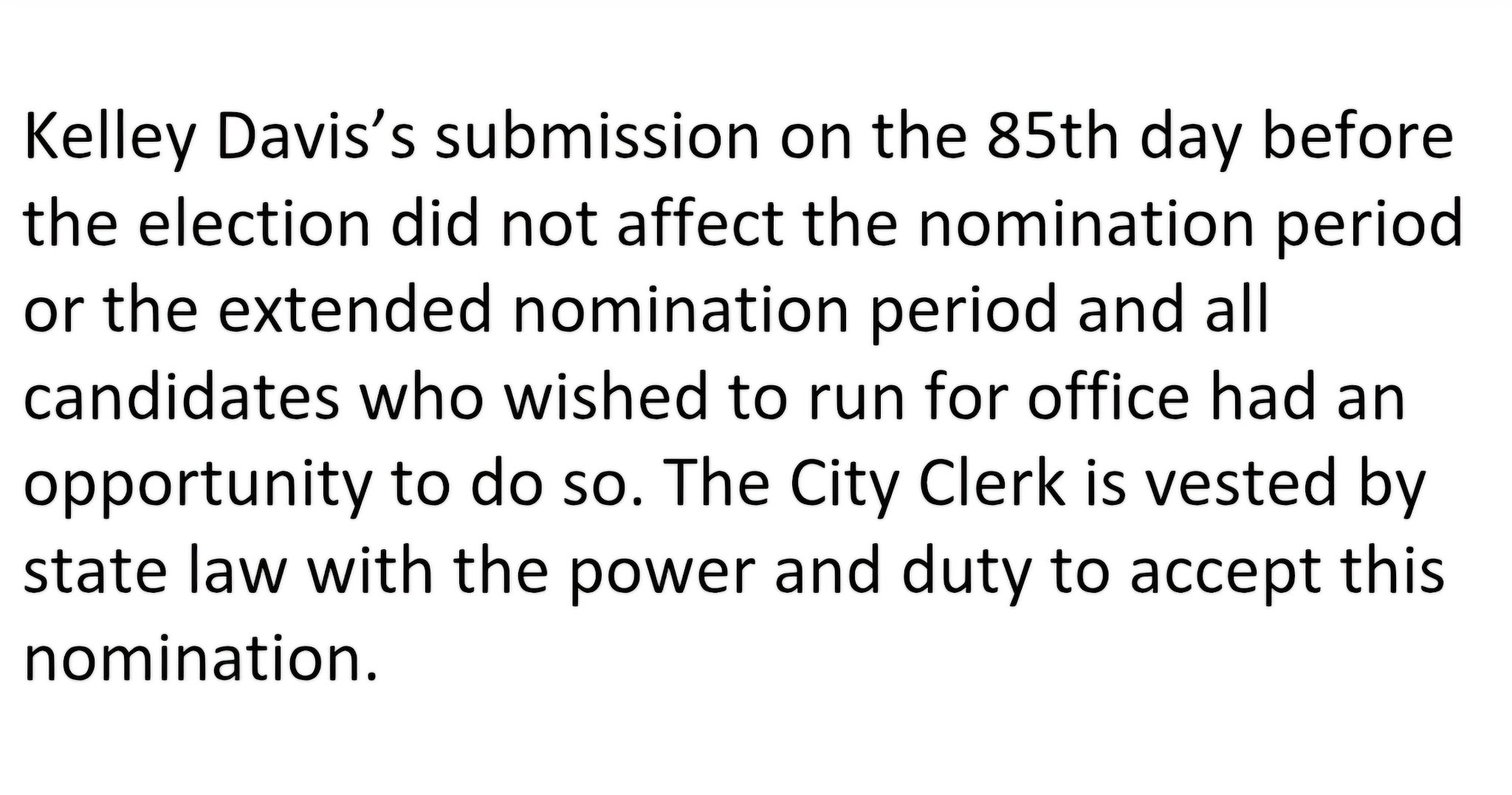
Photo Credit: City Clerk’s Office / City of Auburn
Nader, however, disputes that interpretation of the law, saying that the extension only applies to “non-incumbents.”
Both Nader's interpretation and the City Clerk’s determination are based on California Elections Code §10225. The statute addresses extension periods for potential candidates and outlines the 88-day and 83-day procedures. It states that when an incumbent has not submitted nomination papers, “the voters shall have until the 83rd day before the election…to nominate candidates other than the person who was the incumbent.”
While the city says the failure of another incumbent to file triggered an extension “by operation of law,” Nader maintains that the statutory language means the extended period is intended for candidates other than the incumbent.
The controversy also prompted additional public comment concerning the constitutional responsibilities of elected officials. This includes Sandy, who followed Nader. In reference to the U.S. Constitution, she introduced herself as “one of We the People.”
After thanking the council for their service, Sandy said that she “wanted to remind” council members of their “oaths of office to defend both the federal and the state constitutions.” Following this, Sandy read the preamble to the respective constitutions before referencing the Supreme Court cases Marbury v. Madison (1803) and Trump v. United States (2024).
Sandy characterized the cases as relevant to the discussion, saying they state, respectively, that “‘[a]ny law repugnant to the constitution [is] void,’"* and “that there is no immunity for unofficial acts.” She concluded by saying, “I would advise that this council be careful to abide by the constitutionally pursuant rules and statutes that have been passed concerning local elections.”
The exchange comes as Auburn continues to see debate over governmental transparency and other issues, including a growing DeFlock movement.
The dispute leaves unresolved whether the extended nomination period applied to Davis, putting the interpretation of California Elections Code §10225 at the center of the controversy over Auburn’s election administration.
*Sandy quotes then Chief Justice John Marshall nearly verbatim. Marshall used the word “is,” while Sandy used the phrase “shall be.” To maintain continuity, [is] is used instead of “shall be.”
*9/2/2026: An earlier edition of this story contained a typo indicating that the public speaker was Wayne Mater. It should have been Wayne Nader.
To add to or correct any information in this report, please contact me at robert.m@lead4earth.org or leave a comment below with your thoughts.
0
1

Comments