Photo Credit: City of Auburn / YouTube
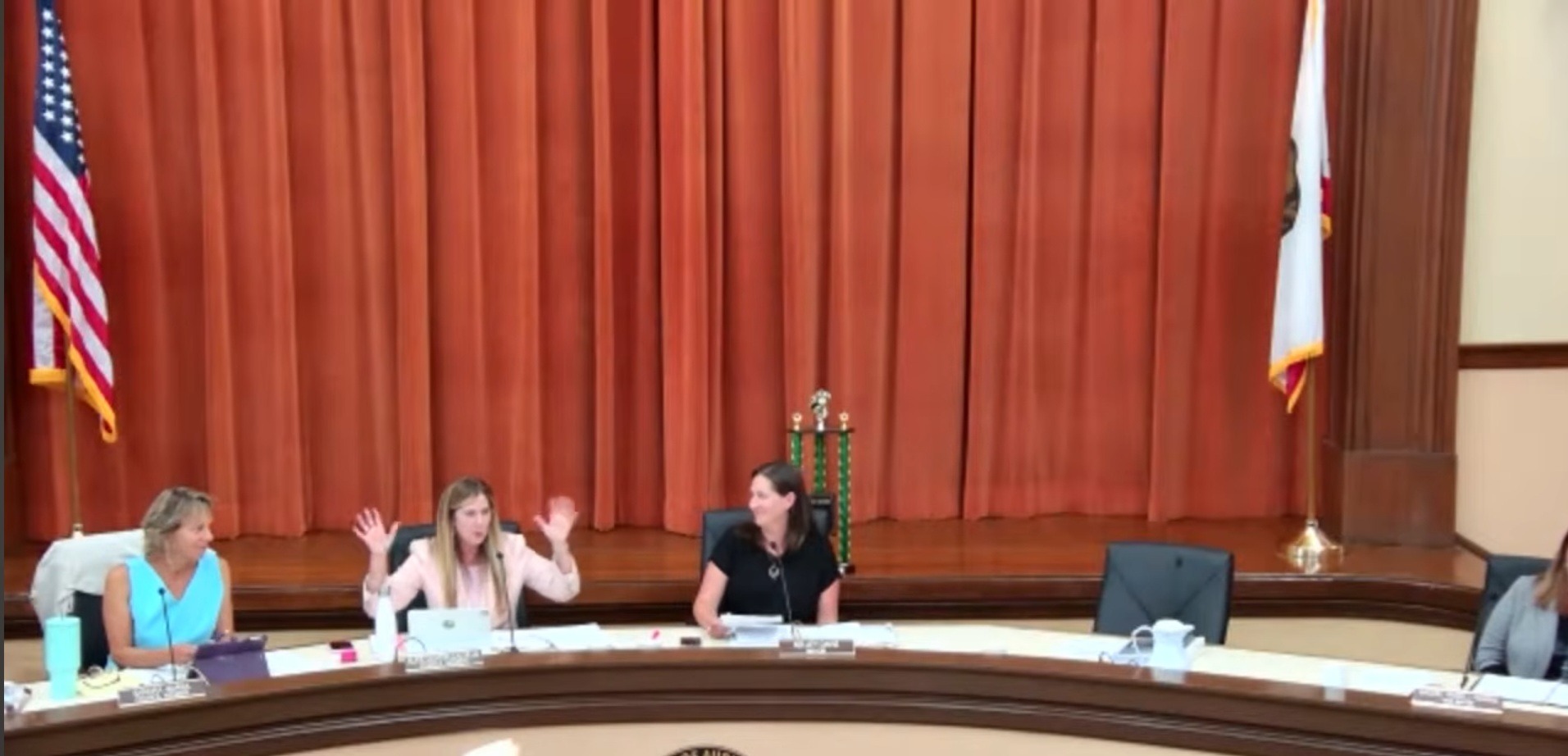
(AUBURN, CA.) — A conspicuous sign attached to the public podium at the Auburn City Council’s August 24 meeting reminded speakers of the three-minute limit for public comment.
The reminder came less than two weeks after the council’s August 10 meeting, where residents spoke at length about Flock Safety license-plate-reading cameras. That meeting ultimately led to the establishment of a public forum scheduled for September 21 to discuss the technology.
Before non-agenda public comment began, Mayor Kelley Davis reminded speakers of the upcoming forum. A total of six residents nevertheless used their allotted three minutes to address the city's use of Flock cameras. Of these, two were in support of Flock cameras and four were against. An additional six email comments from residents were sent to the council, all but one of which was against Flock cameras. This means that of the 12 public comments and emails concerning Flock three supported the cameras while nine opposed them.
An OpGov.News poll conducted through Nextdoor recorded 155 votes opposing Flock cameras, 86 respondents selecting that the cameras make them “Feel Safe,” and 16 who were undecided. The poll reflects the responses of participating Nextdoor users and is not necessarily representative of Auburn residents as a whole.
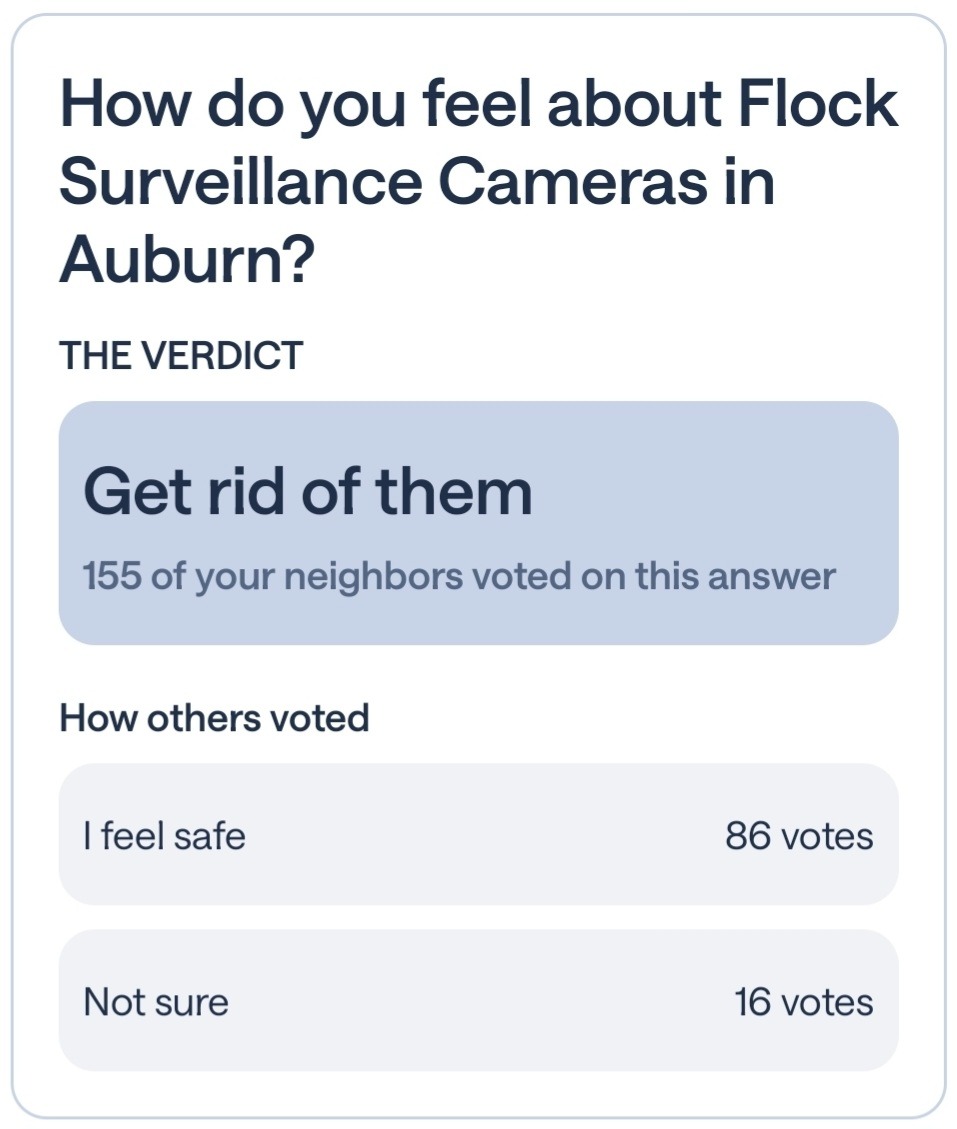
Photo Credit: Nextdoor
Some speakers at the council meeting defended the cameras. This includes Dory Havlin of Auburn, who told the council, “My feeling is If you’re a legit human being, you wouldn’t have anything to worry about, right? So, go for it. Help the police officers.”
Rich Neilson, who described himself as a “retired deputy sheriff,” said he had originally attended the meeting to discuss bicycle lanes, but in addressing the council, Neilson said that he’d had his “life saved from an LPR camera.” He also claimed that people in public do not have “any right” or “expectation” to privacy and encouraged residents to “support…local law enforcement” before he departed.
Neilson’s comments received light applause from Havlin and others.
Supporters, like Havlin and the Auburn Police Department have also pointed to Flock's potential role in serious criminal investigations. As for the latter, a June social media post said officers had “utilized Flock Safety technology to locate and apprehend” a person who had been charged with “unlawful sexual intercourse with a minor.”
The department said such cases demonstrate why Flock technology exists and emphasized that its intended purpose is “not to monitor law abiding residents.”
“Protecting our children should never be up for debate,” the department said, adding that “[i]f technology helps remove an alleged child predator from our streets, that is exactly the kind of technology our community expects us to use.”
These statements are consistent with the Flock camera policies of the Auburn Police Department. These policies also include training and data storage requirements, and restrictions on data sharing. The department’s transparency report shows that data from 12 cameras is currently stored for 30 days. Of a reported 171,151 vehicles captured by the cameras during the reporting period, 103 “user search sessions” have been conducted.
Regardless of these precautions and statistics, opponents of the technology have raised a different concern: that surveillance systems created for legitimate law-enforcement purposes can potentially be used in ways residents did not anticipate.
One of the more prominent opponents speaking at the August 24 meeting was Erik Robb, a candidate for Auburn City Council in the November election. Addressing the public more than the council, Robb used much of his three minutes to criticize Flock surveillance, warning that the cameras could be misused in situations involving personal relationships or disputes with law-enforcement officers.
He concluded with a broader warning that echoes his campaign statements against AI: “It’s not a matter of if. It’s not a matter of a couple of bad apples. If the power is there it will be used, always.” Robb then left the podium to applause from the audience.
Council Member Alice Dowdin Calvillo suggested that attendees use “jazz hands” instead of applause, a procedure “instituted once before.” She explained that applause would “disrupt the council chamber.”
Video Credit: City of Auburn / YouTube
The dispute over Flock is also becoming more visible outside the council chambers. OpGov.News can confirm at least two signs in Auburn opposing Flock cameras and endorsing deflockauburnca.com. Those independently verified are posted near a Flock camera at the intersection of Elm Avenue and Interstate 80.
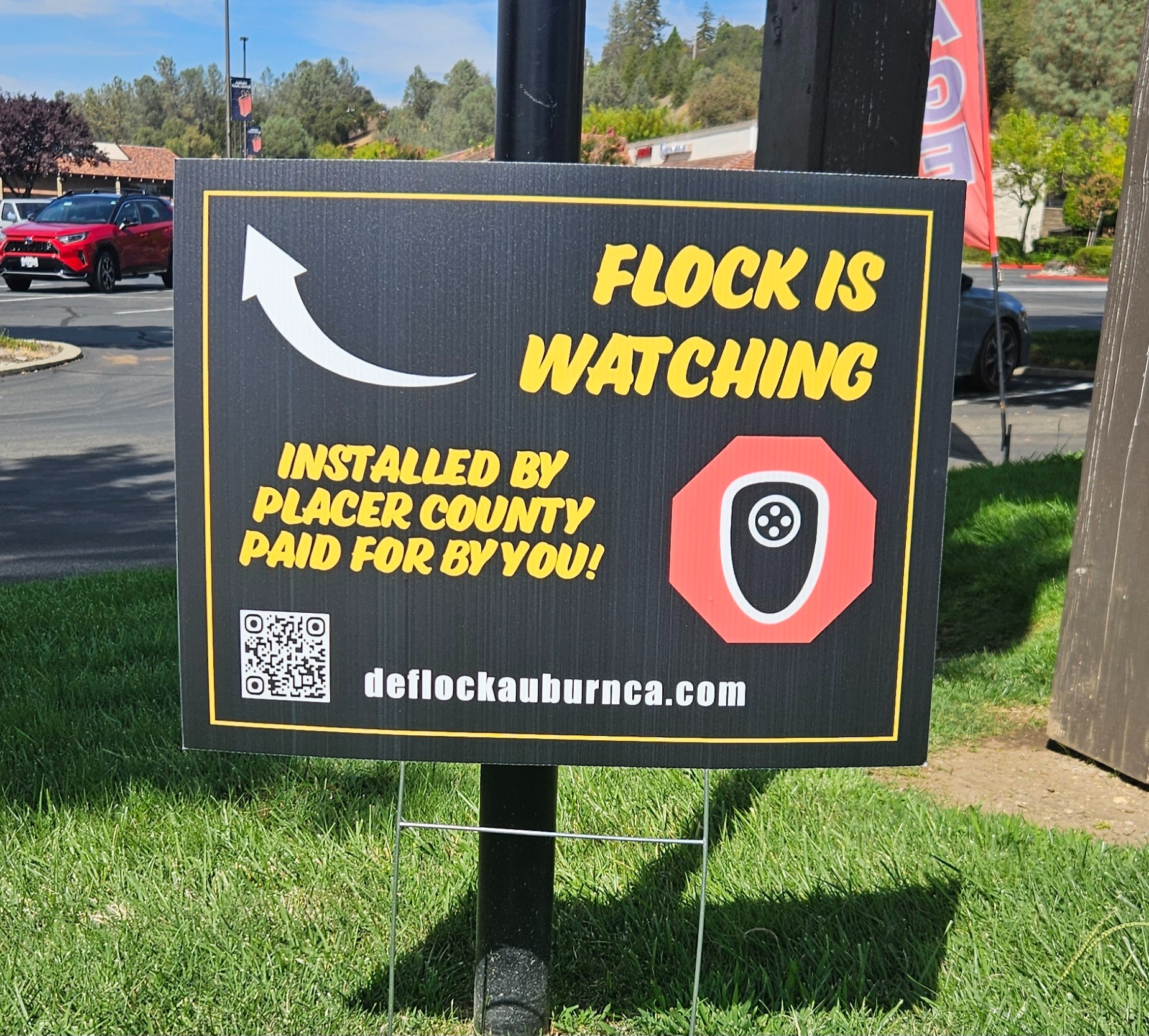
Photo Credit: Robert MacMahon
With the September 21 forum approaching, the disagreement over Flock cameras shows little sign of disappearing. Supporters continue to point to law enforcement and public-safety applications, while opponents question the privacy implications of expanding automated surveillance.
For the Auburn City Council, the September forum will provide another opportunity for residents on both sides to make their case as the city weighs the role of Flock technology in the community.
To add to or correct any information in this report, please contact me at robert.m@lead4earth.org or leave a comment below with your thoughts.
1
0

Comments