(TALLAHASSEE, Flor.) -- The Social Security Administration announced that seniors receiving benefits will receive a 3.6% increase in their monthly payments for an average of $75 each month. The changes will start in January of 2027 and are part of the Cost of Living Adjustments (COLA) for the new year.
The annual increase is derived from the CPI-W index, with a formula tailored for retired citizens. Unlike the CPI-E index used for working citizens, the CPI-W includes medical and housing expenses. Despite the favorable index, many seniors are displeased with the current system.
Cost-of-Living Adjustments increase Social Security payments in accordance with the previous year's inflation. Seniors would prefer for adjustments to be predictive and be made to reflect how inflation will affect finances in the coming year rather than the previous one.
With housing and healthcare prices rising, the delayed adjustments have led to a measurable decrease in senior purchasing power.
Over 70 million Americans receive Social Security, and more than 20% are fully dependent on Social Security as income. More than half of retirees get 50% or more of their income directly from Social Security, creating a divergent issue.
Seniors are in need of Social Security more than ever, and funds are running low. Social Security is paid from the Old Age and Survivors Trust Fund (OASI), which may run out of money as soon as 2032.
Less than 80% of Social Security payments each year are ‘replenished’ by tax dollars, creating a gap once funds run out.
Although legal by the Constitution, any politician who supports limiting or eliminating Social Security would lose support from their largest demographic, making such a change difficult or impossible.
Regardless, a change is imminent. Unless there is an unprecedented increase in working-class citizens, there will be either an increase in payroll taxes or a decrease in Social Security payments.
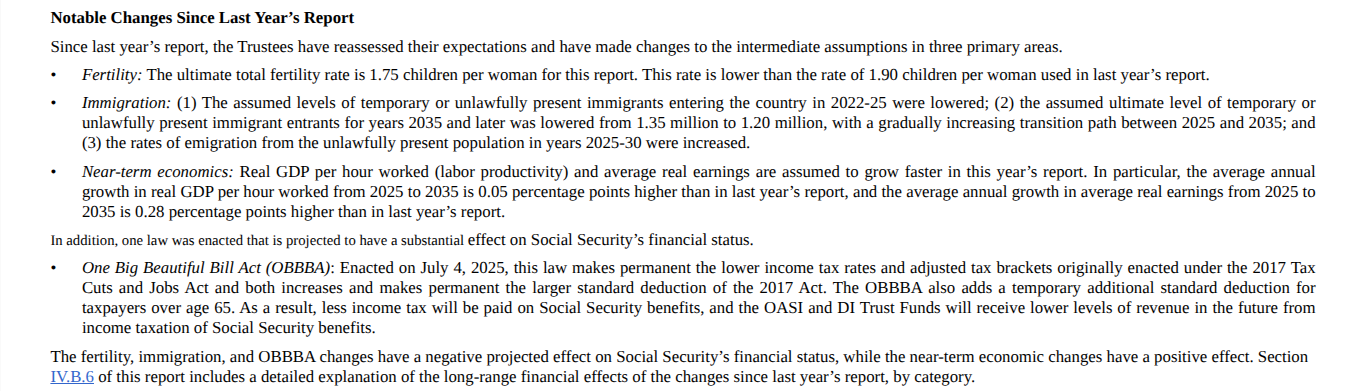
Photo Credit: Social Security Administration
The Social Security Administration (SSA) features fertility rates and immigration as key statistics, as they are indicators of how well the OASI can be replenished. There are currently 2.7 workers per retired citizen, compared to five workers per retiree in 1960. The OASI fund is the single largest and most relevant fund for retirees, with disability only awarded to eligible citizens.
During his previous term, President Donald Trump has both limited legal immigration and opposed raising the age of Social Security.
Tallahassee has a relatively large senior population of over 20,000 people, and could be significantly affected by the change.
Ultimately, there are a few legislative options outside of decreasing every Social Security check by 20%. The government may raise taxes or even the retirement age in an attempt to balance the ratio of earners to beneficiaries. Current discussions include gradually increasing the retirement age to 70, with new requirements only applying to citizens under 50 to accommodate those planning to retire in the near future.
If you have any questions or concerns, please comment and email me at jason.f@lead4earth.org.
0
0

Comments