(OPGOV GLOBAL) – You’ve probably already heard about the deal between the State of Arizona and San Diego: there’s a memorandum in place that will effectively function as a trade of sorts, granting Arizona more water and San Diego some much-needed funding for a massive saltwater recycling project.
Although the details thus far are rather vague, the idea is that the trade will not consist of water being piped to Arizona across state lines. Instead, San Diego will offer part of its allotment of the Colorado River to Arizona, and in return, Arizona will, in part, fund the rather expensive desalination plants San Diego has been working on.
The memorandum is just that, at the moment: an agreement of understanding between the two parties that such an exchange will occur.
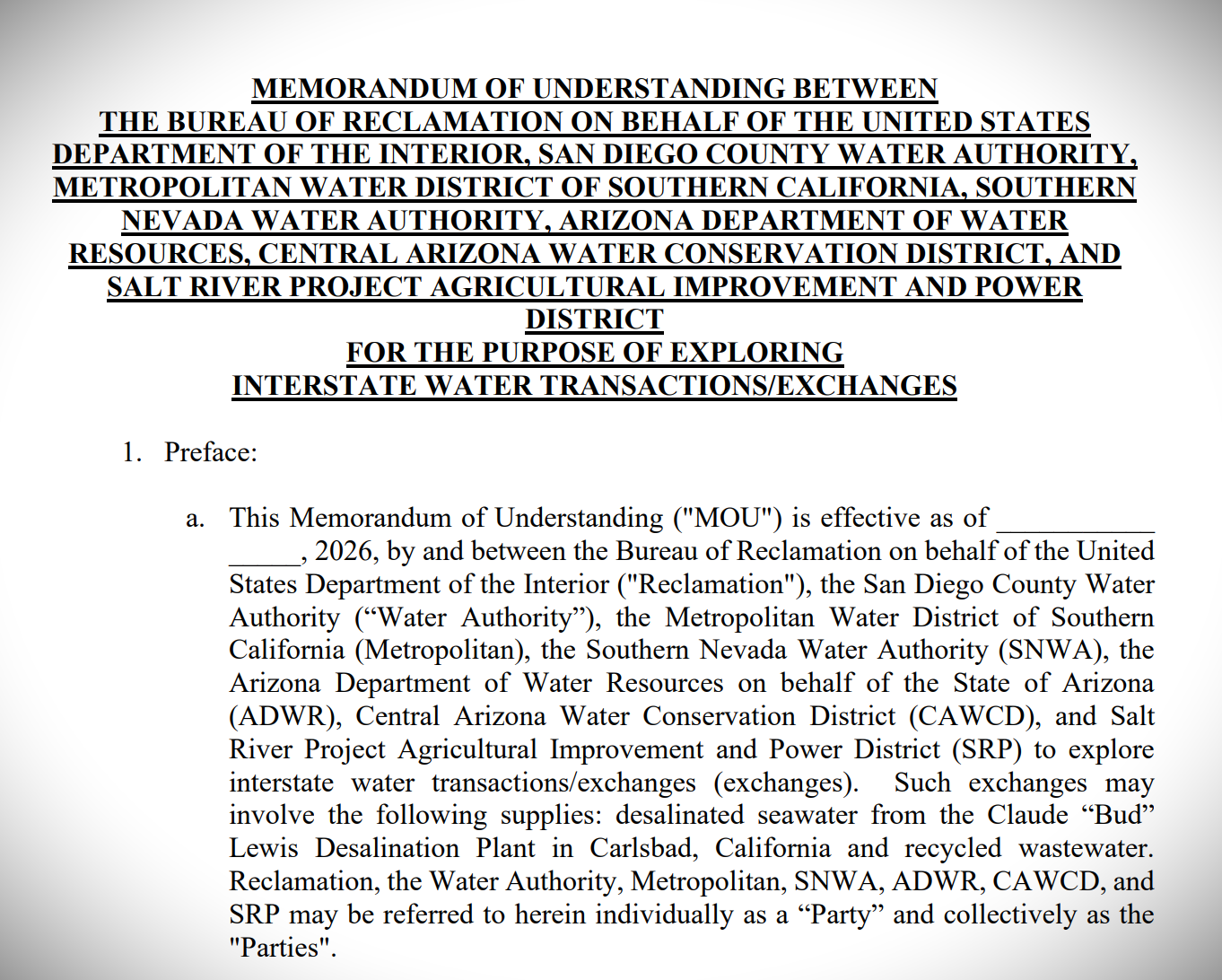
Photo Credit: Arizona Department of Water Resources (ADWR)
The document outlines the basic idea of the exchange, but does not offer details as to how much water by volume over time will be offered in the deal, or the monetary value of Arizona’s end of the deal.
Arizona Department of Water Resources Communication Administrator Doug MacEeachern told OpGov.News in an email that the benefits of such a deal include more successful management of existing Colorado River water allotments, will provide water to agencies that need it most, and will reduce future infrastructure costs.
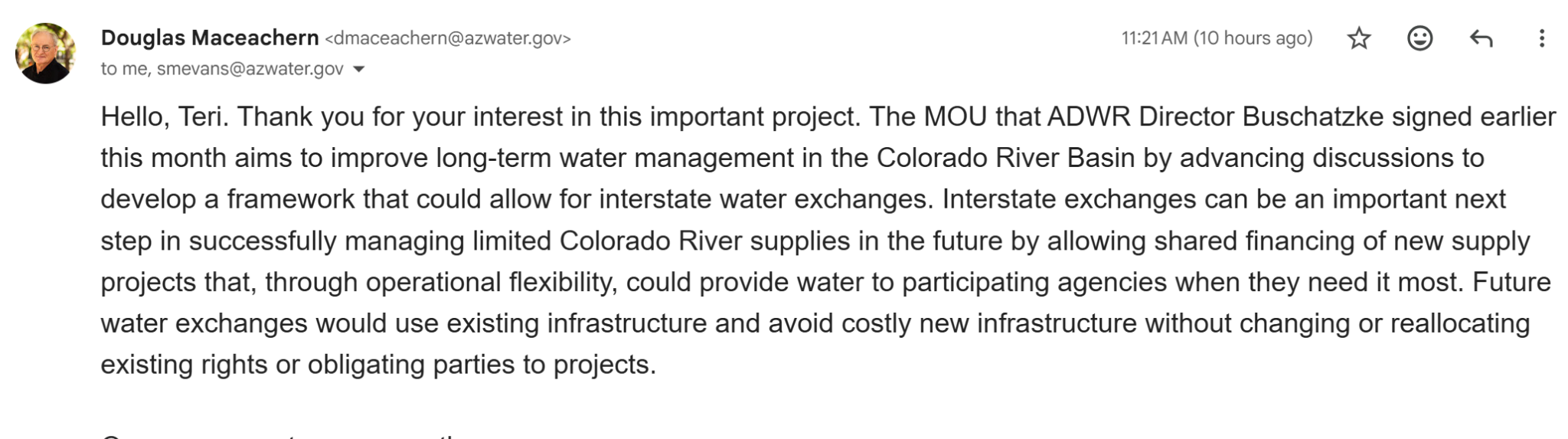
Photo Credit: Gmail / Teri Tracy
These comments align with recent groundwater deficits and forced, fast-paced water infrastructure development across the state, driving some cities further into debt.
MacEachern also responded to several questions posed about the project as detailed below:
Q: Is there a plan yet for allocating the water designated to Arizona by the San Diego Water Authority across the state? If so, what does that plan currently look like, and will there still be significant water detriments in some areas?
A: The MOU commits the parties to creating a framework to make the exchanges work. This is just the first step. There are a lot of details that need to be resolved before we can identify a plan of action.
Q: Though there is no binding agreement yet, are there any hurdles or technicalities that Arizona must resolve before a binding agreement is presented?
A: Yes, there are lots of technicalities to work through. Signing the MOU commits the participants to a process that ultimately could lead to real, wet-water exchanges. But that remains a long way down the road.
Q: If an agreement is reached, what is the estimated amount that Arizona will provide in exchange for how much water from the Colorado River?
A: If your question regards the price of the water, that is one of those "hurdles" that have yet to be worked out and since ADWR is not a water provider, our agency will not be involved in price-setting negotiations.
While the plan remains in its infancy as outlined by ADWR, OpGov.News will continue to follow this story as it develops.
To add to or correct any information in this report, please contact me at tracy.t@lead4earth.org and leave a comment below.
0
0

Comments