(OPGOV GLOBAL) — “It wasn’t simply a blue wave. It was an American tsunami,” said Hakeem Jeffries, the current House minority leader who is poised to become the first Black lawmaker to be elected Speaker of the House in January 2027.
But Jeffries’ appointment is not the only event making history, with election night marking monumental wins for Democrats, women, and minority demographics.
Landmark Wins for Democrats
Both the House and Senate flipped blue. Early projections put democrats on track for around 258 seats, a gain of roughly 43 seats. So if the current projection holds, 2026 would surpass the famous 2018 blue wave and approach the scale of the Watergate-era 1974 election. Democrats also made a big gain of 8 seats in the Senate, the largest since 1994. House and Senate gains included major victories and breakthroughs in traditionally Republican territory, including Texas, South Carolina and Kansas.
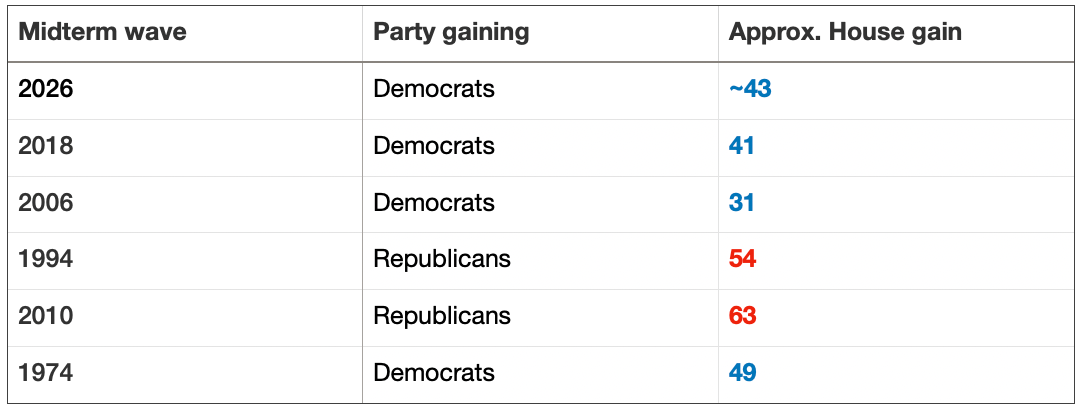
Photo Credit: Naomi Heinen from OpGov.News / Historic House seat gains compared with projected numbers for 2026.
Democrats hold more governorships than Republicans for the first time since before 2010. Democrats are set to hold 28 governor’s offices compared with Republicans’ 20. If the outstanding results hold, with Kansas and Alaska still to be called at the time of publishing but leaning blue, about 75% of Americans will live in states with Democratic governors, with about 53% living in states where Democrats control the governor's office and both chambers of the state legislature—known as a trifecta.
Democrat James Talarico defeated Republican Ken Paxton in Texas to win a U.S. Senate seat, ending a long-standing Democratic drought in Texas statewide politics. He is the first Democrat elected to the U.S. Senate from Texas since 1988, winning by a double-digit margin of 12 points and flipping 16 firmly red counties.
Susan Collins lost her Senate seat in Maine after nearly 30 years, defeated after five terms by Democrat Troy Jackson. Collins lost despite having survived difficult political climates before and being known for cultivating a bipartisan image, which reflected Maine's 50/50 blue-red split well. Jackson won despite being a distinctly progressive candidate, campaigning on policies including Medicare for All, abolishing ICE, and ending U.S. support for Israel, providing a particularly strong data point that only cautious centrists could win difficult races for Democrats in 2026.
Nationally, 66% of young people age 18-29 voted for a democratic candidate for the US House of Representatives, which has only been surpassed once, in 2018, with a 67% blue vote from young people.
Progressive Democratic Socialists more than doubled their House representation, from two members to at least seven, according to early reporting. This is noteworthy because one ofthe big debates heading into 2028 will be whether Democrats should interpret this election as a mandate for progressive economic populism, or a centrist candidate that is simply in opposition to Trump.
Demographic Firsts
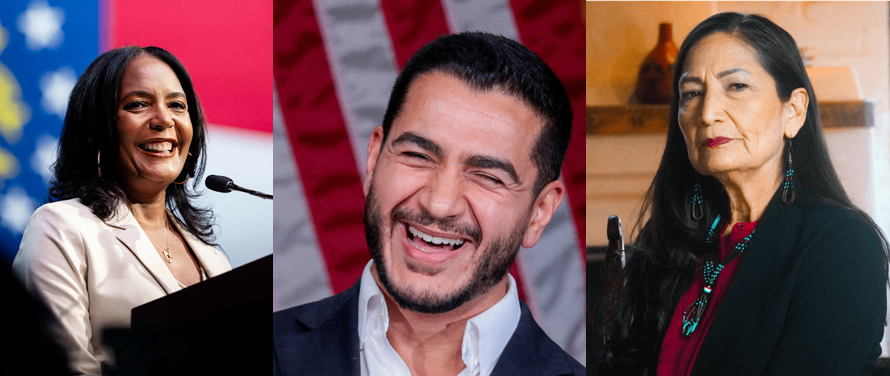
(From Left to Right: Keisha Lance Bottoms, Abdul El-Sayed, Deb Haaland)
Photo Credit: Keisha for Governor, PBS, Deb Haaland for New Mexico
The first Black woman governor in American history, Keisha Lance Bottoms, was elected in Georgia. She is also Georgia’s first governor of color and first woman, as all 83 previous Georgia governors were white men.
Abdul El-Sayed became America's first Muslim senator, winning in Michigan despite facing overtly Islamophobic attacks, and his pro-Palestine views made him a particularly controversial figure in National politics. He won a battleground Senate race, not a safely democratic seat, despite running on progressive viewpoints such as Medicare for all and taxing billionaires.
100 Democratic women are now in the House, and it was a record-breaking year for women candidates overall, 19 Democratic women and seven Republican women ran for governor, and nearly 300 women ran for Senate and House seats, the highest of all time, according to Rutgers' Center for American Women and Politics.
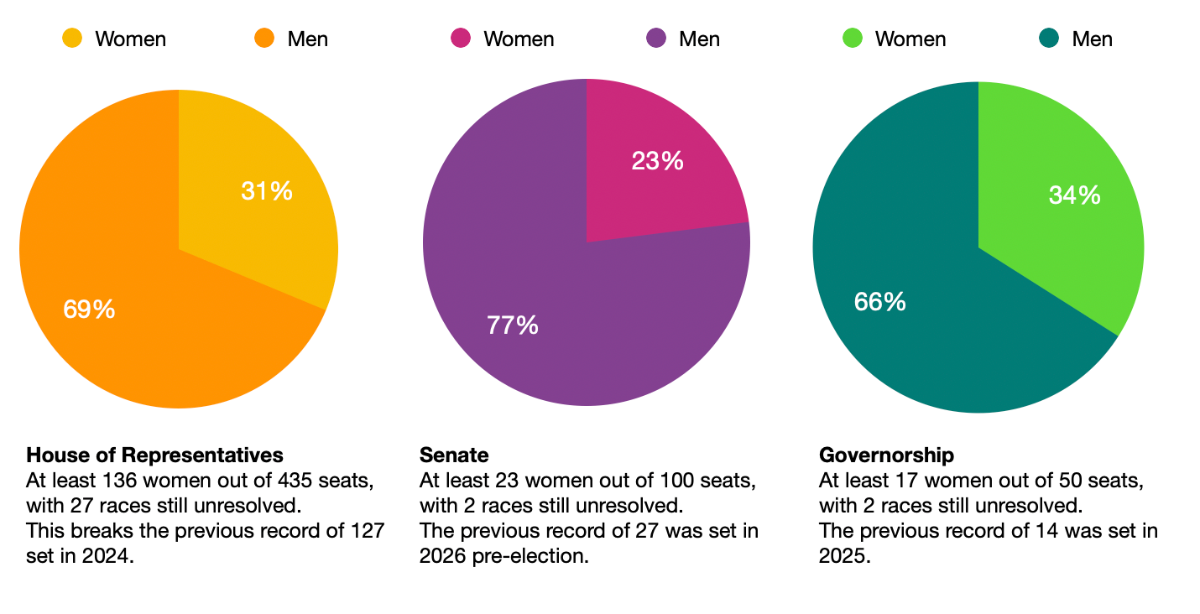
Photo Credit: Naomi Heinen from OpGov.News, historic gains for women Governors, as well as in the House and Senate.
Deb Haaland became the first Native American woman elected governor. A Laguna Pueblo citizen elected in New Mexico, Haaland was one of the first Native American women elected to Congress and later became the first Native American Cabinet secretary.
Chris Pappas became the first openly gay man elected to the U.S. Senate, winning in New Hampshire. One encouraging aspect of this victory is that his LGBTQ identity was reportedly not a controversial issue within his campaign, showing the walls we have scaled over the years for gay rights.
Texas elected its first Latina governor and rejected Greg Abbot. Gina Hinojosa defeated Gov. Greg Abbott, becoming Texas's first Latina governor and producing one of the night's biggest breakthroughs in a state Republicans have dominated for decades. Texas is the country's second-largest state, and a Democratic statewide victory there represents a much bigger national shift than a typical gubernatorial flip.
At least 22 Asian American and Pacific Islander (AAPI) lawmakers are expected in the incoming Congress, the largest membership in American history, following four new House victories that produced historic firsts in Florida, Massachusetts, California and Guam. Dr. Amish Shah holds the lead in a close race that has yet to be decided. If Dr. Shah wins, he will be the first Indian American elected to represent Arizona’s 1st Congressional District and bring the total number of AAPI Members to 23 next year.
Georgia and other states saw a remarkable expansion of Black gubernatorial representation In addition to Bottoms' historic victory, David Crowley won Wisconsin's governorship and Byron Donalds won in Florida, both representing major milestones for Black representation in statewide executive office. The AP noted that the country went from having only three elected Black governors in its entire history to seeing several more breakthrough victories in a single night. Notably, Donalds is a Republican while Bottoms and Crowley are Democrats, showing that the representation milestone spans party lines.
To add to or correct any information in this report, please contact me at naomi.h@lead4earth.org or leave a comment below with your thoughts.
0
0

Comments