(TALLAHASSEE, FL.) – If you have ever wondered why a large corporation was able to do something you believed to be foul, or bully someone in court, you should research the Uniform Trade Secrets Act.
I posted a three-day poll on NextDoor, where only three people claimed to have heard of the Uniform Trade Secrets Act.
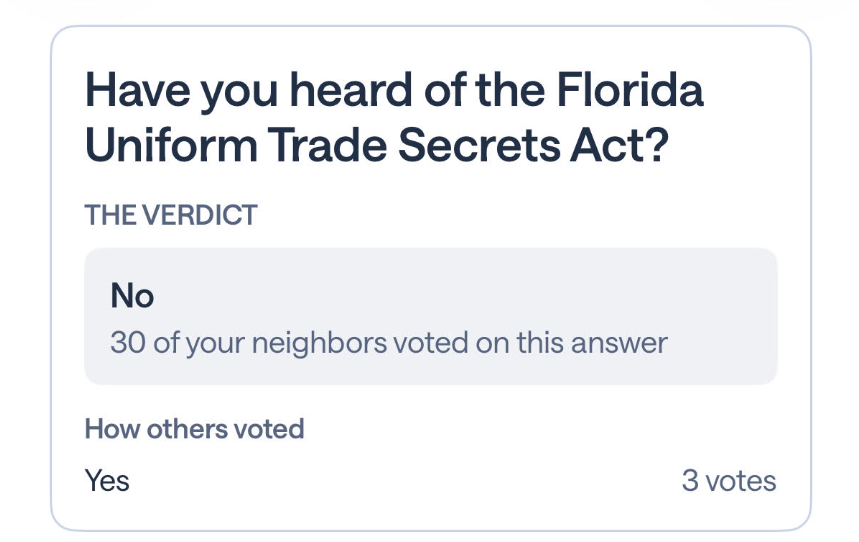
The other 30 had never heard of it, or rather, never heard it by name. If you know someone whose employer has been able to bar them from working for a competitor, it is because of the UTSA.
Passed in 1979, the law was enacted to create a uniform structure for how theft would be treated across state lines. As a model law, however, each state had the freedom to enact the law, as well as modify it for their state practices.
Every state, except for New York, created its own version of the Trade Secrets Act, prompting additional ‘uniform’ legislation. The Defend Trade Secrets Act was passed in 2016.
The new act does not void existing state legislation. If a person or corporation were to sue another party, they have the option to sue in federal or state court.
A company may opt to file in federal court to take advantage of Ex Parte Civil Seizure, which is not available in all state courts. An Ex Parte Civil Seizure is an extreme and swift action where, if accepted, U.S. Marshals can seize assets (anything deemed to be relevant or possessing a potential trade secret) before a defendant is aware there is a case against them.
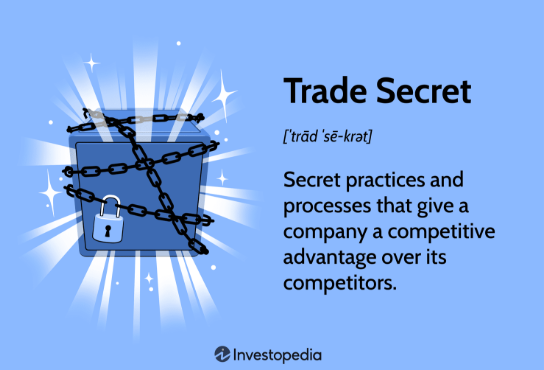
Photo Credit: Investopedia
Conversely, state court proceedings are less likely to be dismissed prematurely and often start more quickly.
Like every state, Florida has their own Uniform Trade Secrets Act (FUTSA), and in comparison to other states, Florida’s legislation provides more protection to individuals and makes lawsuits more difficult.
One employee-friendly policy is the ‘Inevitable Disclosure’ policy, and explicitly, Florida does not allow companies to use it. Inevitable Disclosure refers to the idea that an employee is guaranteed to distribute information or content from a prior job, allowing their old company to prevent them from working within their field. States like Texas operate under the Inevitable Disclosure doctrine, meaning a company could sue to prevent you from taking a job.
Florida courts also demand specific details before pursuing a lawsuit. Before discovery can take place, the plaintiff must describe the trade secret they believe has been stolen or distributed.
Commonly referred to as Reasonable Particularity, Florida has a relatively high disclosure threshold, which has led to some controversy.
Strategically, plaintiffs would prefer to disclose as little information as possible to initiate discovery. Providing specific information can bottleneck what the company can sue for and give away unnecessary secrets.
The high threshold for discovery can give defendants' legal teams easy targets, allowing for quicker motions to throw away the suit.
In 2015, a Florida court famously refused to continue with a discovery period due to insufficient details. Although the plaintiff argued Reasonable Particularity did not exist in Florida law, the court still demanded ‘exemplar’ details to depict what has been allegedly stolen.
Unlike FUTSA, Florida’s Deceptive and Unfair Trade Practices Act is directed to protect consumers, with some debates about its efficiency.
Similar to the United States Trade Secrets Act, most states have a section of their state legislation called ‘Little FTC Acts’ (Federal Trade Commission). Florida courts cannot award a plaintiff any funds that are not directly related to the lawsuit under the Florida Deceptive and Unfair Trade Practices Act.
For example, a person suing a company for false advertising under FDUTSA for a $10 service can only recover $10 if they were to cite the act. If you bought a flute advertised as a medical-grade inhaler or EpiPen, the FDUTSA would only allow you to recover the purchase price, not any ensuing medical bills. Although this scenario would allow for other acts that would award more damages, it is an apt example of the limits of Florida’s trade practice laws.
Ultimately, a business can recover more funds than a consumer can under the two trade secret acts. Assets are more protected than consumers.
Going to court is an overall liability for consumers, as they could be forced to pay for the defendant's court fees should the judge rule against them. Although the same can happen for a company pursuing a frivolous suit, the risk is much smaller.
Corporations have much more funding than consumers, and usually more expensive legal teams. A big company can afford to pay for a lawyer, but the inverse is much different. A company can employ a legal team for hundreds of thousands of dollars, a fee many could never afford.
Effectively, this is a stronger barrier to consumers and employees than to business owners.
If you have any questions or concerns, please comment and email me at jason.f@lead4earth.org. Tell us what you feel about the United Trade Secrets Act!
0
0

Comments