Editorial note: These headlines are based on Michael Arata's submitted opinion article. The claims and opposition should be attributed to critics rather than presented as independently verified findings.
OPINION | By Michael Arata
(CONTRA COSTA COUNTY, Calif.) —If you are registered to vote in one of five particular counties — Alameda, Contra Costa, Santa Clara, San Mateo, or San Francisco — then your November 3rd ballot includes a vote on Measure RTM, the Regional Transit Measure. If passed, RTM would add another one percent to existing sales taxes in San Francisco County (and City), and half a percent in the other four counties.
The transit-tax promoters want RTM to serve as an ATM, from which they can draw another $980 Million annually by 2028, projected to grow with inflation to over $1.5 Billion in 2041, the final year of this 14-year new tax. The total anticipated haul is $17 Billion.
On the other side of the RTM/ATM interface window are taxpayers in the affected five-county region, who are already struggling with severe affordability problems.
Transit-Funding and Spending Realities
Instead of demanding another Billion dollars annually, transit agencies must do far better with their existing taxpayer subsidies. Those include the Santa Clara Valley Transportation Authority’s $1.70 Billion, BART’s $1.63 Billion, San Francisco Muni’s $1.42 Billion, and AC Transit’s $550 Million. Adding in smaller transit agencies, these subsidies already amount to $6.2 Billion in annual taxpayer-funded assistance (taxes, tolls, government grants).
Meanwhile, transit ridership has only partially recovered from its 2020 COVID lows — with BART, for example, at only about 55% of its passenger counts back then. With increasing percentages of Bay Area employees working remotely, ridership may never regain its former proportions.
Transit employee numbers have nevertheless been maintained (or grown) as though nothing has changed. BART, for example, had 4470 employees in 2019, and 4573 as of 2025.
And meanwhile, salary and benefit (total compensation) levels have continued growing! Among the six named beneficiaries of the new taxes anticipated if RTM passes — BART, CalTrain, VTA, SamTrans, AC Transit, and Muni — and as of 2024 (the available data): total compensation exceeded $500,000 for 21 employees. 78 exceeded $400,000 (U.S. Presidential salary); 460 exceeded $300,000); and 3,563 exceeded $200,000.
Note, in the chart which accompanies this article, the rates at which transit-passenger miles dropped during 2019-2024, while operating expenses grew. The ratios are likely a little better now, but they would still show a need for far better transit-agency efficiencies, not a new tax increase.
Sales Taxes: Too High Already
California’s statewide 7.25% sales-tax base rate is the nation’s highest. Counties, cities, and special districts can seek local additions, with a statutory 2.00% cap, total = 9.25%.
Unfortunately, lobbyists and on-call, speed-dial politicians have contrived larger add-ons — violating the 2.00% cap, “notwithstanding” existing law.
Thereby, all but 10 of 69 incorporated Bay Area cities and towns already exceed the statutory 9.25% sales-tax limit. Some already exceed 10%. RTM would make things worse. You can check your new
RTM sales-tax rate at NoNewTransitTax.com.
From toothpaste to teacups, appliances to automobiles: inflation and very high existing sales-tax rates (atop multiple other taxes) already burden Bay Area households excessively. Escalating sales taxes, adding new costs, are themselves inflationary.
Sales-tax increases are also regressive, disproportionately burdening the area’s poorest and most vulnerable residents.
Long and short, Bay Area Transit agencies have an irresponsible spending problem, not a revenue problem. They already receive unreasonably high tax-dollar subsidies, but they want even more. If they’re to be given additional tax assistance, let it come from a redeployment of existing tax-dollar resources — for example the billions still being spent on the “Bullet Train” boondoggle.
Meanwhile, those who would benefit from additional transit-agency spending (including transit unions and contractors) hope that the $9 Million tax-promotion campaign now underway can convince a majority of voters to support them. Here’s hoping you and every other regional voter with whom you speak will just say “NO!” instead.
See NoNewTransitTax.com for more information.
================================================================================
Michael Arata is an Executive Committee member of the Contra Costa Taxpayers Association.
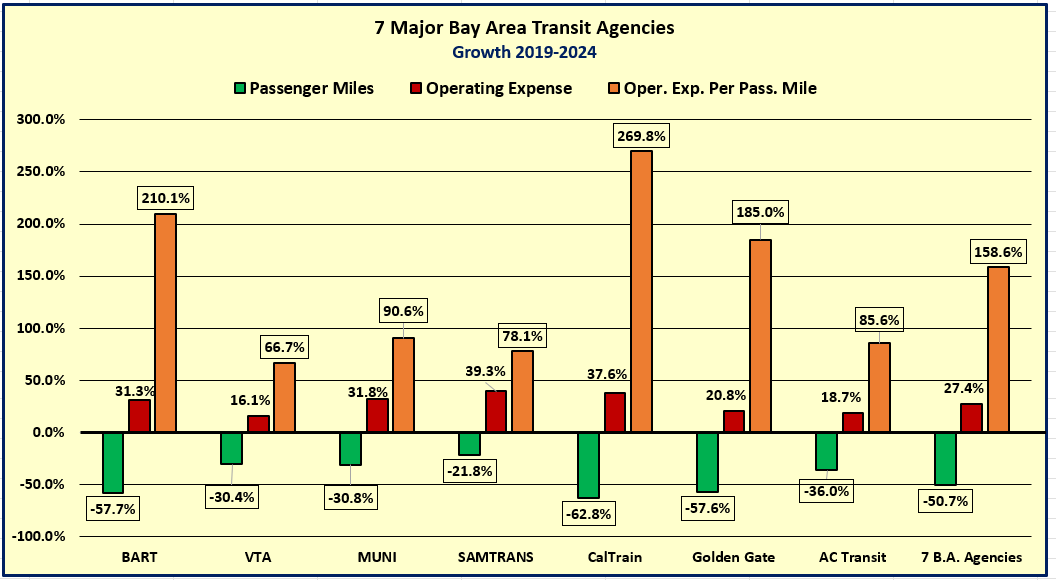
Chart research and design credit: Gregg Dieguez
To add to or correct any information in this report, please get in touch with me at harika@lead4earth.org.
0
0

Comments