(VANCOUVER, Wash) — Vancouver’s 2025 Year-In-Review reveals greater public engagement and serious homelessness issues here.
From the very start, OpGov.ai picked up a "critic's perspective" view, detailing in full, whether by summarization or actual transcript, what happened at every meeting.
The news start-up that is growing exponentially quickly offers a revolutionary way to cover local government, as you have read before. Like all reports, I gather the information and then watch the videos, confirming all AI-generated summaries and providing actual public quotes.
With that, let's begin to see what elected officials offered the tax-paying citizens who voted them into office.
OpGov.ai reports the first meeting of the year "was primarily characterized by a contentious public hearing regarding a citizen-led initiative, 'Save Our Streets,' which aimed to mandate public votes on major road reconfigurations."
"From a critical standpoint, the council and city staff demonstrated a rigid adherence to legal technicalities and established policy, effectively dismissing significant public opposition and a petition signed by over 6,500 residents,” OpGov.ai reports.
The platform gets very personal, reporting public concern beginning with Justin Wood. The resident said as an organizer for Save Vancouver Streets, "he recounted his frustration with the city's process for Southeast 34th Street changes, where surveys offered only one-lane road options without the alternative of retaining four lanes."
"He highlighted the difficulty in contacting council members and the perceived lack of true public engagement," OpGov.ai reports. "He asserted that the initiative aims to require proper information, engagement, and resident input before road changes, rather than preventing all changes."
Jackson Maynard, representing the 'Save Vancouver Streets'and its 6,500 petitioners, asserted that the city council has three options for the initiative: pass, reject to ballot, or pass alternative, but not the power to prevent it from going to the ballot, according to city charter and state law. Maynard argued "that the power to determine an initiative's validity is reserved to the courts, not the council or city attorney."
"He also disputed staff's arguments that the initiative interferes with legislative/administrative power or the Growth Management Act, stating there's no specific statutory grant of authority to the council regarding transportation improvements," OpGov.ai said.
Ken Williams has lived here for 44 years and was reappointed to the Transportation Commission. But at this meeting, he spoke as a citizen, citing" a past public hearing on McGillivray with divided opinions, demonstrating citizen involvement."
"In my opinion, that showed that citizens were involved and heard," Williams said. "It is entirely understandable that whichever side didn't come out on top would say, will , if only they had listened to us, the vote would have been different."
Williams adds, "The commission was asked to make a difficult and contentious decision; they did."
OpGov.ai not only confirms his actual words but also adds more detail, noting that Williams "argued that an initiative requiring a public vote on every transportation change would be a 'colossal effort,' costly, and would delay paving projects by potentially two years."
Janice Ritter, a resident of the Devoe neighborhood with federal transportation experience, acknowledged the difficulties of voting on all traffic ideas but stressed the importance of public input and transparency, according to the platform.
She argued that removing lanes, especially on main thoroughfares, is a significant change that voters should decide, OpGov.ai said.
"She criticized current changes on Fourth Plain as confusing and potentially causing bottlenecks, and felt public involvement was often used as a 'rubber stamp' rather than genuinely influencing designs. She advocated for a vote to ensure fairness and transparency," according to the platform.
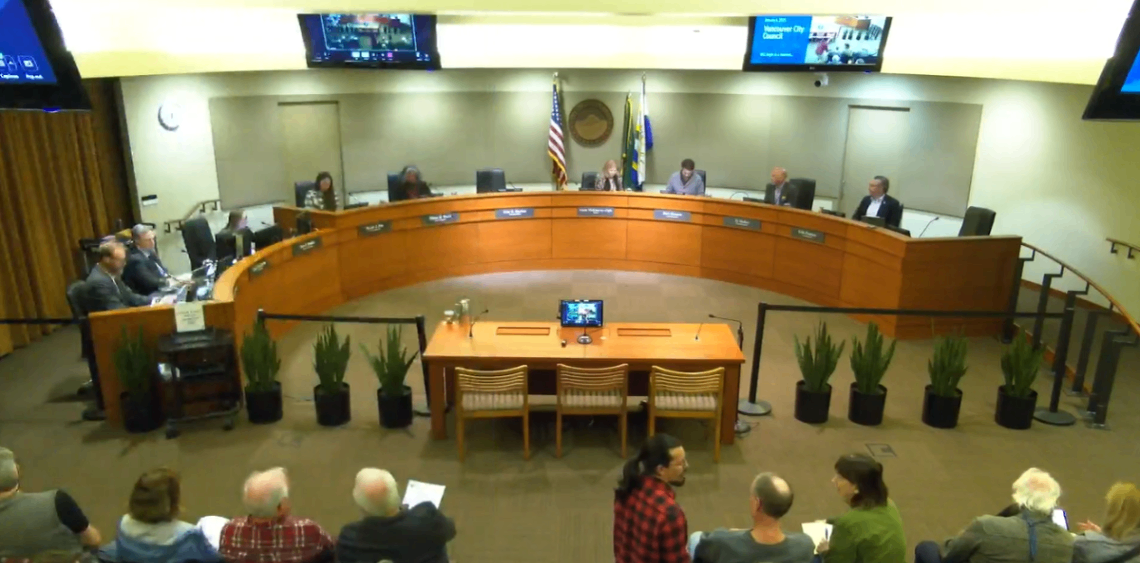
(Photo: Vancouver City Council Meeting January 6, 2025)
April 14, Administrative Approvals and Public Voices Unheard
The Vancouver City Council meeting on April 14, 2025, largely prioritized administrative approvals and developer-friendly policies, while public concerns regarding city development, environmental impact, and infrastructure gaps were acknowledged but not substantively addressed.
The council unanimously passed significant development code changes for Section 30, framed as a "grand bargain" for higher-density housing, despite public comments strongly opposing the benefits for developers and expressing alarm about overpopulation and environmental degradation.
The quick approval of numerous consent agenda items and abbreviated staff reports suggests a desire to move through the agenda efficiently, potentially at the expense of deeper public or council deliberation on each item.
During the public hearing for Section 30 Development Code Changes, Kimberly Elban voiced several grievances. OpGov.ai captured the Elban's poignant perspective on transportation and land use.
She complained about not receiving an email about the public hearing. She criticized scheduling a transportation meeting concurrently, according to the platform, adding "citizens are waking up to the destruction of heritage in Vancouver."
Elban strongly opposed the Growth Management Act, noting that policies that favor developers jeopardize the land itself by destroying farmland and trees and contributing to overpopulation and pollution.
As Washington's second largest city, Elban warned officials about "resource depletion, lack of clean water, and the vulnerability of '15-minute cities' during power outages."
June 16, Homelessness Arises Again
The June 16 meeting presented a mix of administrative approvals, reactive policy discussions, and superficial engagement with public concerns.
"Public comments, though limited, raised fundamental issues, from financial mismanagement to concerns about future-proofing infrastructure," the platform reports, adding specific concerns are solar roads, heated pavements, and the human impact of homelessness policies. "However, these public inputs were largely dismissed or met with clarifications that did not fully address the underlying concerns."
Resident Carmen De Leon critiqued agenda for very specific reasons: $110 million.
De Leon said the shortfall is due overspending, claiming the "city was projecting to tax residents more, specifically a 3% 'swipe fee' on transactions in Vancouver to cover mismanagement."
"She urged residents to demand accountability for being nearly $150 million 'out of whack' instead of allowing perpetuated overspending and subsequent taxation," OpGov.ai reports. "She argued that spending millions on the opioid problem is misdirected, stating that drug users should be arrested and sober up in jail, and that stopping the flow of drugs into the country is the real solution, implying current policies are ineffective and perpetuate the problem."
August 11, 58th Street Rezoning and Public Turnout
A heated debate, approprioatily in August over the 58th Street rezoning xxx.
"Despite the applicant's arguments for increased housing density to address the housing crisis, the proposal faced overwhelming public opposition, with residents citing severe concerns over inadequate infrastructure (roads, sidewalks, transit), potential spot zoning, loss of natural environment (trees), and the impact on neighborhood character and safety, especially for schools and a nearby park," according to OpGov.ai.
The Planning Commission's prior denial and the emotional testimony from long-time residents ultimately swayed the council, which voted 5-2 to deny the R50 rezoning,” the platform added.
This meeting had a great turnout from community members, who spoke out against the 58th Street rezoning.
Dave Gardner, a Walnut Grove homeowner, acknowledged the need for housing but urged the council to consider the 'human impact.' During his testimony, he called on those opposed to stand, giving a powerful visual appeal that added weight to his argument.
This underscores the importance of public involvement in these proceedings.
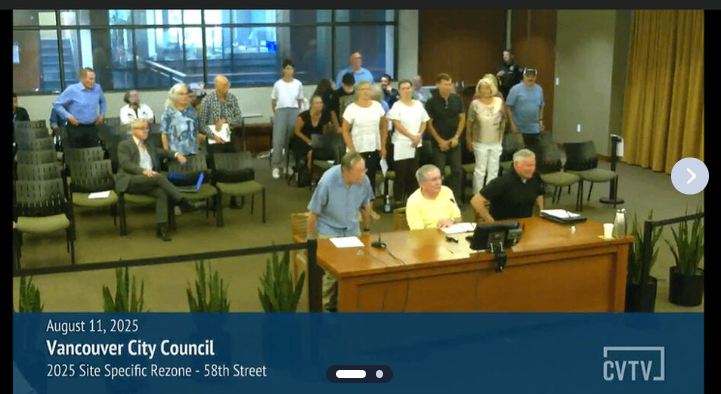
(Photo: Residents Standing to Add Weight to Their Voices at Vancouver City Council Meeting August 11,2025)
Oct. 6 Kim Harless Ethics Complaint as Election Looms
The Vancouver City Council meeting on October 6, 2025, was largely dominated by a contentious ethics complaint against Councilor Kim Harless, which became the central focus of public comments, with many residents speaking in support of Harless.
Monica Soeta described Harless as a 'genuine human being' who thinks 'seven generations to the future,' loves what she does, and deserves full support from the council.
Election for Mayor and Three Councilmembers
As the election drew near, OpGov.ai presented the candidates to residents in the article “Vancouver Incumbents Vye Against Newcomers”.
On election night, all incumbents were victorious.
Nov. 10 City of Vancouver Gets a New Flag
The new banner, featuring Columbia River symbolism, natural environment, and iconic landmarks, was developed following a community-led design and feedback process.
“This project was facilitated by a volunteer selection committee including two of our city council members, three commissioners from the culture arts and heritage commission, including myself, and two youth,” Rose Mendoza, flag committee chair, said. “We received 138 entries.”
The flag tells a story of a community shaped by the Columbia River, which had a deep sense of place for generations. Mendoza pointed out the flag’s green that symbolizes Vancouver's forest parks and commitment to sustainability.
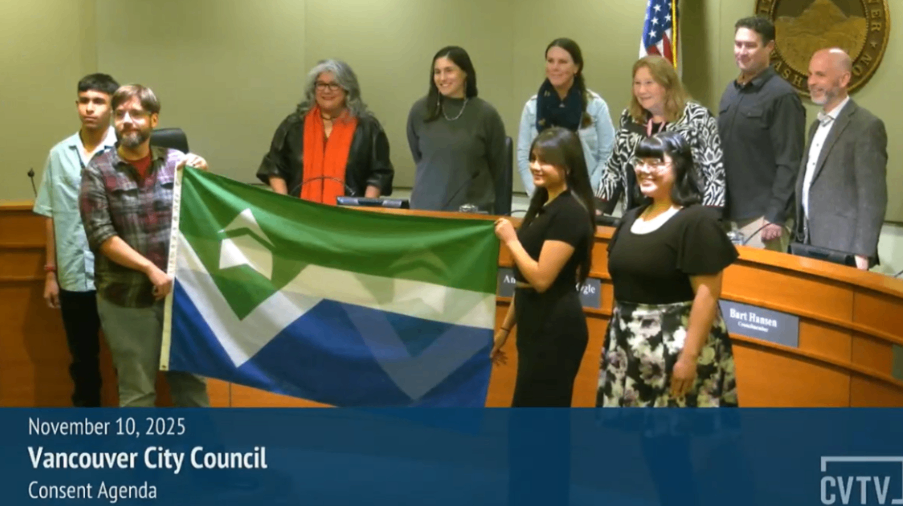
(Photo: New Vancouver City Flag at Vancouver City Council Meeting November 10, 2025)
“The emblem draws inspiration from Vancouver's iconic landmarks, including the fort, which calls to our history,” Mendoza said, adding the bell tower looks to our future.
The Grant Street Pier, which also looks to the future, according to Mendoza, is “a nod to the past and a symbol of forward progress."
Additionally, the notable Chevron symbol shows the Vancouver connection between the land and the water, which moves down in the path forward and down to the field of blue, representing the Columbia River that shows the community's deep connection to the river that shaped the city’s culture, economy, and sense of place.
Dec.1 Affordable Housing and Community Communications
Significant tension between ambitious development goals and persistent community concerns regarding neighborhood character, public engagement, and growth impacts is how OpGov.ai reports Monday night's city council meeting went down.
Citizens cited a "lack of clear communication, and insufficient attention to existing covenants or the unique characteristics of established single-family neighborhoods like South Cliff and Dubois Park."
The Dec.1, meeting also held a discussion regarding the council’s 2026 schedule, with a focus on providing more opportunities for community engagement.
“Discussions around the 2026 meeting schedule highlighted the council's struggle to balance efficiency with enhanced public access, eventually opting for more frequent public communication opportunities while rejecting several proposed meeting dates due to logistical constraints,” OpGov.ai said.
Ultimately, two motions were passed. One to have a public forum after every regular City Council meeting in 2026, aiming to increase public access. And the second is to continue quarterly off-site community forums in 2026, despite logistical challenges and some debate over their effectiveness, acknowledging community desire for diverse engagement.
Dec. 8 Kim Harless Issued Non-Public Admonition
Council Member Harless was found to have violated Section 5.0 of the Code of Ethics ('appearance of impropriety') and was issued a non-public admonition after a contentious 5-1 vote. The initial motion to dismiss the complaint failed at a 3-3 tie.
Erik Paulsen points out that it is the citizens of Vancouver that determine who is on council.
“Fortunately or unfortunately the timing of this complaint coincided with an election I think it was unfortunate that the allegations were made and unresolved prior to the election. However, one could argue that the fact that they were unresolved at the point of the election gave voters an opportunity to weigh in on this question of whether or not what was done was improper or not and let that inform their decision,” Paulsen said.
Sarah Fox saw fit to not dismiss the complaint.
“I have had a lot of training in understanding of that appearance part even if there is no actual benefit personal benefit to me. I also take a very cautionary approach to things that could appear as if I have some benefit to gain,” Fox said.
“It is a point in time to say we recognize that there were mistakes made perhaps on many sides of this issue, but I don't think that we could say that there wasn't any mistake made,” Fox said.
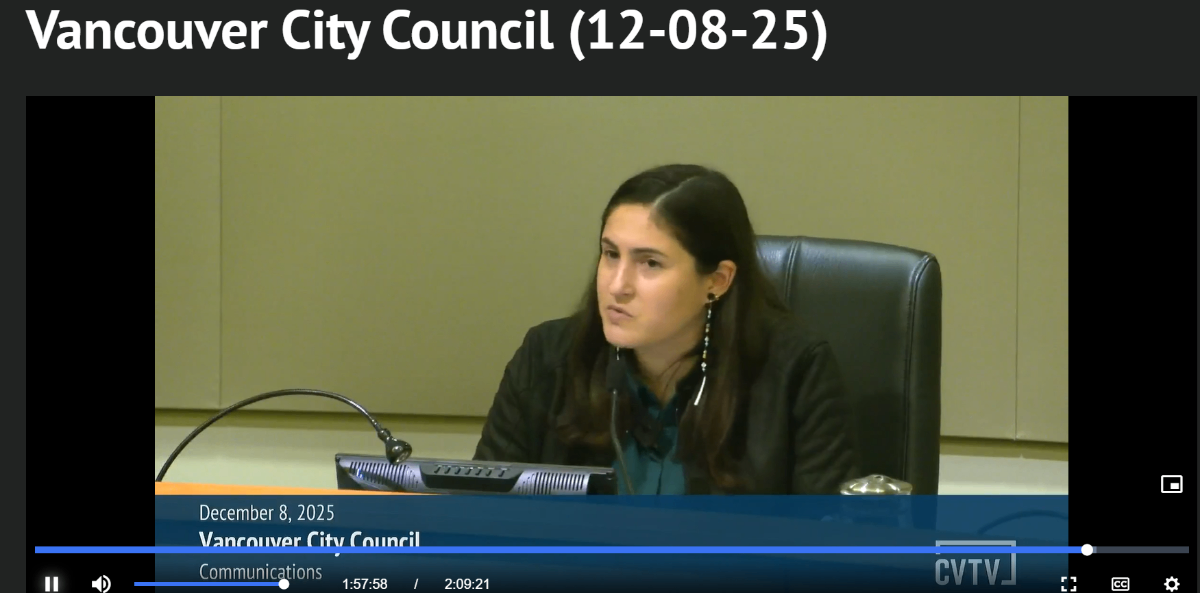
(Photo: Councilwoman Kim Harless Vancouver City Council Meeting December 8, 2025)
Returning to chambers after the decision was made, Harless expressed her frustration over the process and read a brief statement.
Dec. 15 Homeless Person’s Memorial Day Comprehensive Plan’s Preferred Alternative Map Approval
The Vancouver City Council meeting on December 15, 2025, primarily focused on housing, density, and homelessness, highlighted by a critical vote on the Comprehensive Plan's Preferred Alternative Map.
The Comprehensive Plan's Preferred Alternative Map, advocating for increased density and mixed-use zoning, was overwhelmingly approved by the council (7-0 vote).
The mayor called upon the people of Vancouver to observe a moment of silence to remember those lost to homelessness this year, to reflect on the challenges faced by those without safe and stable homes, and to actively support local efforts working to eliminate homelessness in our communities.
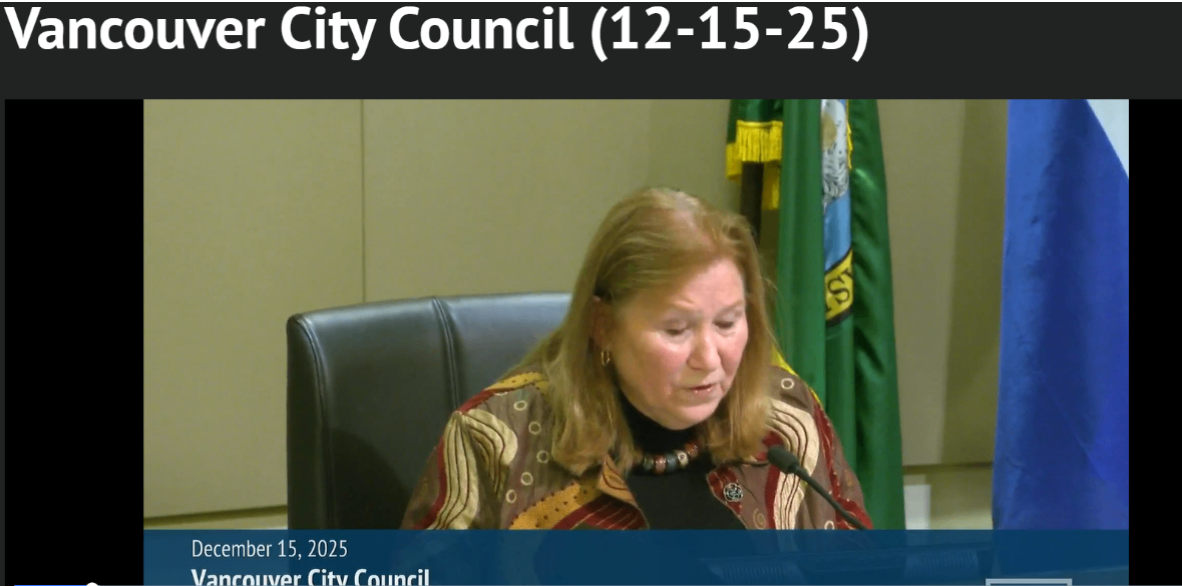
(Photo: Vancouver Mayor Anne McEnerny-Ogle City Council Meeting December 15, 2025)
Jamie Spinelli, Vancouver’s Homeless Response Manager, also spoke, providing the council with some good news.
“I did want to also make sure that the community hears that when these proclamations are made," Spinelli said. "There are many people and organizations and groups who do actually listen to these proclamations and kind of spring into action, and that is impactful."
The proof is in the numbers, according to Spinelli, adding "we can tell at least a 19% reduction in deaths connected to the homeless community, which is incredible."
"I really wanted to thank you all, as well as all of the other participants in that, organizations that are here tonight," Spinelli said. "Everybody’s just banded together to help these numbers go down."
This statistic was met with applause in the council chamber. The homeless advocate said she looks forward to no more memorials as officials work hard to end the local issue.
If you would like to comment or add to this report, please email me at rory.h@lead4earth.org.
0
0

Comments