(VANCOUVER, Wash.) — The Vancouver City Council approved an ordinance allowing for the deferral of traffic and park impact fee payments for middle and multi-family housing. The ordinance passed during the Monday, November 9 meeting will make it possible for developers to delay payments until buildings are occupancy ready.
Photo Credit: CVTV
According to the city’s website, “middle housing refers to several housing types that fit between detached single-family houses and large apartment buildings. Examples of middle housing include duplexes, triplexes, fourplexes, sixplexes, rowhouses/townhouses, stacked flats, courtyard apartments, and cottage housing.”
“Middle housing uses land more efficiently than large lots with individual homes while still being smaller than a large apartment building.”
This comes with several benefits, including a reduced need to build housing in natural areas, lowering housing and public infrastructure costs, and providing a larger customer base that will support neighborhood businesses.
Senior Planner Mark Person provided the council with a presentation on the deferral.
Person began by pointing out that the last action by the council was on August 19th of 2025, when an update was passed to include multifamily housing impact fee and to promote more housing production.
“As part of the comprehensive plan and code update, that newly adopted code was not included in our repeal and replacement, so we are here to put that back in place and update it to include middle housing.”
“We're not hitting that 1,900 a year that we need, so we're trying to use all the levers that we can to make that happen. Impact fee is a one-time fee for new development. It's proportionate share of infrastructure cost to maintain that level of service standard impact fees include parks, traffic, and school fees calculated.”
“The fee is calculated upon building permit application and historically paid upon issuance of that building permit the fees are placed in an interest-bearing account until encumbered and fees may only be used for projects on capital improvement plan and subject to a refund if that fee is not encumbered after 10 years. And just a note here that school impact fees are not included in this change,” Person said.
Deferred fees are expected to be received within three years.
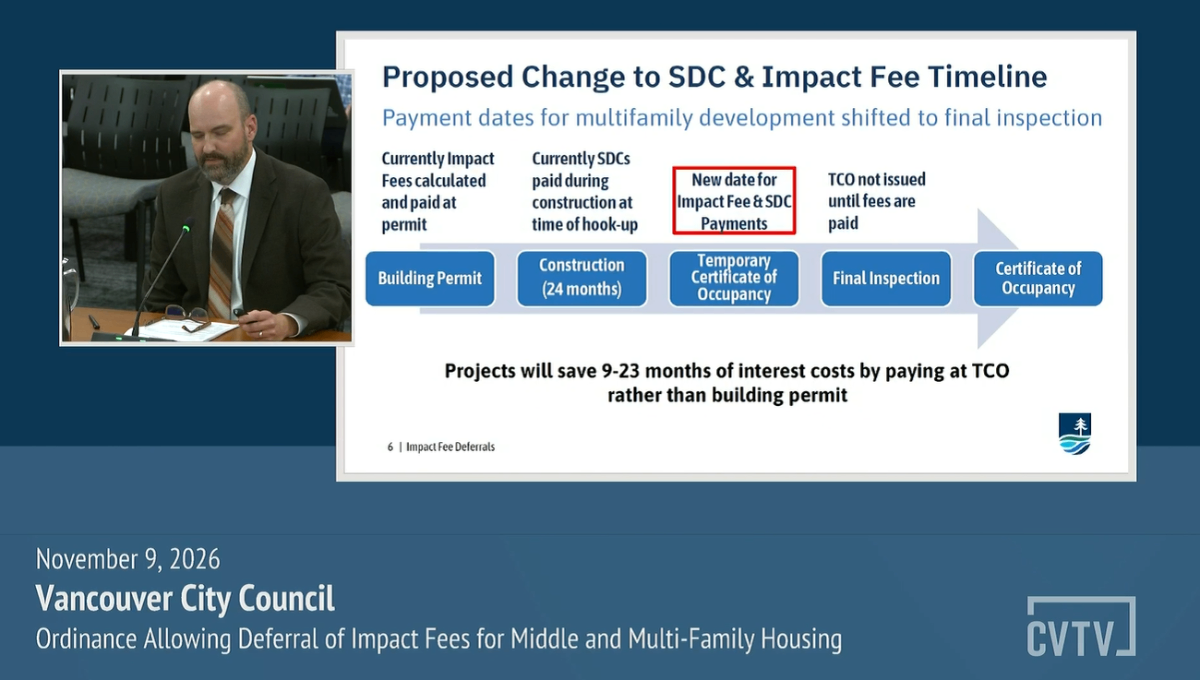
Photo Credit: CVTV
Following the presentation, Kimberly Elbon, joining virtually, strongly opposed the impact fee deferral, arguing that deferring these fees shifts the financial burden of infrastructure strain (roads, traffic, parks) onto taxpayers.
“Fees exist for a reason. They ensure that when big developers come into your city to build massive complexes, they pay their fair share to cover the strain they placed on our roads, on the traffic infrastructure, and the public parks. By giving developers a free pass to defer these fees, you're essentially shifting the financial burden off corporate balance fees and onto the backs of everyday, hardworking Vancouver taxpayers. When corporate developers get a break, the citizens get the bill,” Elbon said.
Elbon asked for greater transparency and urged the council to stand up for the people of Vancouver and protect public funds by voting no on the ordinance.
The ordinance passed with no further deliberation.
OpGov.News will update this article with any new information that becomes available.
To add to or correct any information in this report, please email me at rory.h@lead4earth.org.
0
0

Comments