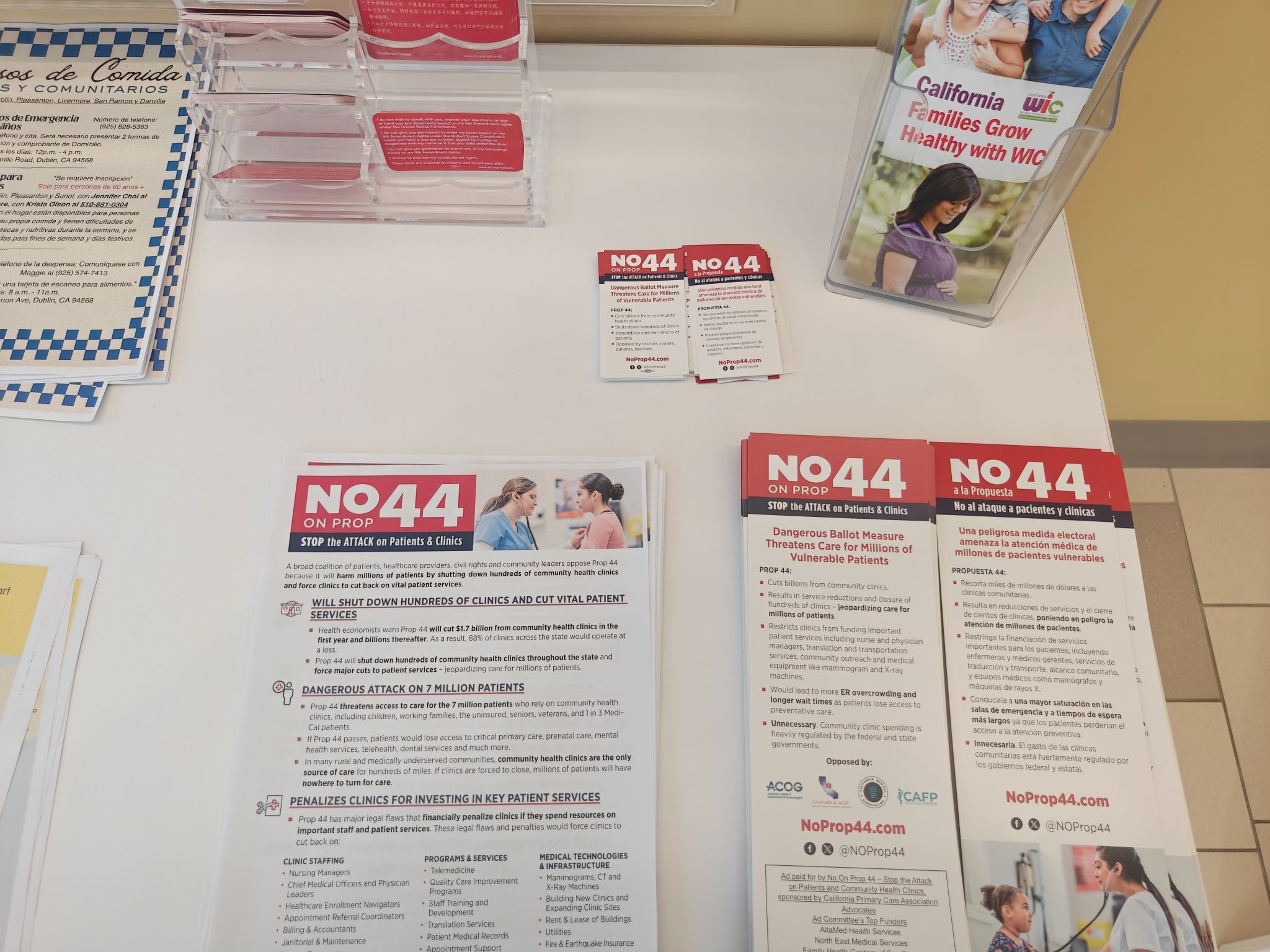
Photo Credit: Joel Martinez / No on Prop 44 information at the Axis Community Health’s administrative offices in Pleasanton.
(PLEASANTON, Calif.) – Pleasanton-based Axis Community Health is pushing back against Proposition 44, a California ballot measure that would require nonprofit Federally Qualified Health Centers (FQHCs) to spend a minimum of 90% of their annual revenue on patient care.
Axis Community Health serves low-income residents in the Tri-Valley, yet it is among multiple private nonprofit clinics opposing Prop 44.
Axis CEO Liz Perez-Howe summarized the clinic's stance in a guest opinion piece entitled “Vote No on Prop 44: Protect healthcare in the Tri-Valley” published in the Pleasanton Weekly on September 17. In it, she wrote of the proposition that “its practical effect would be fewer services for the patients that rely on us.” The article was shared by the company on social media, including on LinkedIn, where Perez-Howe is said to speak of “the dangers of Prop 44.”
These, according to Perez-Howe, include a narrowly defined list of allowable expenses that do not include such things as clinic rent, interpreters, “telehealth systems,” or “outreach staff.”
“These expenses may not take place inside an examination room,” Perez-Howe wrote, “but they make every patient visit possible. Treating them as unrelated to patient care ignores how healthcare delivery actually works.”
As indicated by a legislative analysis provided by the state’s elections office, administrative costs for Safety Net Clinics, such as Axis Community Health, must not exceed “10 percent of revenue.”
According to its website, Axis provides “comprehensive healthcare services” to over 15,000 people across the Tri-Valley, with the “primary focus [of] serving individuals and families with incomes at or below 100% of the Federal Poverty Line (FPL).” As indicated by the U.S. Department of Health and Human Services, 100% of the FPL in 2026 is an annual income of $33,000 for a family of four.
The clinic provides services such as primary care, dental services, women’s health services, behavioral and mental health services, WIC support, and Medi-Cal and Covered California enrollment assistance.
According to CalMatters, “Supporters, led by the health workers union SEIU-UHW, argue that clinics should spend more on direct patient care and less on executive pay and overhead.”
CalMatters also notes that, “With federal cuts under H.R. 1 - which is expected to leave many more uninsured - looming, supporters say it is especially critical for clinics to prioritize patient care now.”
Prop 44 is endorsed by the Service Employees International Union-United Healthcare Workers West and is opposed by associations such as the California Primary Care Association, California Medical Association and California Hospital Association. The California Democratic Party is opposed to Prop 44.
Axis Community Health is a member of the California Primary Care Association.
“Prop 44 sets a simple standard: clinics must devote at least 90% of total revenue to their mission, primarily direct patient care. It’s a floor for patient care, not a cap,” said a SEIU-UHWW spokesperson.
OpGov.news reached out to the CPCA and the Axis Community Health Board of Directors for a statement, but received no response.
Proposition 44 will appear on the November 3 ballot. Information about Prop 44 and other propositions will be available in the California Voter Information Guide at voterguide.sos.ca.gov. The measure will only apply to a select number of private nonprofit FQHCs and will not affect public clinics that are operated by the government.
To add to or correct any information in this report, please contact me at joel.m@lead4earth.org or leave a comment below with your thoughts.
0
0

Comments