(ROSEVILLE, Calif.) — The national conversation around unsafe e-device usage is one facing many cities, Roseville being one. E-devices, which include any electric bicycle, scooter, or other motorized transportation device, are increasingly being used by adolescents as an alternative to traditional scooters and bikes. Substantial resident frustration over reckless driving has initiated calls for increased awareness around safe riding practices.
A recent programmatic effort between the Roseville Police Department (RPD) and the city’s school district has taken aim to educate residents about the laws tied to the different device models.
E-bicycles and relevant regulations are differentiated by three classes. Type 1 devices come pedal-assisted, have a 20 mph maximum speed, no minimum age requirement, and are allowed wherever regular bikes are ridden. While Type 2 e-bikes may have additional throttle-assist technology, their regulations are consistent with those for Type 1. Type 3 devices are only pedal-assisted but these bikes are only one level below conventional motorcycles or mopeds. Maximum speeds are 28 mph, are prohibited on multi-use trails, require a helmet and cannot be used to transport more than the rider. Operation of Type 3 e-bicycles require riders to be a minimum of 16 years old.
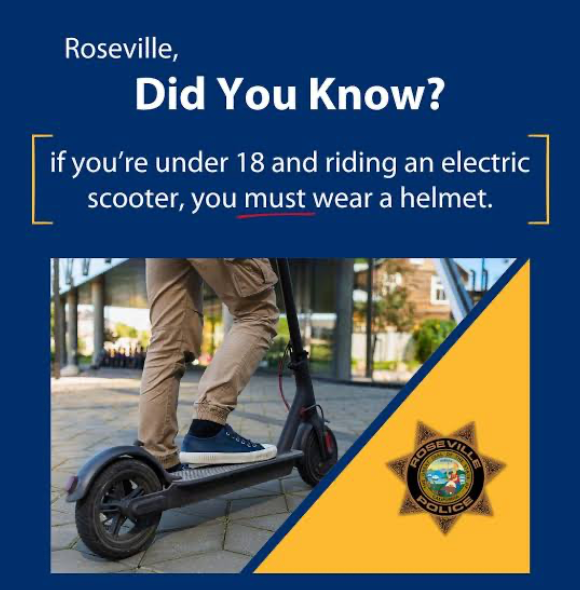
Photo Credit: Roseville Police Department / Informational graphic used for e-device education
While all three e-bikes and e-scooters are common in Roseville, safe usage and adherence to rules has been called into question by local residents.
Many Roseville citizens have taken to online platforms to share their concerns. A Sunset Heights resident, Joy Kodani, took to Nextdoor to share her own experience with underage device use.
“I see SOOOO many kids riding eBikes/eMotos anywhere they please, including on sidewalks, private property, and in traffic. If your kid has one, please be aware of where they are riding it.”
OpGov.News reached out to Jessica Hull, Executive Director of Communication and Community Engagement for the Roseville City School District, about whether she's aware of e-device use among children.
“[I’m aware] Every single day, every single day,” Hull said. “The last two years, concerns have come directly to school sites and to the district office, not just from families and staff, but from community members as well.”
In a city growing in demographic variety, resident frustrations have come from a range of sources. While Hull shared worries have been expressed by newer families, she noted that older community members have expressed particular concern.
“So many residents from the retirement communities were reaching out, saying ‘Hey, we’re trying to take a walk during the time that kids are traveling to and from [school],” Hull said. “‘It used to be that they’d be walking by us, or they’d be riding their bike, [...] and now they’re zooming by us and pushing us off the [bike/walking] path.”
Given the prevalence of e-device use among young residents, RPD and the school district, particularly with Hull’s efforts, have directed attention towards RideSmart’s education protocols. RideSmart, acronymed by letter, provides a comprehensive approach to establish safe riding habits. The program emphasizes ‘Rules First,’ ‘Inspect Your Gear,’ ‘Designated Paths,’ ‘Eyes Up, Hands Ready,’ ‘Slow Down Safely,’ ‘Mind Others,’ ‘Always Wear a Helmet,’ ‘Respect the Rules,’ and ‘Teach & Share.’
Photo Credit: RideSmart / The program logo, incorporating emblems of Roseville Police Department and the Roseville City School District
OpGov.News spoke to Lt. Nick Gaines, a public information officer for RPD, for further elaboration on RideSmart.
While California Highway Patrol is responsible for traffic concerns involving e-bikes, Gaines shared that the city of Roseville has been a spearhead in successfully addressing device safety. The RideSmart program is just a first step in a more comprehensive plan to foster increasing use and concern around the devices.
“Ultimately, it has to start with parents understanding what they’re buying for their kids,” Gaines said.
Among e-device regulations, e-scooters, for example, require a learners permit. Gaines highlighted the overlooked necessity of educating parents.
“Most parents don’t even think about [licenses] because we grew up riding scooters,” Gaines said. “So the issue with this whole influx of e-devices is just a lack of awareness on the part of parents.”
Confusion from parents is only complicated by the differing laws and safe riding practices required for different e-device classifications.
Hull emphasized how many adults, who remain unfamiliar with e-device technology, are even more uncertain about which laws pertain to specific devices.
“When we hosted a family webinar in October, and one of the parents said, ‘How do you determine whether something is class one, two, or three?” Hull said.
Gaines highlighted that while users can be any age, concerns are typically targeted towards Roseville’s younger demographic which remain under their parents guardianship.
“Are there adults doing ridiculous things on these devices? Of course there are,” Gaines stated. “But the majority of the community problem, or the perspective on e-devices, usually associate it with reckless kids and to some extent that’s accurate.”
Given the high propensity of adolescent e-device use in Roseville, the RideSmart program was developed as a tool to address safety where it matters most directly. The strategy prioritizes increasing awareness within schools where information is extended to children and adults alike.
“[RideSmart] has a very detailed outline of education first, both in the classrooms, on back to school nights, and during parent webinars where the police department is present to discuss e-devices,” Gaines shared.
Among the educational methods, RideSmart has facilitated a ‘What Did You Know?’ series, various webinars, and information resources to explain e-device distinctions and the relevant laws and regulations.
After the inaugural implementation of RideSmart this fall, RPD contacted students whose unsafe use of e-devices had been confirmed. In cases where riders were found riding without helmets or not adhering to speed rules, officers are unable to issue formal citations and instead notify guardians about safety violations.
On the ground police presence has also initiated better riding habits. Without force, Hull shared how officers will provide students with an explanation in instances of non-adherence to rules.
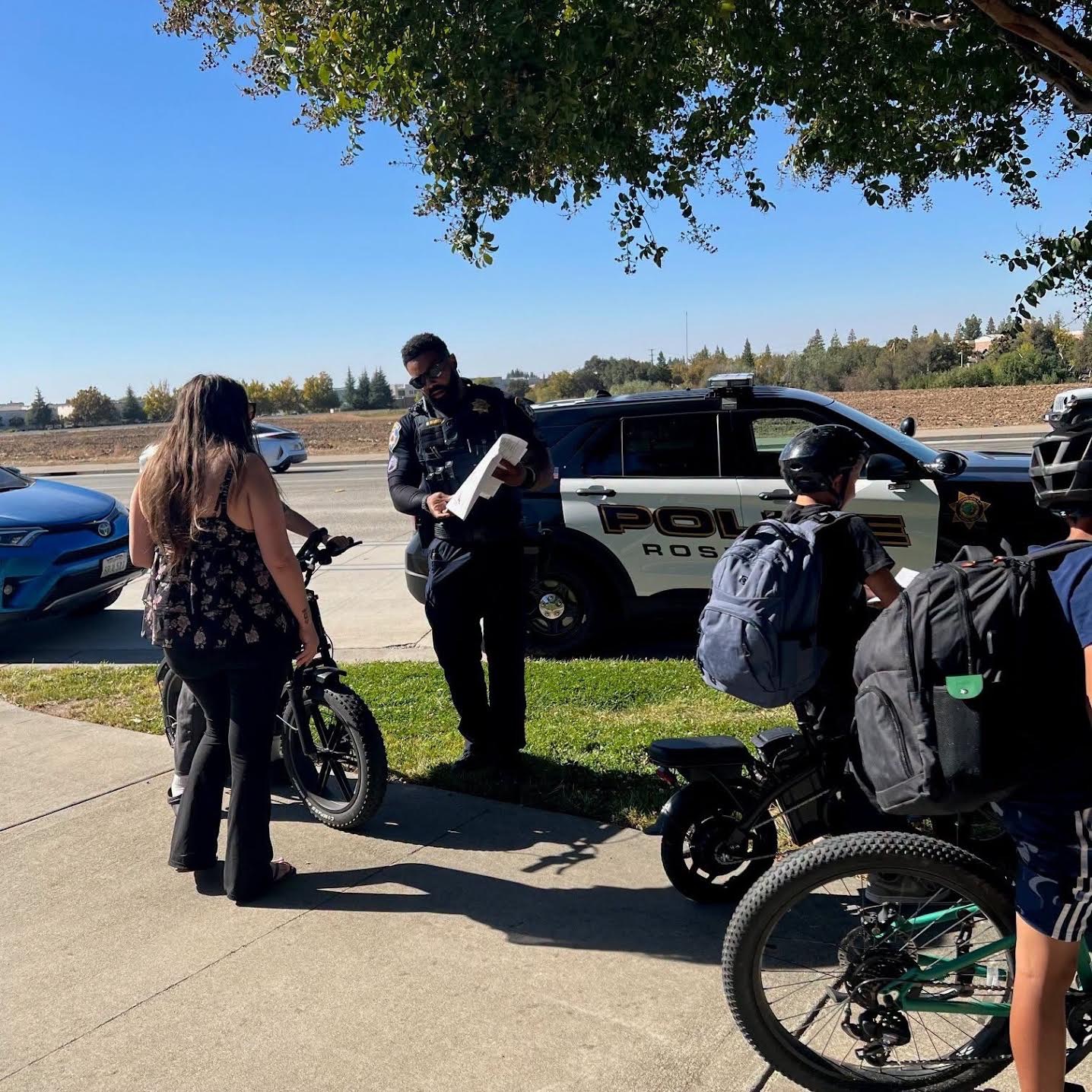
Photo Credit: Roseville Police Department / Officers sharing safety information with adolescent e-device riders
“When an officer is in the area and has the time, they stop by at drop off or pick and hang out by the bike rack,” Hull said. “They talk to kids and families and say, ‘Hey, did you know you actually need to be 15 and a half and have a permit to ride this?'"
When new e-device laws were approved in January of this year, rules were updated revolving around instances of underage users operating without helmets. In addition to requiring that e-bikes install red lights with built-in reflectors, the law, AB 544, prohibits fees or citations for lack of helmets under the condition that guardians can prove the minor’s completion of a safety course and obtainment of a regulation-grade helmet. Beyond new legal rules, RideSmart’s education initiative is exploring adequate policing methods on the side of RPD.
Lt. Gaines acknowledged the department is currently developing greater enforcement measures. Recognizing the balance needed in adequately responding to community concerns, RPD is exploring more effective consequences while balancing the rights held by minors.
“[RideSmart] is a very involved educational campaign, and the enforcement part is coming,” Gaines promised. “Schools can only do so much from an education standpoint. [RPD] can only do so much from an enforcement standpoint. You need to have both to make it effective.”
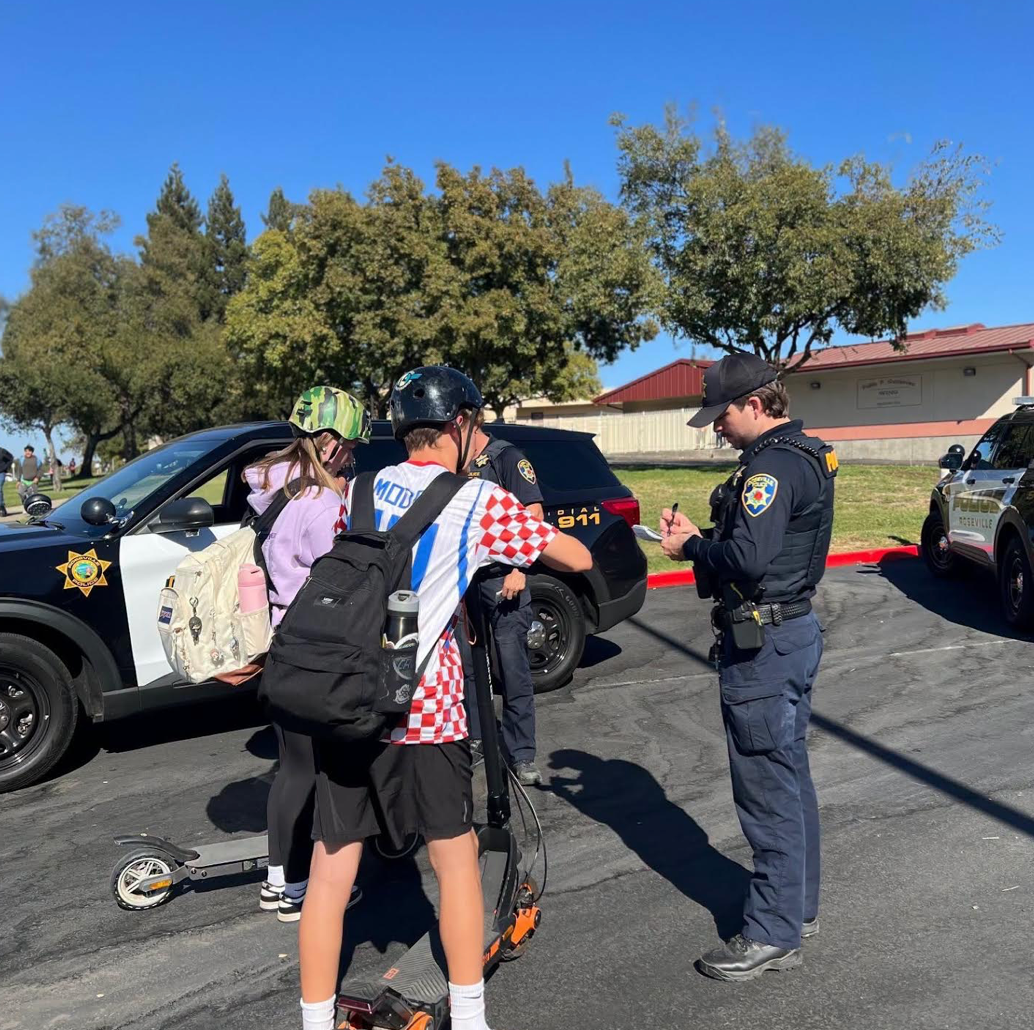
Photo Credit: Roseville Police Department / Law enforcement making a visit to a Roseville middle school
Despite plans from law enforcement for consequence expansion, Hull emphasized how the Roseville school district remains dedicated to understanding and honoring the transportation needs of students and their families. Many adolescent students rely on e-devices for commuting to school.
Hull emphasized how even without current increases in enforcement, community members have already recognized the success of RideSmart's education methods.
“It’s something that we are often hearing about,” Hull shared. “I received one call from a resident of one senior community saying, ‘Wow, they’re riding with helmets! I didn’t see helmets before. Now they’re riding with helmets!”
Next steps in updating the program include the possibility of including other collaborators in the project. This upcoming Spring, RideSmart is looking to emphasize the importance of e-device safety through partnering with local healthcare partners.
“Accidents happen all the time with this,” Hull said. “We’re not trying to run a scare campaign but at the same time, [healthcare agencies] can share the types of injuries they have seen and the frequency.”
The school district is also looking to increase awareness through providing the perspective of insurance impacts.
“The final piece of the puzzle is sometimes you don’t really think about something until it impacts you financially,” Hull highlighted. “A lot of times, there’s no insurance coverage whatsoever. So we’re trying to look at that and educate people on what, if any, insurance should you have on these devices?”
More immediate programmatic changes include an updated December initiative in advance of holiday shopping. The winter campaign seeks to ensure that adults are informed on their purchases and choosing the appropriate e-devices for their children’s age.
Hull also mentioned a recent RideSmart update in which three Roseville middle schoolers have offered to serve as program ambassadors. The students are set to visit regional elementary schools, where e-devices are also growing in popularity. Hull shared her hopes of acquiring more students to serve as ambassadors of the program.
“It’s really wonderful because that’s when you really see an impact when the kids care about it,” Hull said. “Even if just a couple of kids at your school are tasked with reminding their peers about the rules, it makes a big difference.”
As e-device technology continues to develop through innovation, RideSmart plans on adapting to these changes.
More information and program updates can be found on the school district’s webpage.
To add to or correct any information in this report, please contact me at piper.a@lead4earth.org.
0
0

Comments