(SAN RAMON) – It's called the Freedom of Information Act (FOIA) for a reason.
Every red-blooded American citizen has the right to see what elected officials correspond. Many are ignorant of the right, which is a shame, since the day-to-day correspondence behind many pressing matters matters a lot.
It gives context, and most of all, knowledge. And you know what they say about knowledge. It's power.
With all of that, emails are often treated as routine correspondence. Still, in San Ramon, they have become a detailed record of how residents are engaging with major planning and climate decisions.
In a San Ramon FOIA Series, OpGov.ai reports on its third round, sent promptly by the city, showing its willingness to demonstrate it has nothing to hide. Obviously, officials correspond in other ways unbeknownst to us, but FOIA is the beginning of the search for truth, which must start somewhere.
(Photo: Federal Government FOIA Website Page)
The first report, San Ramon Provides FOIA Request Right on Time, reports just that in the shortest version to start the series. The next FOIA report, "Freedom of Information Act Affordable Housing Density Emails Come In, detailed a local issue that as of late demands much attention. In the third round of emails, OpGov.ai obtained a new set of public correspondence sent to city officials, regional agencies, and state lawmakers that builds on earlier reporting about downtown development, transparency, and climate planning.
The emails, written over several months, expand on concerns first raised during City Council and Planning Commission meetings and offer additional context about why residents say they continue to write in.
OpGov.ai first flagged these issues during earlier City Council and Planning Commission meetings this spring. This report follows up on issues raised during public meetings and reviews submitted emails on a rolling basis, questioning whether recent city actions align with adopted plans, climate commitments, and public process expectations.
The emails, authored by San Ramon resident and certified planner Brian Swanson, challenge the City Council’s decision to reduce minimum development intensity downtown, question whether San Ramon’s Draft Climate Action Plan can realistically meet its stated goals, and raise concerns about how public meetings and comments are noticed, documented and made accessible.
A central focus of the emails is the City Council’s approval of a request by Sunset Development Company to reduce the minimum Floor Area Ratio (FAR) in the Downtown Mixed-Use North (DMU-N) district from 1.25 to 0.5.
Swanson argues the original standard was adopted as part of the General Plan 2040 update after years of public input and analysis, and that lowering it now risks weakening long-term planning goals. He warns the change could also raise questions under California’s Housing Crisis Act, commonly known as SB 330, which restricts local governments from reducing residential development capacity below 2018 levels without offsetting measures.
While acknowledging that the city increased the maximum allowable FAR in a 2023 zoning update, Swanson contends that lowering the minimum threshold could still function as a form of downzoning by making lower-density projects easier to approve. He writes that staff reports presented to decision-makers did not include a comprehensive analysis of how the change could affect actual housing capacity.
City Council approved the FAR reduction at a public meeting earlier this year. The meeting materials and recording are available on the OpGov.ai platform.
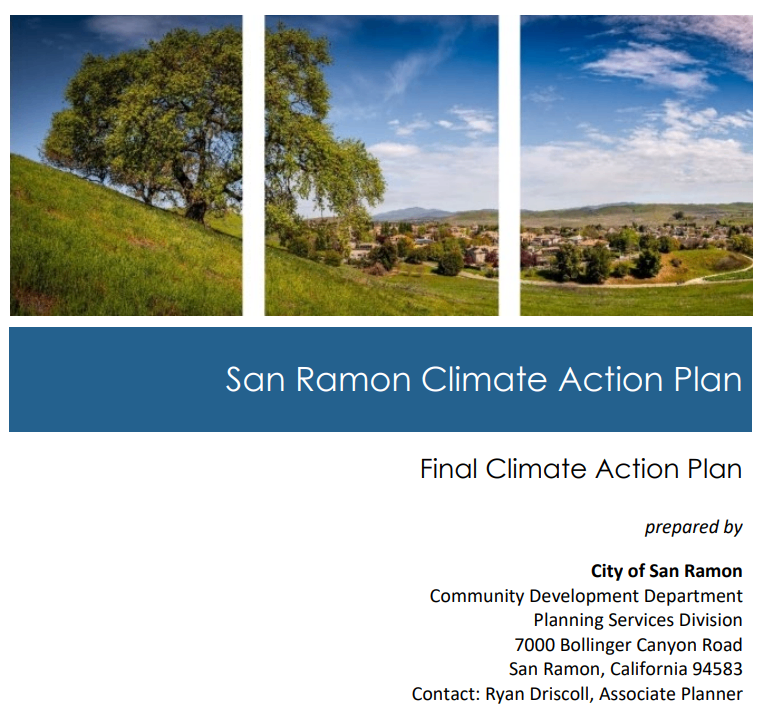
(Photo: San Ramon Climate Action Plan Document Cover)
In separate correspondence, Swanson sharply criticizes San Ramon’s Draft Climate Action Plan, which is currently under public review. He describes the plan as ambitious in language but disconnected from implementation, budgeting, and recent policy decisions. The entire public hearing meeting is here if you would like to add video to this reading material.
Among the concerns raised are transportation and land-use assumptions that, according to the emails, no longer align with city actions. Swanson points to road widening projects along Bollinger Canyon Road, limited public transit service, and the dissolution of Transportation Demand Management advisory structures as examples of gaps between adopted plans and execution.
The Draft Climate Action Plan projects a 14% transit mode share by 2030. Swanson argues that goal is unrealistic given current service levels and staffing capacity. Questioning whether the plan adequately accounts for recent reductions in downtown development intensity, which he says undermine transit-oriented development and greenhouse gas reduction goals.
Similar concerns about climate planning and implementation have been documented elsewhere in California. In a 2023 report, the California State Auditor found that many local governments adopted climate action plans without clearly identifying how measures would be implemented, funded or monitored over time( California State Auditor report). The audit noted that while cities often set ambitious emissions-reduction targets, gaps in staffing, budgeting and accountability made it difficult to assess whether those plans would achieve their stated goals. The report emphasized that clearer implementation frameworks are critical if climate action plans are to function as more than policy statements.
National reporting has also highlighted the challenge cities face in aligning land-use decisions with climate goals. An analysis by Governing Magazine found that zoning changes, density reductions and transportation investments frequently move forward independently of climate planning, even when adopted policies call for compact, transit-oriented growth. The report notes that this disconnect is common across cities and often emerges not from a single decision, but from a series of incremental policy choices that cumulatively undermine long-term climate objectives.
Similar to what we are seeing in San Ramon.
Attached to the Climate Action Plan comments is a supplemental document labeled “Exhibit A,” which compares the Draft CAP to previously adopted city plans, including the Walking District Master Plan, the General Plan 2040 Environmental Impact Report, the CityWalk Master Plan and the Bicycle Master Plan.
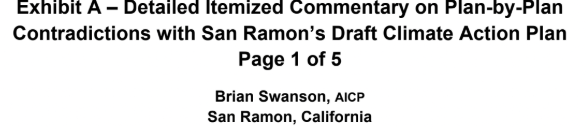
(Photo: Brian Swanson Email Document to Officials)
The document argues that pedestrian, bicycle and transit commitments appear repeatedly in policy documents but are not reflected in completed projects or enforceable programs. Swanson contends that recent City Council actions, including the FAR reduction, directly contradict assumptions used in environmental reviews and climate modeling.
Swanson argues, “the Walking District Master Plan (2022) was adopted with the stated goal of making San Ramon’s core “walkable, connected, safe, and comfortable” An excerpt from the document:
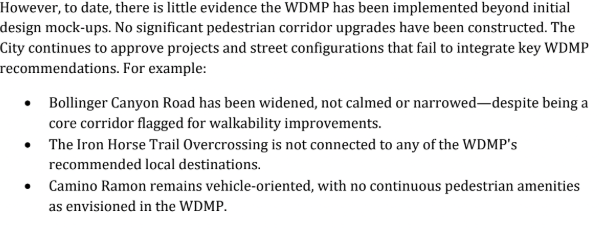
(Photo: Brian Swanson Email Document to Officials)
Other emails focused on public processes. Swanson questions whether Architectural Review Board meetings that are not broadcast or recorded meet transparency expectations, and raises concerns about meeting locations, audio amplification and accessibility under the Americans with Disabilities Act.
He also objects to the practice of storing written public comments separately from agendas and minutes, arguing that fragmentation makes it difficult for residents to track how their input is considered.
City staff acknowledged receipt of the emails but have not yet issued detailed written responses addressing the questions raised.
OpGov.ai previously reported on similar transparency concerns raised by residents during recent City Council and advisory body meetings. San Ramon Officials Betray Public Trust
As San Ramon continues work on downtown development and the Climate Action Plan, the latest round of correspondence highlights unresolved questions about planning consistency, public notice and implementation capacity. Whether those concerns lead to policy changes or procedural reforms remains to be seen, but the volume and detail of the emails suggest that scrutiny of city decision-making is likely to continue.
For questions or comments about this report, contact:ananya.s@lead4earth.org
0
0

Comments