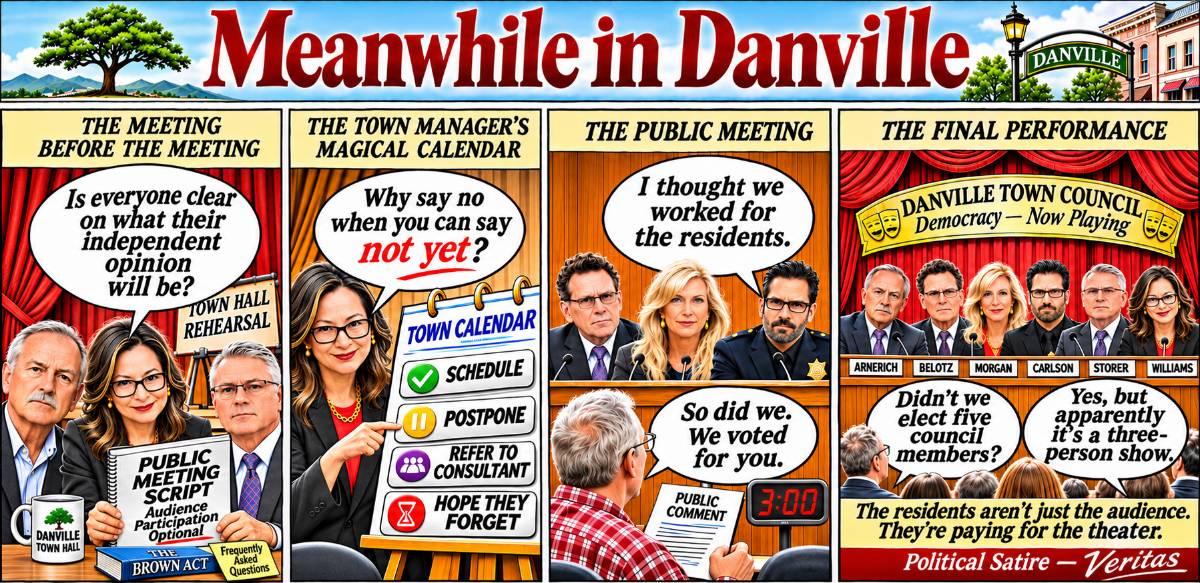
But what if the most important political decisions are shaped before the public meeting even begins? Enter Town Manager Tai Williams and the fascinating world of municipal politics, where the dress rehearsal may be more important than the performance.
The Unofficial Executive Committee
Imagine a hypothetical political inner circle consisting of the Town Manager and two influential council members. Three people, no published agendas, no public minutes and no pesky residents asking inconvenient questions. Call it a cabal or, to sound more respectable, the
Committee for the Strategic Management of Democracy.
With approximately 31 years in office, Newell Arnerich, and 17 years, Robert Storer, possess nearly half a century of combined municipal political experience. While newly elected council members are reading the rulebook, these veterans could probably write it — complete with footnotes, shortcuts and a chapter entitled “Advanced Municipal Maneuvering.”
Whether such an alliance exists remains unproven. Nevertheless, political longevity should provide institutional knowledge, not institutional ownership.
The Art of Political Persuasion
The greatest political skill of a Town Manager may not be telling council members what to do, but convincing them that what the administration wants is what they wanted all along. Staff prepares the reports, presents the alternatives and makes recommendations. It’s the municipal equivalent of a restaurant offering an extensive menu while the kitchen recommends only one entrée. Everything else, unfortunately, requires further study.
If two influential council members share the administration’s priorities, their conversations with colleagues could also shape the eventual outcome. The question is whether those conversations encourage independent judgment or develop collective agreement before the public has an opportunity to participate.
Naturally, residents would still be allowed three minutes to comment on the menu after dinner had been cooked.
Fifty Shades of the Brown Act
California’s Brown Act was designed to keep public business public. Individual briefings are permissible, but private communications involving a council majority, including through intermediaries, can constitute prohibited serial meetings.
When does briefing become lobbying? When does persuasion become collective deliberation? Perhaps Town Hall should keep two copies of the Brown Act — one in the council chambers and another beside the telephone. Transparency involves considerably more than remembering to sit in separate chairs.
The Town Manager’s Magical Calendar
Why say no when you can say “not yet”? Delay is the sophisticated cousin of denial, minus the embarrassing voting record. Perhaps Town Hall needs four buttons on its municipal calendar: “Schedule,” “Postpone,” “Hope They Forget” and, for particularly troublesome matters, “Refer to Consultant.”
Meanwhile, residents conduct research, prepare reports and deliver three-minute speeches. Their reward? “Thank you for your public comment.” Six magnificent words that acknowledge everything, promise nothing and come with absolutely no expiration date.
Perhaps Danville could establish a municipal cemetery for unresolved issues. Headstones might read: “Here Lies an Urgent Public Safety Concern — Referred to Staff,” and “Here Lies an Uncomfortable Decision — Pending Further Study.” Flowers may be delivered during regular business hours, subject to staff approval.
Welcome to Town Hall, Denton Carlson
Perhaps Carlson’s orientation packet should include the Brown Act, an organizational chart, a flashlight and a compass. The flashlight is for transparency. The compass is to distinguish the administration’s direction from the direction established by the elected council.
Who’s Really Running Danville?
Who sets the agenda? Who authorizes delays? Are all five council members equally informed? Residents should not have to wonder whether their three minutes of public comment are competing against three weeks of private political persuasion.
The Town Manager works for the Town Council. The Town Council works for the residents. Perhaps someone should frame that organizational chart and hang it prominently in Town Hall.
Public meetings should be where decisions are made, not where previously developed decisions are unveiled. Danville residents elected a five-member Town Council, not a backstage management team. Democracy means knowing who wrote the script and whether the ending was decided before the curtain went up.
After all, the residents are not merely the audience.
They’re paying for the theater.
0
0

Comments