After passing what OpGov.News has called the “King’s Ordinances”—Ordinances 531 and 532—the San Ramon City Council faced another decision involving public oversight.
This time, the proposal was described simply as a “Zoning Ordinance Text Amendment.”
But buried within hundreds of pages of proposed changes was something far more consequential: the deletion of Municipal Code provisions implementing Measure G, including the requirement for supermajority votes and at least three public hearings before both the Planning Commission and City Council for General Plan amendments.
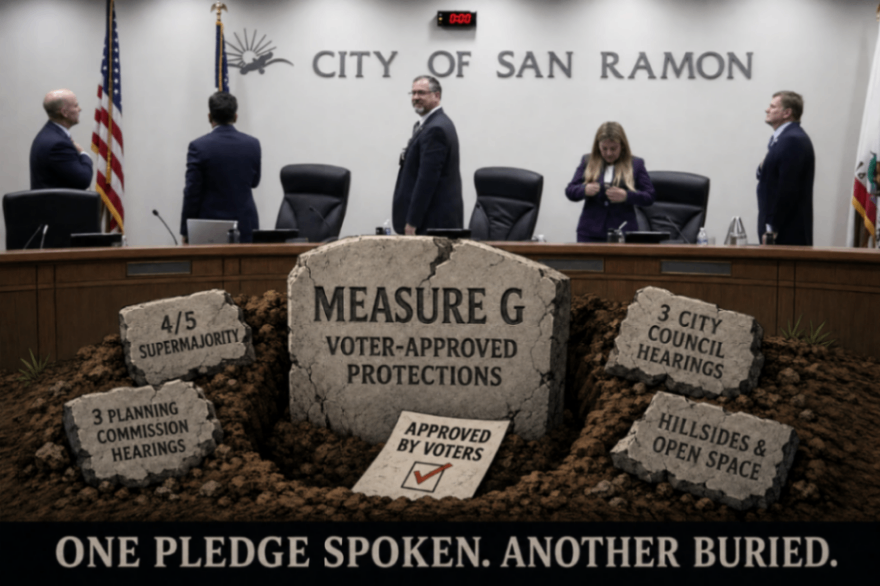
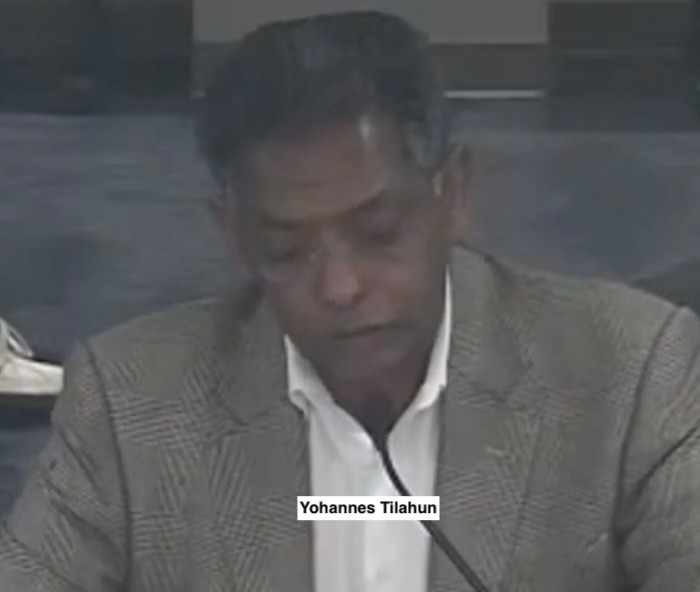
Credit : San Ramon Youtube Channel and Veritas
Measure G was approved by San Ramon voters in 1999. Yet when Ordinance 534 came before the City Council on September 23, 2025, council members did not meaningfully discuss the removal of these protections.
They did not ask why references to Measure G were being deleted.
They did not discuss why three required public hearings were being reduced to just one.
They did not discuss why the four-fifths supermajority requirement was being eliminated.
They did not explain why protections originating in a voter-approved initiative could be removed through a council-approved zoning text amendment.
The silence was striking.
What Was Measure G?
Measure G was adopted during a period of intense community concern about growth, hillsides and open-space preservation.
The measure established a two-year moratorium on amendments to the General Plan and Zoning Ordinance while a citizen-based General Plan Review Commission prepared a new General Plan. It also required the commission to develop a plan for acquiring ridgeline and agricultural lands adjoining San Ramon for permanent open-space preservation.
The resulting General Plan was then submitted to San Ramon voters.
But Measure G did not stop with the creation of that plan.
Section 6 established safeguards for future amendments:
“The General Plan adopted pursuant to Section 5 may only be amended by a 4/5 vote of the City Council after a recommendation in favor of such amendment is made by a 4/5 vote of the Planning Commission.”
It also required public hearings:
“Neither the City Council nor the Planning Commission shall so vote until they have held at least three public hearings respectively.”
These were not merely symbolic references added years later by city staff. They were written into the voter-approved measure itself.
The City Attorney’s 1999 impartial analysis also told voters that:
“In acting on any subsequent amendments to the Plan, both the Planning Commission and City Council are required to conduct a minimum of three public hearings.”
The analysis further stated that subsequent amendments would require four-fifths approval from both bodies.
For more than two decades, San Ramon followed these requirements when processing General Plan amendments. As recently as February 2025, the City described a proposed amendment to General Plan 2040 as beginning “a series of public hearings as required by San Ramon’s Measure G.”
That history was carefully documented in public comments submitted by former Planning Commissioner Eric Wallis, who participated in the original General Plan Review Commission process.
What Ordinance 534 Actually Deleted
The City Attorney has since argued that Ordinance 534 did not repeal or amend Measure G. According to the attorney, the Council merely removed references to Measure G from an ordinance previously adopted by the Council.
But the redlined ordinance shows that the Council removed much more than a historical reference.
Ordinance 534 deleted language stating:
“Amendments to the General Plan are governed by Measure G adopted by the voters of San Ramon…”
It also eliminated:
The Planning Commission’s four-fifths vote requirement for General Plan amendments.
The City Council’s four-fifths vote requirement.
The requirement that Council approval be substantially consistent with the Planning Commission’s four-fifths recommendation.
The requirement for at least three public hearings before the Planning Commission.
The requirement for at least three public hearings before the City Council.
These were the principal procedural protections contained in Section 6 of Measure G.
The City Attorney’s response acknowledges the practical result:
“It simply makes clear that the procedure for adopting Amendments to the General Plan is no longer governed by its terms.”
That sentence is important.
The City may argue that Measure G technically remains in the historical record. But if future General Plan amendments are no longer governed by its voting and hearing requirements, then its remaining practical protections have been eliminated.
The Connection to Ordinances 531 and 532
This controversy did not arise in isolation.
Only two weeks earlier, on September 9, 2025, the City Council adopted Ordinances 531 and 532, amending development agreements involving major Bishop Ranch and CityWalk properties.
OpGov.News called them the “King’s Ordinances” because they shifted significant review authority away from the Planning Commission and toward administrative decision-making.
The Planning Commission had recommended approval of one of the amendments on a 3–1 vote while one commission seat was vacant. That vote did not represent four-fifths of the full five-member commission.
Because Ordinances 531 and 532 were development-agreement amendments rather than General Plan amendments, it would be legally imprecise to claim that Measure G’s supermajority requirement directly applied to those ordinances.
But the 3–1 vote demonstrated why the distinction matters.
Large development proposals may involve multiple interconnected approvals. A development-agreement amendment may be considered separately from a General Plan amendment, even when both concern the future of the same large development area.
Measure G’s supermajority and hearing protections acted as an additional safeguard whenever a General Plan amendment was required.
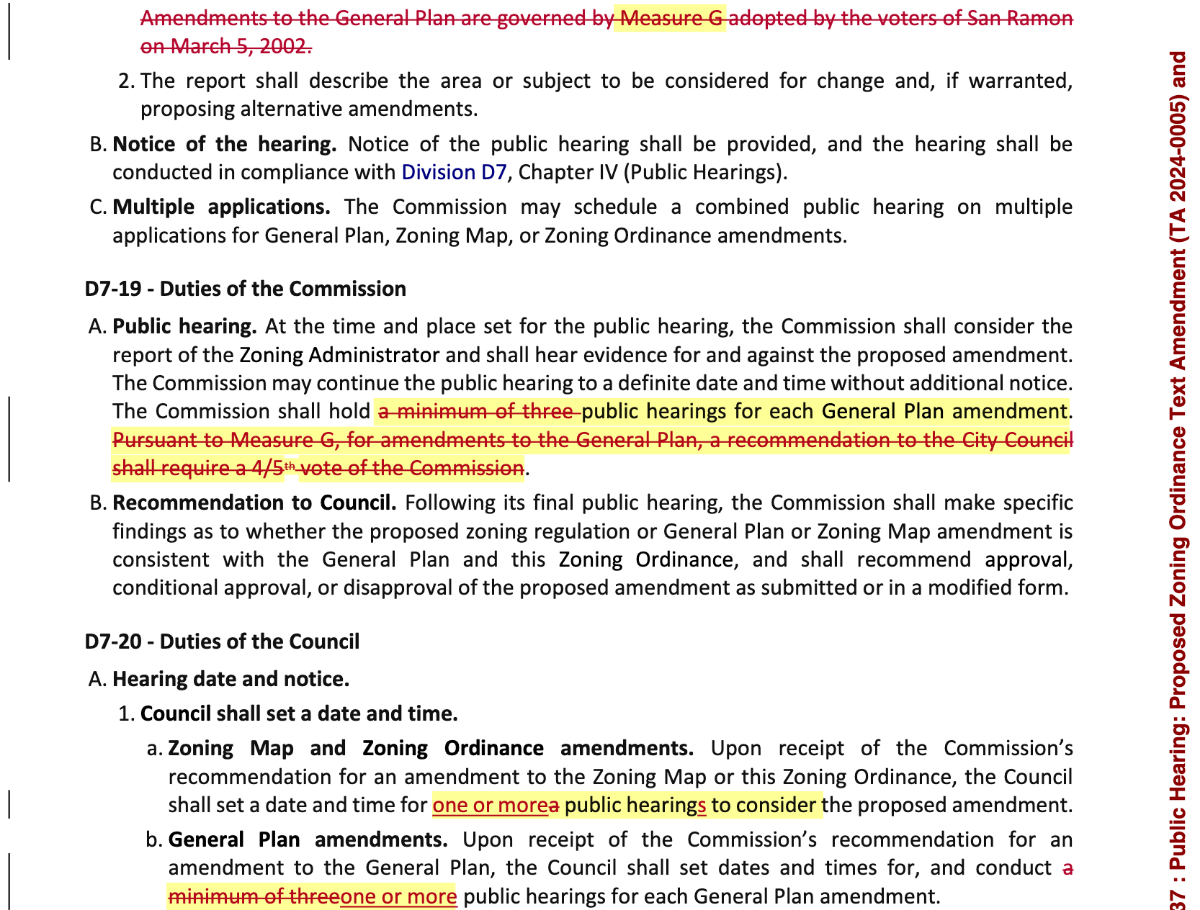
Credit : San Ramon City Agenda Item Oct 14th 2025.
Ordinance 534 removed that safeguard for future General Plan amendments.
That sequence demands public examination:
July and August 2025: The Planning Commission considered the development-agreement amendments.
August 19: The Planning Commission recommended the controversial zoning text amendments later adopted as Ordinance 534.
September 9: The Council adopted Ordinances 531 and 532 despite extensive public opposition.
September 23: The Council considered the zoning text amendment removing Measure G’s supermajority and three-hearing requirements.
October 14: The Council adopted Ordinance 534 through its consent calendar.
This does not, by itself, prove that Measure G was removed specifically to facilitate one development.
But it raises an unavoidable question: Why did the City eliminate voter-approved safeguards at the same time it was streamlining review procedures affecting some of San Ramon’s largest development areas?
The Council owed residents a public answer.
The Warning the Council Did Not Address
During the September 23 hearing, I reminded the Council that the previous Planning Commission vote had been 3–1 and that the community had already raised serious concerns about the loss of public oversight.
I then addressed the Measure G deletions directly:
“Measure G was a voter-mandated measure which said a supermajority was required and a minimum of three Planning Commission and three City Council meetings were required. That was the spirit of this measure.
Now the text amendment is changing the supermajority to a regular majority and three meetings to one meeting.… You previously said that a voter-approved measure should go back to the voters and should not be amended through a text amendment. We are looking forward to hearing your argument.”
No substantive argument came.
The Council did not publicly address the deletion of Measure G references, the supermajority requirement or the three-hearing requirement.
“Only the Voters Can Change It”
The Council’s silence was even more significant because, during the September 9 meeting, Councilmember Robert Jweinat had reportedly acknowledged the basic principle:
“Measure G is a voter-approved initiative protecting hillsides and open space. It cannot be repealed or amended by Council action. Only the voters can change it.”
Yet two weeks later, when the Council was directly asked how that position could be reconciled with the Measure G deletions in Ordinance 534, no explanation was offered.
The City now relies on a narrower legal theory: Measure G governed only the General Plan prepared after the 1999 vote, while the City Council later chose voluntarily to extend its requirements to subsequent General Plan amendments.
Under that interpretation, the Council claims it could remove those later Municipal Code provisions without returning to voters.
But that theory conflicts with the language presented to voters about “subsequent amendments,” the City’s consistent practice for more than two decades, its application of Measure G to later General Plans and its own public information.
At minimum, such a significant reversal required a transparent public legal analysis.
It did not receive one.
Buried in the Consent Calendar
Ordinance 534 returned for adoption on October 14 as Item 5.3 on the consent calendar—a portion of the agenda normally reserved for routine matters approved without separate discussion.
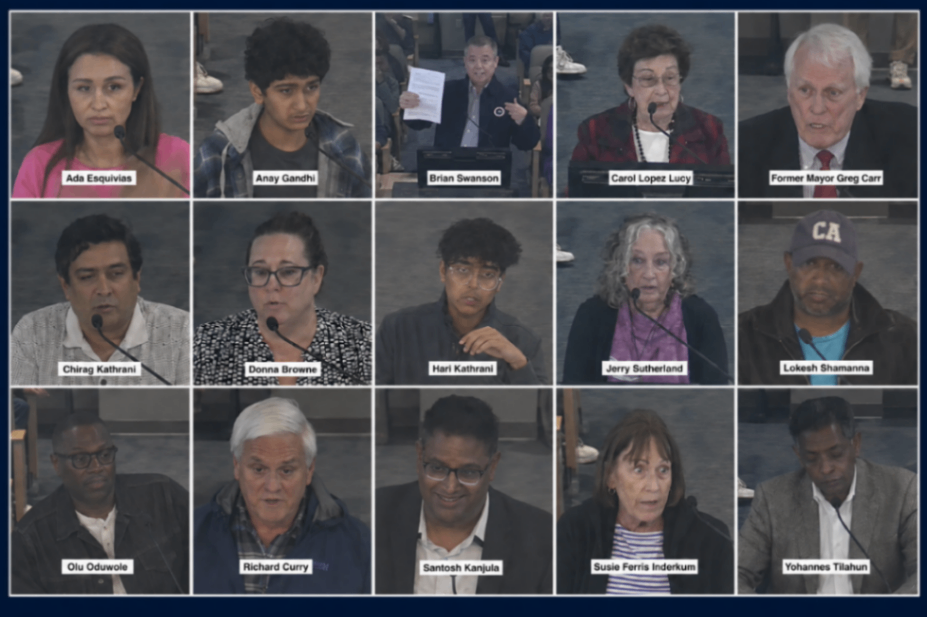
Credit : City Of San Ramon Youtube Channel
Approximately 25 residents took turns asking the Council to remove the item from the consent calendar and hold a full public discussion.
Speakers questioned the Council’s legal authority, the loss of public participation and the failure to explain why a voter-approved measure no longer governed General Plan amendments.
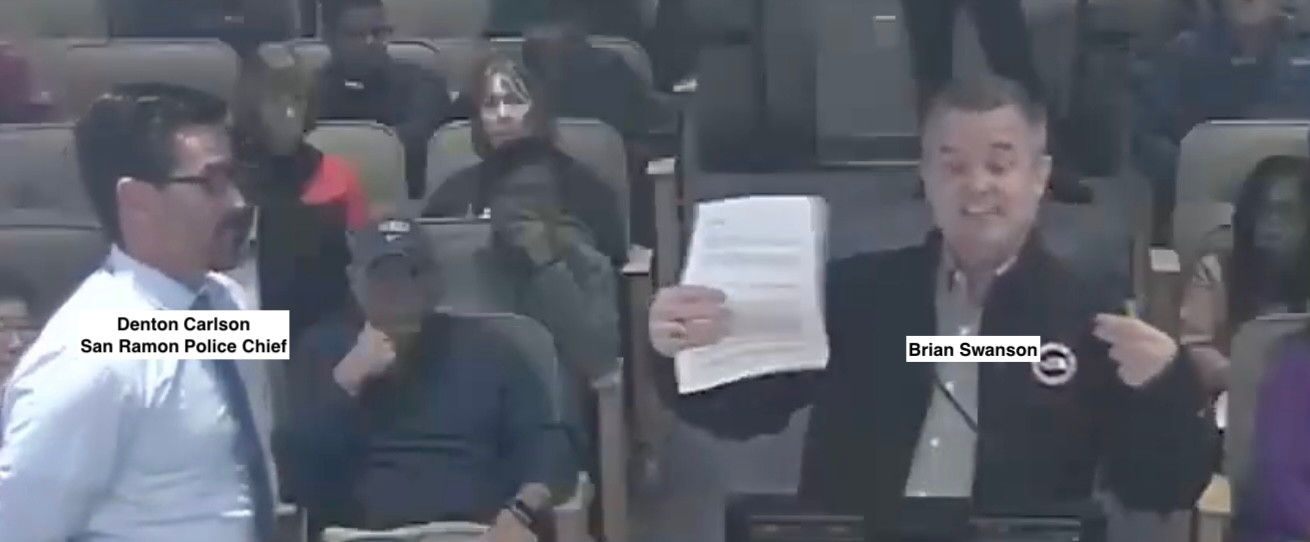
The Council Chamber was full that evening—an important fact Brian Swanson emphasized while addressing the Council. Residents had filled the room to demand that Ordinance 534 be removed from the consent calendar and discussed publicly. Yet the Council proceeded without opening a substantive discussion.
When Swanson continued pressing the Council after his speaking time expired, San Ramon Police Chief Denton Carlson approached the podium and physically escorted him from the chamber. The scene captured the deterioration in trust that evening: a packed room asking elected officials to discuss the removal of voter-approved protections, a Council that remained silent, and a resident physically removed while demanding answers.
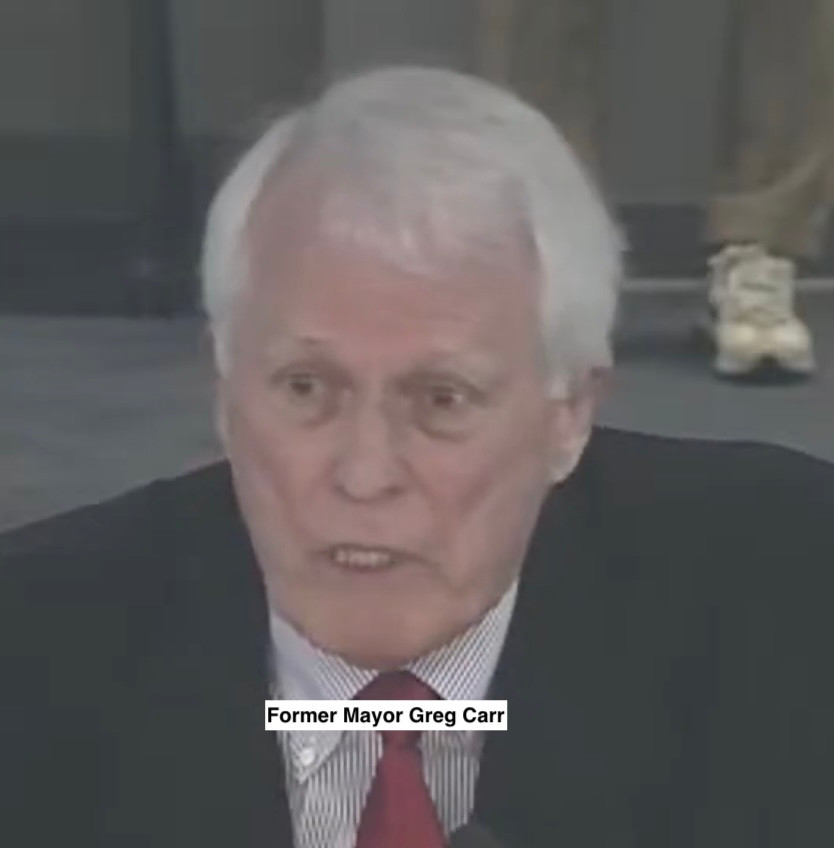
Former Mayor and Councilmember Greg Carr also urged the City to communicate clearly with residents about Measure G, state housing requirements and the consequences facing the City.
Despite those requests, the Council did not pull Item 5.3 for substantive discussion. Ordinance 534 was adopted without council members publicly confronting the central questions raised by residents.
Review the October 14 meeting and public comments.
The City Attorney’s Answer Does Not Resolve the Question
The City Attorney is technically correct that Ordinance 534 did not erase the original Measure G document.
But that does not answer what residents asked.
The Council removed the operative Municipal Code provisions implementing Measure G. Future General Plan amendments would no longer require the same four-fifths votes or minimum of three hearings before each body.
Calling this the removal of a “reference” minimizes the substance of what changed.
The unresolved question is not whether the words “Measure G” still exist in an archive.
The question is whether the Council had the legal authority to eliminate the remaining practical protections of a voter-approved initiative without first returning to the voters or obtaining a judicial determination that those protections were no longer enforceable.
The staff report asserted that Measure G no longer controlled these procedures and that portions conflicted with state law. But it did not provide residents with a controlling court decision establishing that Section 6 had expired or could be eliminated by Council action.
Nor did the Council publicly test that legal theory.
It simply remained silent and voted.
Democracy Requires More Than a Technically Correct Label
Whether one supports or opposes additional development is not the only issue.
The deeper question is how government treats laws approved by its residents.
Measure G was presented to voters as a safeguard governing subsequent amendments to their General Plan. The City followed it for more than two decades. Then, in 2025, its central protections were removed through something presented as a zoning “text amendment.”
At the first Council meeting, the deletions were met with silence.
At the second, the ordinance was placed on the consent calendar and adopted despite approximately 25 requests for public discussion.
A voter-approved safeguard should not lose its practical effect without a clear legal explanation, an open debate and direct accountability from every elected official voting to remove it.
San Ramon residents received none of those things.
Questions for Every Candidate for Mayor and City Council
Questions for Every Candidate for Mayor and City Council
The debate over Measure G is not only about what happened in 2025. It is now an election issue.
Every candidate running for Mayor or City Council should answer the following questions clearly:
If elected, would you restore the central safeguards embodied in Measure G—including a four-fifths supermajority and at least three public hearings before both the Planning Commission and City Council for significant General Plan amendments?
If you would not restore those exact requirements, what comparable protections would you establish to ensure that major land-use decisions receive meaningful public review?
Would you support placing the question before San Ramon voters rather than allowing the Council alone to decide whether these protections should exist?
Would you commit to preventing consequential land-use and public-participation changes from being adopted through the consent calendar?
Candidates should not answer simply by saying they support “transparency” or “community engagement.” Residents deserve specific commitments.
Will you restore the spirit of Measure G—or do you believe a simple Council majority and a reduced public-hearing process provide enough protection for San Ramon’s future?
Attached is the copy of the public comment from Attorney Eric Wallace (Former Planning Commissioner of San Ramon)
Photographs
8-5-25 public comment on Item 9.1-5
8-5-25 public comment on Item 9.1-5.pdf
0
0

Comments