Editorial note:
This illustrated opinion series examines a recurring pattern in local government. The “Master Puppeteer” is a political archetype, not an allegation that any particular person has committed an unlawful act. The series explores political culture, independence, access, public accountability, and the risks that arise when experience hardens into entitlement.
The cartoons depict patterns of political influence and institutional culture. They do not suggest that every person shown within such a system knowingly participates in, recognizes, or accepts that influence.
THE MAN ABOVE THE CHAMBER | PART 5 OF 5
When the Public Finally Looks Up
The whole machine depends on invisible strings. Public scrutiny changes who holds them.
By Mellisa Martinez | Illustrated political commentary
“Residents are not merely the audience. They own the theater.”
Longevity, Familiarity and Term Limits
The Master Puppeteer flourishes most easily where there are no term limits. Time is the resource from which every other advantage is built. Over twenty or thirty years, he accumulates relationships no newcomer can replicate. Commissioners become candidates. Candidates become councilmembers. Councilmembers help identify future candidates. The same political family renews itself while calling the arrangement stability and continuity.
Term limits are not a perfect remedy. They can remove capable officials and shift power toward permanent staff, consultants or lobbyists. Long service is not inherently abusive. But term limits perform one indispensable function: they guarantee that the performance must eventually end.
They remind every official that the chair belongs to the public.
Without that reminder, longevity can begin to resemble ownership. The cast changes. The director remains.
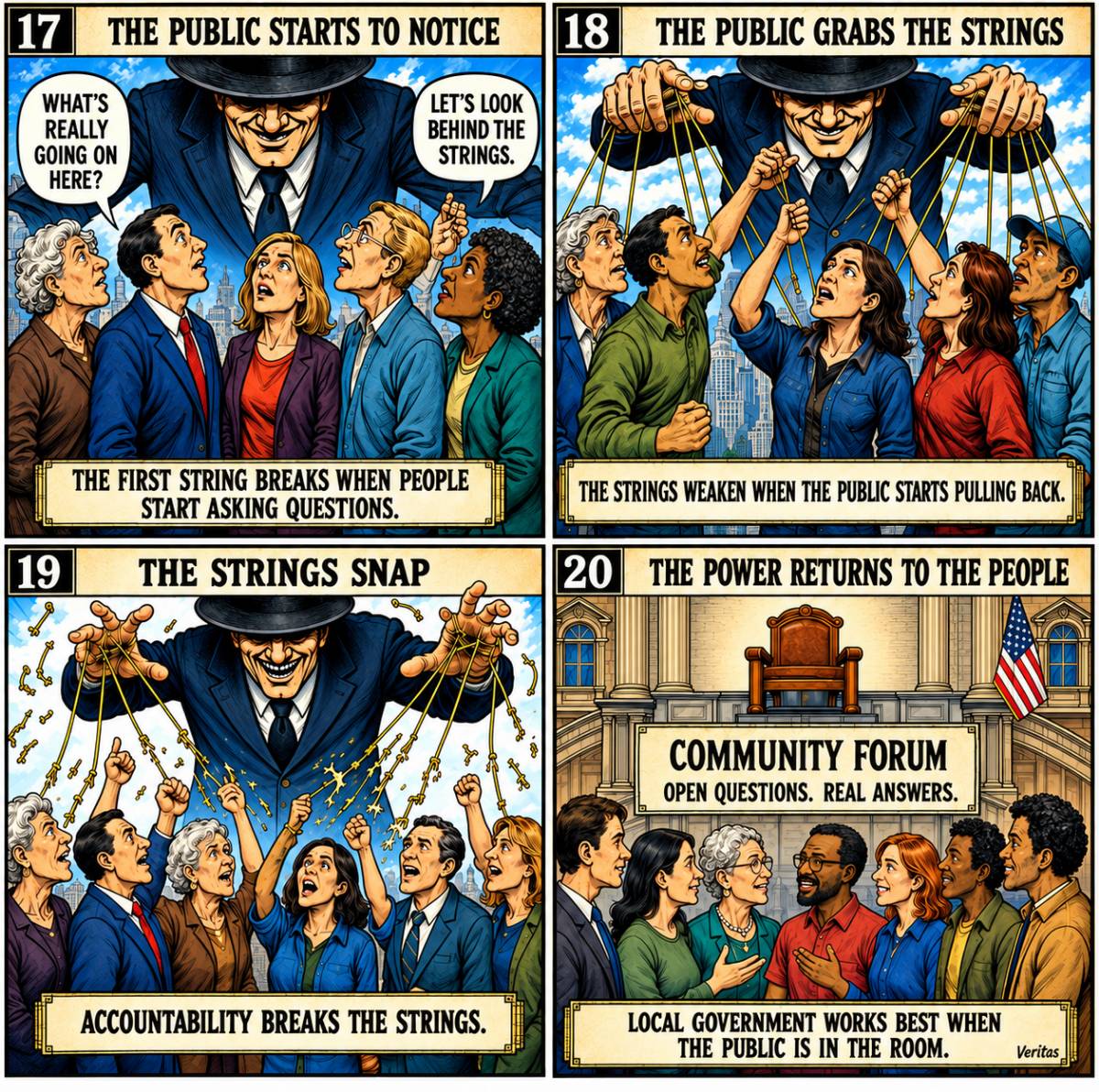
The Public Looks Up
After years of influence, the Puppeteer may forget the most basic fact of public office: he works for the people. Residents who question him become obstacles. Staff members who offer unwelcome advice become disobedient. Colleagues who disagree become people who have failed to appreciate his superior experience.
He may still insist that everything is “for the good of the town.” The public’s answer is the essential democratic question: Who gets to decide what the good of the town actually is?
He begins as a public servant and ends by expecting the public to serve him.
The Office Belongs to the Public
It does not matter how many elections he has won, meetings he has attended or years of history he remembers. The office belongs to the public. The council chamber belongs to the public. Elected officials are temporary stewards, not owners.
The Puppeteer’s power depends on residents watching the stage without examining the rigging. It weakens when they begin asking: Who encouraged this candidate to run? Who repeatedly endorses whom? Who controls appointments? Can staff offer unwelcome advice without fearing retaliation? Who receives access before decisions are made? Are public reports presenting genuine alternatives or guiding the council toward a predetermined outcome?
These are not necessarily allegations of illegality. They are questions about political culture—and whether democratic procedures remain meaningful.
When the Strings Become Visible
Eventually, the audience looks up. Residents trace the connections among appointments, endorsements, campaign messages, staff reports, meeting schedules, alliances and votes. They request records, examine contributions, attend meetings and insist that candidates answer publicly and independently.
Once the strings are visible, they become harder to dismiss as coincidence. Some loosen. Others snap. The Puppeteer’s greatest adversary is not another politician.
It is an informed public that refuses to confuse longevity with wisdom, intimidation with leadership, self-interest with public service or political choreography with consensus.
Residents are not merely the audience. They own the theater.
What Accountability Looks Like
Public scrutiny should lead to structural reform, not merely a change of personalities. Communities can debate reasonable term limits; require clearer disclosure of campaign endorsements and political relationships surrounding appointments; provide earlier public notice and complete meeting materials; strengthen rules protecting professional staff from political interference; and make major policy decisions in public rather than allowing access and timing to determine who is heard first.
No reform can eliminate ambition, loyalty or political alliances. Nor should it. Democracy depends on persuasion and coalition-building. The goal is simpler: no individual should become so institutionally dominant that disagreement feels risky, succession feels choreographed or public participation begins only after the important conversations are over.
The chamber’s five seats are temporary public trusts, not rewards for loyalty or prizes for those who have waited patiently on the political bench.
Future councilmembers should rise because of their ideas, judgment, knowledge and independence—not because a powerful figure has decided they can be trusted to preserve an existing agenda.
The Master Puppeteer is not merely a cartoon villain. He is a warning about what can happen when experience hardens into entitlement, influence becomes control and loyalty replaces independent judgment.
But there is one thing even the most powerful Puppeteer cannot control forever: an informed public.
The strings work only while people are willing not to see them. Once residents look up, ask questions, examine appointments and endorsements, demand records and insist that every elected official answer for themselves, the arrangement begins to change.
The strings loosen. Some snap.
Eventually, every puppeteer loses his grip. Every chair becomes empty.
The town belongs to the people.
THE END
THE MAN ABOVE THE CHAMBER | FIVE-PART WEEKLY SERIES
0
0

Comments