Editorial note:
This illustrated opinion series examines a recurring pattern in local government. The “Master Puppeteer” is a political archetype, not an allegation that any particular person has committed an unlawful act. The series explores political culture, independence, access, public accountability, and the risks that arise when experience hardens into entitlement.
The cartoons depict patterns of political influence and institutional culture. They do not suggest that every person shown within such a system knowingly participates in, recognizes, or accepts that influence.
THE MAN ABOVE THE CHAMBER | PART 4 OF 5
Inside the Machine
How pressure can shape staff reports, implementation and the public story after a vote.
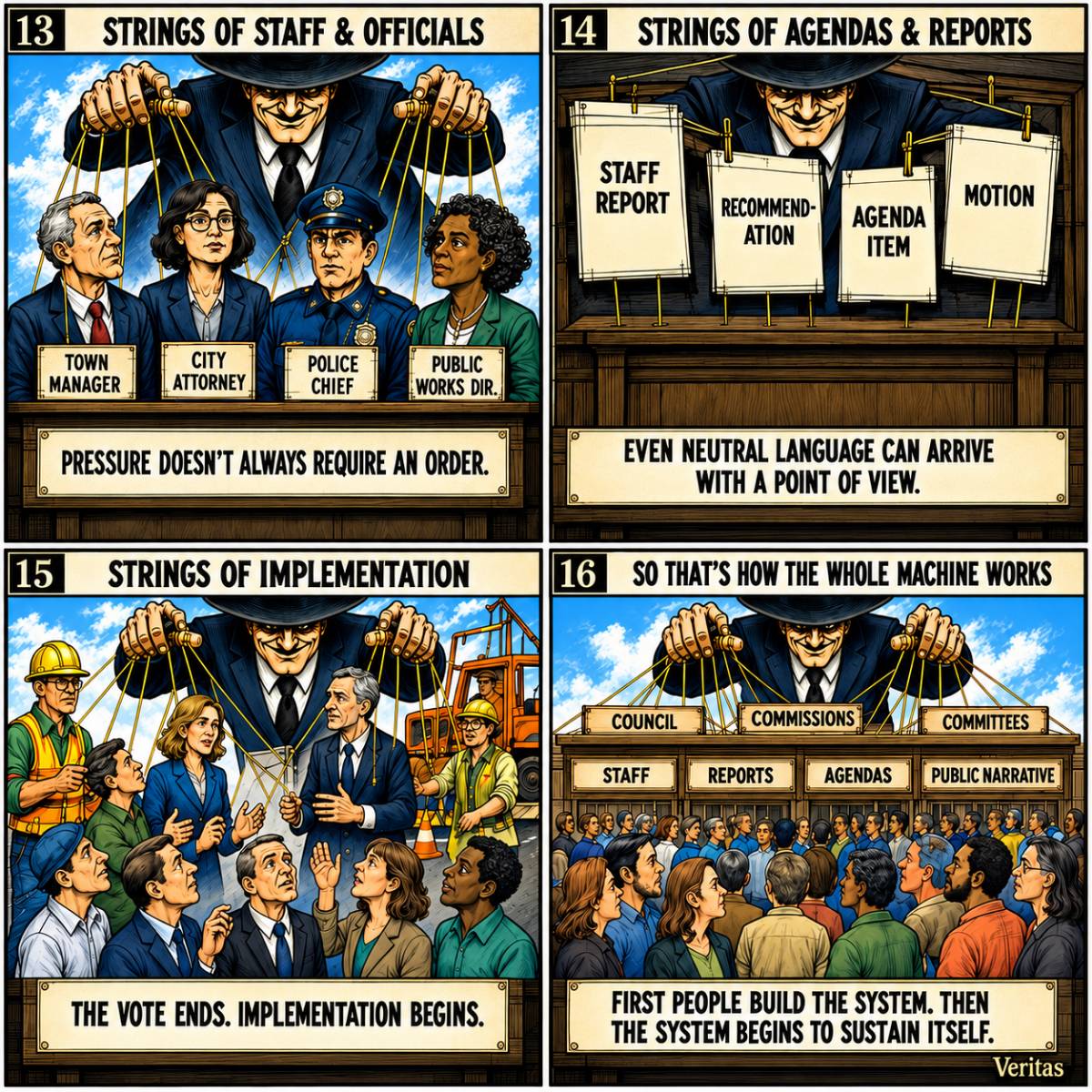
Episodes 13-16: Senior Staff, Reports, Implementation and the Whole Machine
Credit : Veritas
Pressure on Staff and the Record
Professional judgment becomes vulnerable when it conflicts with a conclusion a powerful official has already reached. An employee can be challenged aggressively in public, a technical disagreement can become a test of competence and a private conversation can carry more weight than anything recorded in the minutes.
Formal authority is not always necessary for pressure to work. A raised voice, public rebuke, icy silence or carefully placed reference to accountability may be enough. What one official calls leadership, another person may experience as intimidation.
A staff report need not contain a false statement to guide a predetermined result. It need only emphasize certain facts, minimize others, narrow the alternatives and present the preferred outcome as the most responsible path.
Questions That Carry Their Own Answers
Many political questions are speeches wearing question marks: “Wouldn’t delay expose the town to unnecessary risk?” “Isn’t this the only financially responsible option?” “Wouldn’t rejection undermine years of planning?” The conclusion is embedded in the question.
Over time, pressure can produce anticipatory obedience. Reports are softened before anyone asks. Alternatives disappear. Difficult findings migrate to appendices. Recommendations arrive aligned with the political weather. At that point, the Puppeteer no longer needs to pull every string. People begin moving before his hands do.
Controlling the Public Story
The same influence can extend to the public story. Campaigns repeat phrases such as experienced leadership, proven results, continuity and responsible government. After a contentious vote, newsletters and social-media posts describe the decision as a collaborative achievement. Objections vanish from the headline. By morning, choreography has become consensus.
When a popular idea becomes unavoidable, the Puppeteer may adopt it, modify it slightly and present himself as its responsible steward. He first calls it unnecessary, then impractical, then premature. When it becomes inevitable, he calls it leadership.
Editing the Past
Longevity can make the Puppeteer the town’s unofficial historian. He remembers old agreements, former employees and decisions made before newer officials entered public life. That knowledge is valuable, but it also gives him the power to frame history selectively.
Memory becomes authority. Authority becomes authorship. He does not merely influence the town’s future; he edits its past.
The phrase he returns to most often is that he acts “for the good of the town.” He may sincerely believe it. That is precisely the danger: the public good and his agenda have become indistinguishable in his mind.
But no elected official owns the definition of the public good. The town is not his agenda, and his agenda is not the town.
Next week: What changes when the public finally looks up, traces the strings and demands answers.
0
0

Comments