Editorial note:
This illustrated opinion series examines a recurring pattern in local government. The “Master Puppeteer” is a political archetype, not an allegation that any particular person has committed an unlawful act. The series explores political culture, independence, access, public accountability, and the risks that arise when experience hardens into entitlement.
The cartoons depict patterns of political influence and institutional culture. They do not suggest that every person shown within such a system knowingly participates in, recognizes, or accepts that influence.
Who Gets Heard Before the Vote?
Access, appointments and the quiet distinction between community partners and public critics.
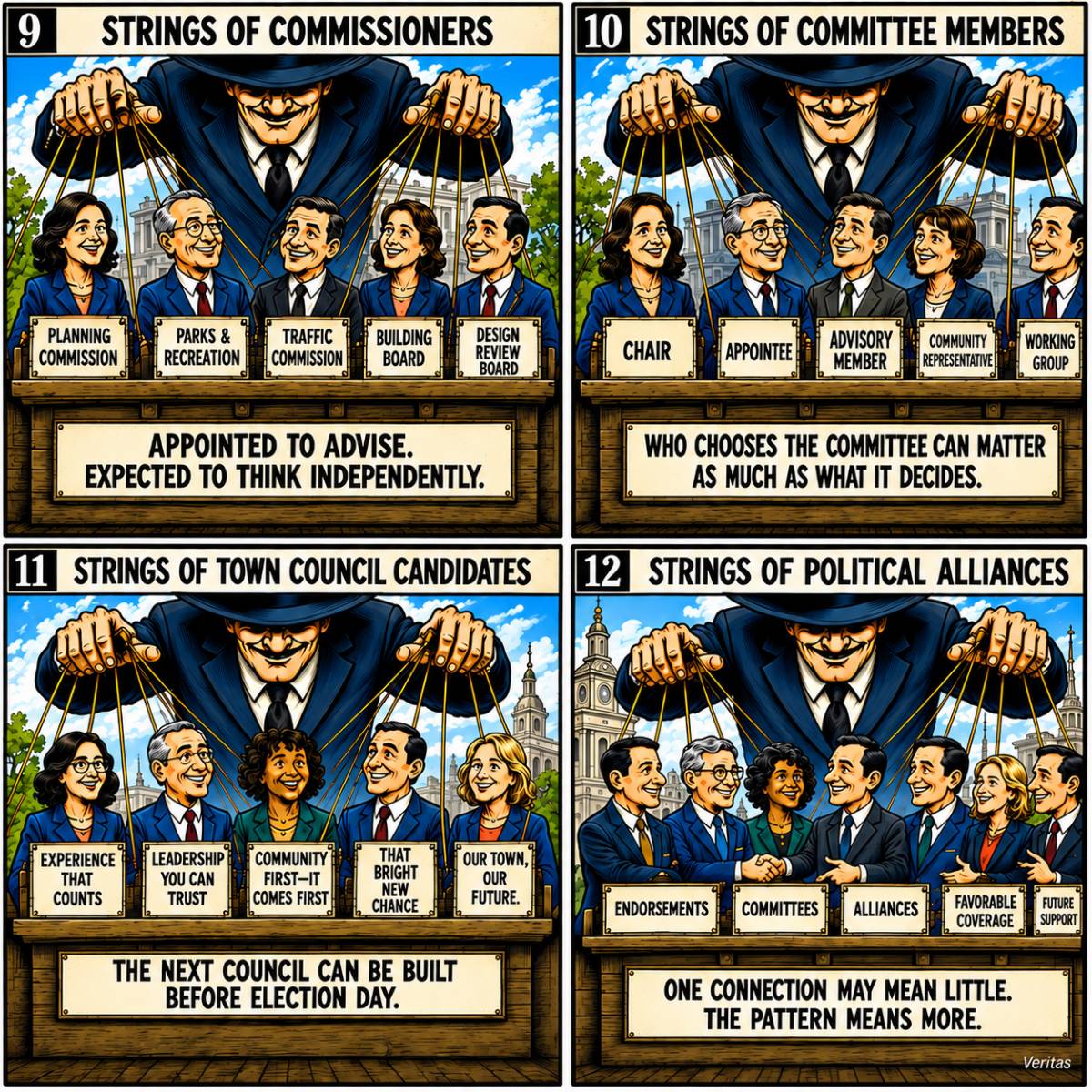
Episodes 9-12: Commissioners, Committees, Candidates and Alliances
“Access can be more valuable than instruction.”
Privileged Access Before the Decision
The Puppeteer understands that access can be more valuable than instruction. Certain selected residents receive private meetings, advance information, returned calls and invitations to civic events. Their concerns enter the process while decisions are still being shaped. Others receive three minutes at the microphone after the report is written, the recommendation made and positions have begun to harden.
Everyone may technically send an email or attend a meeting, yet not every voice is heard at the same stage of the decision. The same donors, commissioners, organizations and habitual endorsers can be consulted repeatedly, then presented as “the community.” Repetition is mistaken for representation.
The Puppeteer may describe this preferred access as simply being “for the good of the town.” But when the same voices repeatedly reach the room before everyone else, access itself becomes a form of influence.
Partners and Interruptions
Supportive speakers are greeted warmly, thanked by name and praised for their thoughtful remarks. Critics may receive procedural reminders, visible impatience or the observation that the council has “already heard that point.” Supporters become community partners. Critics become interruptions to community business.
Civility can become a shield when residents are warned against personal criticism or repetition while officials themselves interrupt colleagues, belittle objections or question motives. In that chamber, civility risks becoming a rule imposed downward rather than a standard practiced by everyone.
Dividing and Outlasting Opposition
Opposition can also be divided. One critic is privately praised as reasonable while another is described as extreme. Established organizations are encouraged to distance themselves from persistent newcomers. Once divided, each group is easier to manage.
And when confrontation becomes inconvenient, the Puppeteer waits. Residents tire. Volunteers have jobs and families. Staff members transfer. Reporters move on. Elections come and go. He remains.
The Puppeteer does not always defeat his opponents. Sometimes he simply outlasts them.
Controlling the Agenda
The easiest debate to win is the one that never occurs. Influence over what reaches the council, when it appears, how it is described and how much time the public receives can shape the outcome before anyone casts a vote.
A favored proposal arrives polished, urgent and ready for action. An unwelcome proposal takes another path: more analysis, more legal questions, more outreach, another commission, another study session, another budget cycle. Delay is a veto that leaves no fingerprints.
Urgency can be manufactured just as easily. A preferred measure suddenly must pass that evening to avoid losing funding or creating uncertainty. Questions become delays, delays become dangers and caution becomes irresponsibility.
Next week: How influence reaches staff reports, implementation and the official story told after the vote.
0
0

Comments