Editorial note:
This illustrated opinion series examines a recurring pattern in local government. The “Master Puppeteer” is a political archetype, not an allegation that any particular person has committed an unlawful act. The series explores political culture, independence, access, public accountability, and the risks that arise when experience hardens into entitlement.
The cartoons depict patterns of political influence and institutional culture. They do not suggest that every person shown within such a system knowingly participates in, recognizes, or accepts that influence.
THE MAN ABOVE THE CHAMBER | PART 2 OF 5
How Power Recruits Power
The most lasting form of political control is not winning today’s vote. It is shaping tomorrow’s council.
By Mellisa Martinez | Illustrated political commentary
Episodes 5-8: Campaigns, Appointments and Dependable Votes
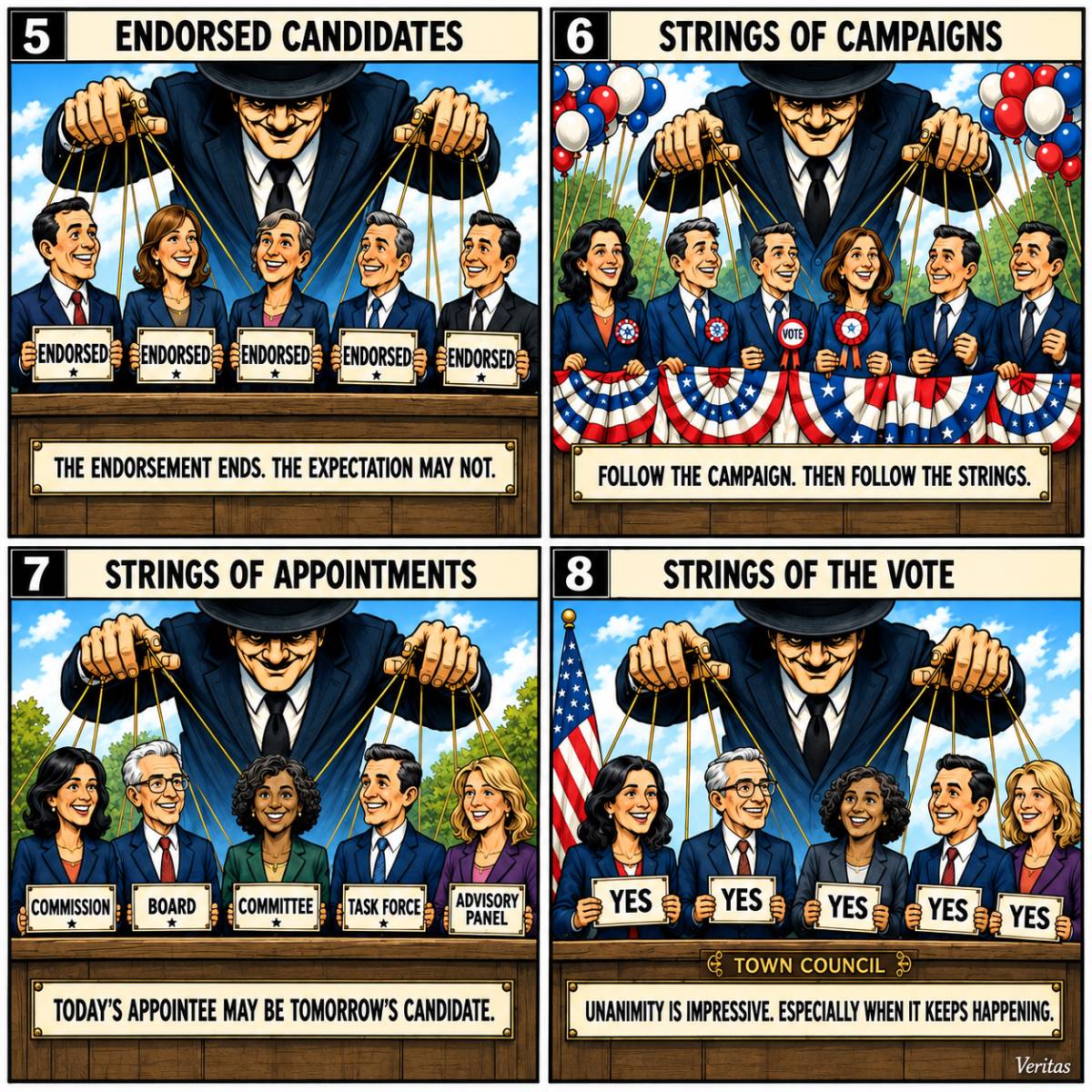
“A five-member council requires only three dependable votes.”
The Political Bench
The Puppeteer’s greatest achievement is not controlling the council seated before him. It is shaping the council that will come next.
Every town has a political bench occupied by commissioners, committee members, civic volunteers and familiar residents who have attended meetings for years. Some are thoughtful and independent. Others have perfected the disciplined stillness of people hoping to be noticed without becoming controversial.
They appear at ribbon cuttings, praise collaboration and continuity, and speak just often enough to seem engaged—but rarely enough to endanger their future.
Three Dependable Votes
A five-member council requires only three dependable votes. With three, a private preference becomes public policy. A favored appointment is approved. A controversial project advances. An inconvenient proposal is delayed, referred, studied and eventually escorted into administrative oblivion.
Candidate recruitment therefore becomes long-range planning. The Puppeteer notices who asks difficult questions and who has mastered the safer art of asking questions whose answers are already known. When a seat opens, one of the waiting figures may be invited onto the stage.
Endorsements appear. Civic leaders praise the candidate’s temperament. Campaign literature introduces a fresh, independent voice with deep roots and a commitment to community values. What the literature cannot answer is why this person was elevated while others remained invisible. Was the candidate selected for judgment, courage and knowledge—or because powerful people already knew what kind of vote they could expect?
The preferred candidate may not need to be openly loyal. Anticipatory loyalty is more useful: the arrangement has been internalized so completely that following it feels like independent thought. The Puppeteer calls this his playbook. The public might call it political cultivation.
The Political Debt That Need Not Be Spoken
Once elected, the new councilmember owes nothing under the law. Politically, however, the account may be considerable. Doors were opened, credibility conferred, and opposition discouraged. The debt need never be discussed. Gratitude is most effective when it disguises itself as agreement.
Soon the new member learns the chamber’s grammar. Supporting the Puppeteer is “teamwork.” Deferring to him is “respecting experience.” Preserving the existing structure is “continuity.” A result arranged before the meeting becomes “consensus.” The council still has five seats, but it may no longer contain five independent centers of judgment.
The Convenient Definition of the Public Good
The Puppeteer rarely describes any of this as accumulating power. He calls it protecting the town. Endorsing dependable candidates is “for the good of the town.” Preserving familiar leadership is “for the good of the town.” Rewarding loyalty is continuity. Discouraging dissent is unity. Keeping influence in trusted hands is stability.
The remarkable thing about the Puppeteer’s definition of the public good is how consistently it benefits the Puppeteer.
Who Really Presides?
In many towns, the mayor’s position rotates. One person holds the gavel this year; another will hold it next year. The Puppeteer regards this as a charming administrative custom.
Even when someone else is mayor, he may dominate discussions, interrupt colleagues, reframe their questions and lecture the person holding the gavel as though the mayor were a substitute teacher unfamiliar with the lesson plan.
The official mayor presides over the meeting. The Puppeteer presides over the room.
The purpose of a public rebuke or dismissive interruption is not merely to win one vote. It can make the next disagreement less likely. A humiliation today may produce silence tomorrow.
Next week: Who gets heard before the vote—and how access becomes political currency.
0
0

Comments